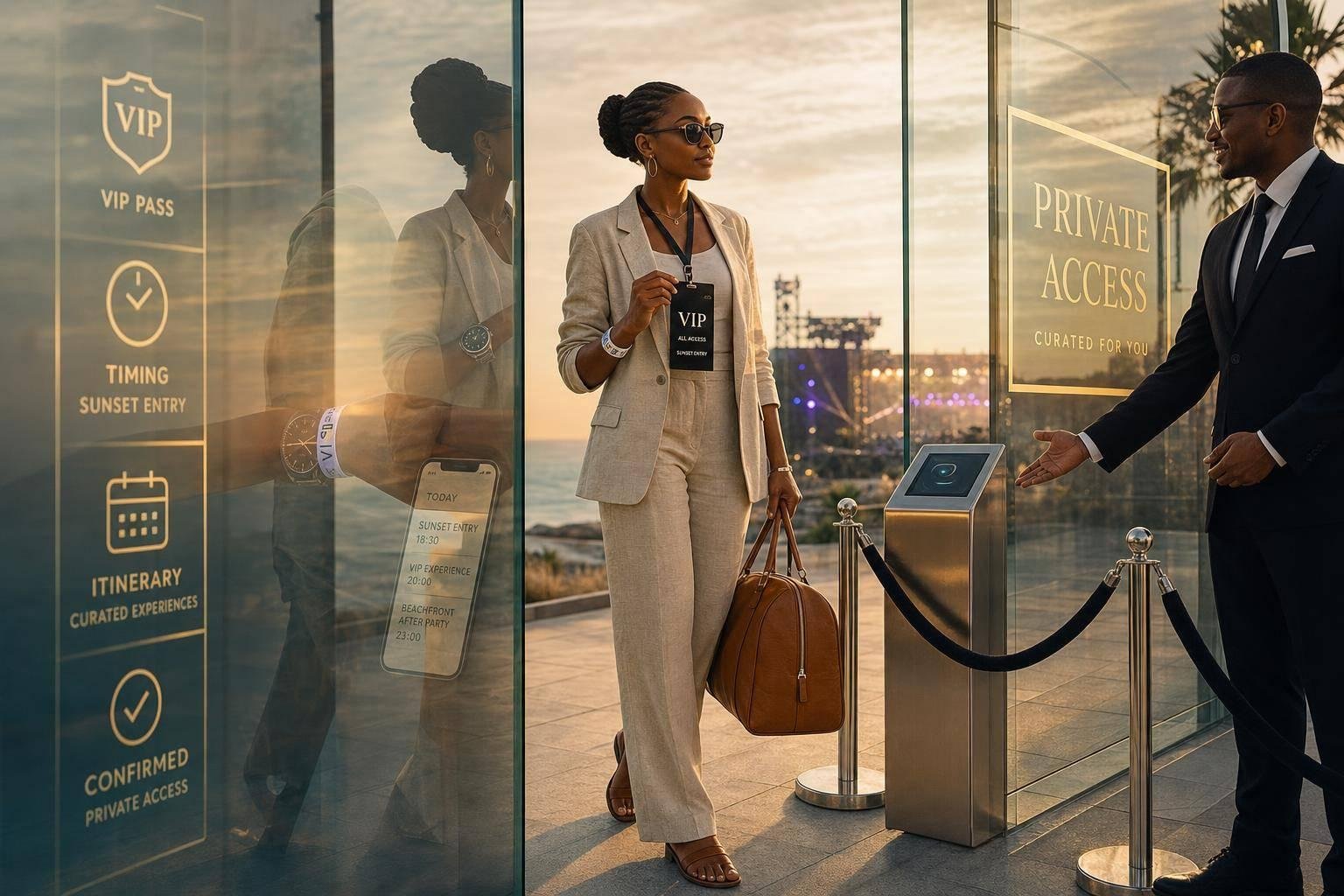
VIP does not mean all-access. In most cases, it means a short list of perks tied to one event, one area, or one schedule.
If I were booking a festival trip, I’d check four things first:
- What the pass covers: lounge, viewing area, screenings, tastings, or one named event
- What it does not cover: backstage, guaranteed seats, after-parties, or full-site access
- How entry works: timed pickup, ID check, named credential, security line, or host check-in
- How the day is timed: airport arrival, hotel, credential pickup, traffic, and return transfer
The article makes one point very clear: the pass is only half the plan. At music events, VIP may mean better viewing and restrooms. At film and fashion events, access often depends on accreditation or invitation. At food events, timed tastings and late arrivals can ruin what you paid for.
A few numbers show why timing matters:
- Lollapalooza VIP passes were listed at $1,850 per person
- Rio Carnival 2025 average nightly hotel rates reached $306
- The busiest Rio night hit $509
- The guide suggests checking hotels 6–9 months out
- By 90 days before travel, hotel and transfer plans should already be set
Here’s the short version: read VIP as a benefits list, not a promise. Then match your bespoke travel packages and entry timing to the strictest part of the event schedule.
| Festival type | Access usually comes from | Main VIP perk | Main risk |
|---|---|---|---|
| Music | Ticket tier or hospitality package | Viewing areas, lounges, bars | Traffic, weather, late exits |
| Film | Public ticket or accreditation | Screening access, lounges, markets | Sold-out screenings, pickup rules |
| Fashion | Invitation or brand list | Show entry, assigned seating, host support | Tight arrival cutoffs, traffic |
| Food | Premium pass or timed booking | Tastings, demos, hosted dining | Missed time slots, overlap |
If I had to boil the full guide down to one line, it would be this: private festival access works only when the written terms and the travel plan line up.
Pass Types, Hosted Entry, and What VIP Typically Includes
General Admission, VIP, Hospitality, and Credential Categories Explained
Not all passes work the same way. The pass you book affects when you should arrive, how check-in works, and whether you need hosted entry.
General admission (GA) is the basic option. It covers standard entry and nothing more. That means no lounges, no priority line, and no reserved viewing areas.
VIP passes usually add a smoother on-site experience. Depending on the event, that can mean dedicated entry, premium restrooms, lounge access, and preferred viewing. But the key phrase here is depending on the event. VIP is not one fixed package.
Premium hospitality leans more toward comfort and service. You may get a private lounge, food and drinks, and concierge-style help. Still, that does not automatically include artist areas or reserved seats.
Industry badges and press credentials are different from leisure upgrades. They are working credentials. For example, SFFILM‘s 2026 industry badge includes one ticket per regularly priced screening, up to four per day, based on availability, and it clearly excludes Opening and Closing Night, parties, Centerpiece, Awards, and Tributes.
Sponsor guest access is narrower. It is controlled by the brand and usually applies only to the sponsored lounge, dinner, or event.
Invitation-only guest lists are often the most specific of all. In most cases, they cover one named event after ID verification.
Use these categories to line up your pass with the trip you’re actually taking. A screening-heavy film trip, for example, calls for something very different from a lounge-focused social weekend.
| Access Category | Who It’s For | What It May Include | Key Limitations |
|---|---|---|---|
| General admission | General public | Standard festival grounds | No lounges, priority entry, or reserved areas |
| VIP | Premium leisure attendees | Faster entry, lounge, upgraded restrooms, preferred viewing | Benefits vary by event; no automatic backstage or artist access |
| Hospitality / platinum | Comfort-focused attendees | Private lounge, food and beverage, concierge-style service | May still exclude artist areas, reserved seats, or invite-only events |
| Industry badge | Film or trade professionals | Designated venues, screenings, markets, or industry spaces | Eligibility rules, reservations, and capacity limits apply |
| Press credential | Authorized media | Press screenings, media areas, priority access under festival rules | Restricted to approved working media only |
| Sponsor guest access | Brand-hosted guests | Entry to a sponsored lounge, dinner, or selected event | Scope is controlled by the sponsor; does not cover the wider festival |
| Invitation-only guest list | Named individuals | Entry to the specific named event after ID verification | No transferable ticket, no plus-one, no access beyond the invitation |
All benefits are event-dependent and subject to the official terms of each festival.
Hosted Entry and On-Site Guest Services: What to Expect
Hosted entry sounds more glamorous than it usually is. In practice, it often means guest-list confirmation, ID check, credential pickup, security screening, and then directions – or sometimes an escort – to the assigned area. It does not usually mean a private entrance or an all-day personal handler.
Most of the time, the host is there for arrival or for a set reception window. After that, you’re moving through the event under the venue’s normal flow.
It helps to know who does what:
- Venue hosts handle entry and on-site procedures.
- Sponsor hosts handle brand spaces.
- Festival liaisons deal with accreditation and program questions.
- Travel concierges handle transfers, hotel timing, and logistics.
Before you travel, get the basics in writing: the host’s name, mobile number, hours, exact meeting point, and late-arrival process. That small step can save a lot of stress if timing slips.
At Cannes, for instance, an approved personalized badge includes the holder’s name, photograph, and represented media outlet, must be collected from an accreditation office, and is nontransferable. So whether your access comes as a wristband, QR code, laminate, or mobile ticket, confirm the pickup process, the ID needed, and what happens if the item is lost.
Jo Vacations provides bespoke travel services and checks that the festival or credentialing office has confirmed access in writing.
What all this looks like in practice can shift a lot from one festival to another.
What VIP Access Usually Does Not Include
This is where people get tripped up. A VIP label can sound all-access, but it usually isn’t.
VIP does not automatically mean backstage entry, artist access, guaranteed seating, or free movement across the venue. Those items need separate written confirmation under the event’s current official terms.
Even higher-tier access often stops short of the following:
- Backstage, dressing-room, or production areas
- Meet-and-greets, autographs, or personal introductions with artists
- Reserved or guaranteed seating – SFFILM states that its industry badge does not entitle the holder to a reserved seat.
- Hotel accommodation, airport transfers, or local transportation
- Dining reservations, chef-table access, or festival meals outside the stated package
- Entry to every screening, runway show, after-party, or premium program
- Re-entry privileges, parking, coat check, or plus-one access
- The right to transfer, lend, or resell the credential
Film festival terms make this point very plainly. Some badges leave out opening and closing nights, awards ceremonies, tributes, and premium screenings even when they cover other parts of the program. That gap matters a lot when the schedule is fixed and the day is tightly timed.
sbb-itb-6675d37
How Private Access Works Across Festival Types
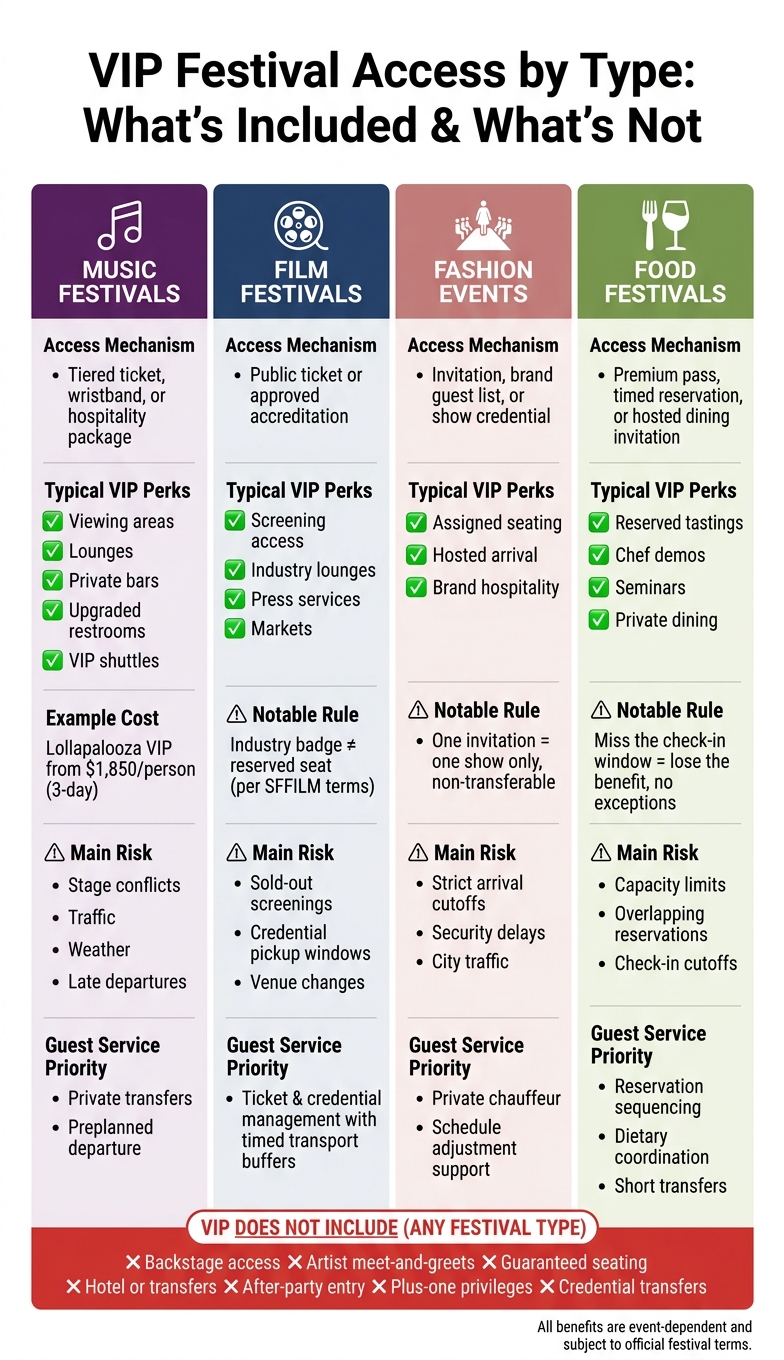
VIP Festival Access by Type: What’s Included & What’s Not
The big difference between festival types comes down to entry, movement, and timing. Once VIP moves from a nice-sounding label to the way the event actually runs, the event type starts calling the shots.
Music Festivals: Viewing Areas, Lounges, and On-Site Logistics
At music festivals, VIP often means faster entry and a more comfortable day on-site. But the exact perks can change a lot from one event to the next. Some higher hospitality tiers may include private tables, cabanas, hosted bar service, or near-stage viewing areas. Still, those perks depend on the event itself. They’re not built into the VIP label by default.
That said, VIP doesn’t erase the basics of a large outdoor festival. Weather still matters. So do long walks, crowd flow between stages, and time spent standing. A raised viewing deck might cover just one stage. A lounge might look good on paper but sit too far away to use between short sets.
Late departures can also become a headache. At some festivals, return shuttles run only during a set window after the music ends. So if you’re staying for the headline act, a prearranged private transfer is often the safer bet.
A published Lollapalooza VIP example shows how far these packages can go. Its three-day passes started at $1,850 per person and included access to two Lolla Lounges, raised viewing platforms, complimentary drinks, mini spa treatments, VIP golf-cart shuttles, and air-conditioned restrooms.
That same VIP label means something very different at film and fashion events, where access depends less on comfort and more on credentials.
Film and Fashion Events: Accreditation, Invitations, and Tight Schedules
Film and fashion events play by a different set of rules. Here, access is usually based on accreditation or invitation, not a ticket upgrade.
Film festivals separate public tickets from professional credentials. Press, industry, filmmaker, and invited-guest accreditation each come with their own rules, privileges, and limits. Biennale Cinema, for example, separates press accreditation from industry accreditation, which is reserved for audiovisual professionals. And even with accreditation, entry is not unlimited. Eligibility rules and time windows still control what you can do.
Fashion week is even tighter. There usually isn’t a general VIP ticket you can just buy. Access depends on a designer or brand guest list, show-specific credentials, or press and buyer status. Seating is assigned. Arrival cutoffs are strict. And one invitation usually gets you into one show, not the full week.
Both film and fashion events also come with practical pressure points. Security screening can slow things down. Venues can change. City traffic can eat up what little arrival time you had left.
| Category | Eligibility | Likely privileges | Booking method | Key restriction |
|---|---|---|---|---|
| Film public ticket | Open to the public | Admission to a specific screening | Official ticket sale | No automatic access to premieres or industry areas |
| Film industry credential | Verified film professional | Professional ticketing access, lounges, markets, or film libraries | Accreditation application | Screening access may still require a hard ticket; reserved seating is not guaranteed |
| Film press credential | Active journalist with relevant coverage or assignment | Press access, media facilities, and possible press screenings | Press application and approval | Use may be limited to editorial coverage; access is discretionary |
| Fashion invitation or brand credential | Designer, brand, sponsor, buyer, press, celebrity, or approved guest | Show entry, assigned seating, hospitality, or backstage access when specifically stated | Direct invitation, agency, or brand guest list | Non-transferable, show-specific, deadline-sensitive, and subject to security and seating controls |
| Hosted fashion hospitality | Invited guest of a brand, sponsor, or luxury partner | Coordinated arrival, host reception, events, and sometimes transportation | Private host or concierge arrangement | Does not automatically provide access to unrelated shows or after-parties |
Food Festivals: Timed Tastings, Chef Events, and Hosted Dining
Food festivals work in their own way too. They’re built around timed participation, not one central viewing area.
A premium pass may include expedited entry, reserved tastings, chef demos, wine or spirits seminars, sponsor lounges, and private dining. But each perk tends to come with its own check-in window and capacity cap. If you miss a tasting time, that benefit is usually gone, no matter what your pass includes.
That’s why transport and check-in have to work together. At food events, timing isn’t a side issue. It’s the whole game.
Here’s the quick side-by-side view:
| Festival type | Primary access mechanism | Typical VIP benefit | Main scheduling risk | Guest service priority |
|---|---|---|---|---|
| Music | Tiered ticket, wristband, or hospitality package | Viewing areas, lounges, private bars, upgraded restrooms, shuttles | Stage conflicts, traffic, weather, and late departures | Private transfers and a preplanned departure option |
| Film | Public ticket or approved accreditation | Screening access, industry facilities, lounges, or press services | Sold-out screenings, credential pickup, hard-ticket rules, and venue changes | Ticket and credential management with timed transport buffers |
| Fashion | Invitation, brand guest list, or show credential | Assigned seating, hosted arrival, hospitality | Strict arrival deadlines, security, seating assignments, and city traffic | Private chauffeur service and schedule adjustment |
| Food | Premium pass, timed reservation, or hosted dining invitation | Reserved tastings, chef events, seminars, lounges, or private dining | Capacity limits, overlapping reservations, and check-in cutoffs | Reservation sequencing, dietary coordination, and short-distance transfers |
Jo Vacations builds transfers, hotel timing, and arrival buffers around the event’s strictest checkpoints.
Arrival Planning and Door-to-Door Itinerary Design
Logistics decide whether VIP access works in practice. If you miss a pickup, show up late, or get a fixed entry window wrong, the pass can lose its point. Once access is set, timing becomes the next hard limit.
Booking Around High-Demand Dates and Fixed-Time Events
Festival dates can wipe out hotel inventory fast. During Rio Carnival 2025, average nightly rates hit $306, about an 80% increase over the first-quarter baseline, and the busiest single night climbed to $509.
The practical move is simple: book your stay as soon as festival dates are confirmed, not when the lineup goes live. Start checking availability 6–9 months out and treat a refundable hotel reservation as the first thing you lock in. By the 90-day mark, you should already have a confirmed hotel, a backup option, and your airport transfer mapped out.
Pick the hotel based on privacy, pickup access, and how easy it is to recover between late nights, not just how close it is to the venue. Sometimes a place a bit farther out is the better choice. It may offer discreet arrivals, a dependable private-car pickup point, quieter rooms, and easier access when roads near the event are shut down or turned pedestrian-only. The same thinking applies to credential pickup, late-night return routes, and the airport transfer path.
Write every appointment in local destination time. Download mobile tickets before you leave. Save offline copies. And check the dress code for each access area so nothing catches you off guard.
A Day-by-Day Festival Timeline That Protects Comfort
Build the plan backward from the credential desk or venue entrance, not from the event’s posted start time. A premiere, runway show, tasting, or headline set may start at one time on paper, but your arrival target is earlier. Security checks, credential pickup, seating, and the walk from the vehicle drop-off point all take time, and most travelers underestimate every one of them.
A dependable framework is pretty straightforward. Arrival day should cover the airport meet-and-greet, private transfer, hotel check-in, unpacking, and wardrobe prep – nothing more. Credential day should be treated as a scheduled logistics block, not a casual errand. The Detroit Jazz Festival‘s 2026 VIP instructions show this clearly: pre-festival wristband pickup was available on September 3 from 2:00–6:00 p.m. by appointment at the Detroit Marriott at the Renaissance Center, with on-site pickup during set hours at the VIP entrance from September 4–7.
On event day, leave room for an easy breakfast, a weather and traffic check, dressing time, an early private transfer, and a return vehicle confirmed before you even leave the hotel. After a late night, the next morning should move at a slower pace unless an early plan is fully intentional. The itinerary should also separate "must not miss" items from optional ones, so a 30–60-minute delay doesn’t snowball into a missed show or tasting.
How Jo Vacations Builds the Trip Around the Event
Door-to-door planning turns access rules into something you can actually use. Jo Vacations builds the entire trip around the event calendar, not just the festival dates. That includes the full sequence from airport arrival through departure day. In practice, that means choosing a handpicked 5-star boutique hotel, private villa, or luxury resort based on privacy, venue proximity, late-night transfer ease, and recovery time instead of treating the hotel as a separate booking.
Private airport transfers are coordinated with flight monitoring, so if a delay changes the arrival window, the pickup shifts too without the traveler having to step in. Ground logistics – credential collection timing, venue drop-off points, late-night return routes, and backup vehicles – are built into the itinerary rather than left for the day of the event. Private guided experiences and dining reservations are placed on days that don’t compete with fixed-time festival plans, which helps keep the trip paced in a way that makes sense.
The 24/7 on-trip concierge support handles live changes as they happen: a venue instruction update, a road closure that changes the drop-off point, or a restaurant reservation that needs to move. That keeps arrival, entry, and return timing in sync.
Choosing the Right Access Level and Final Verification Steps
Match Your Access Level to What Matters Most to You
VIP is just a label. What matters is the result you want. Your entry, how you move through the event, and when you need to be where all come back to the package you pick.
| Your Priority | Access Feature That Matters | Key Question to Ask |
|---|---|---|
| Best sightlines | Reserved viewing platform | Is seating guaranteed, or first-come within the VIP zone? |
| Comfort | Lounge, private restrooms, meals | Are these open all day or only during set hours? |
| Networking | Hosted receptions, industry lounges | Is entry automatic, or does it require a separate reservation? |
| Privacy | Discreet entrance, dedicated host | Does "private access" mean a restricted zone or a fully private experience? |
| Family pacing | Quiet areas, meal timing | Do children need their own credential? |
| Solo travel security | Staffed desk, secure transport | Where does a solo traveler go if the driver or contact is unreachable? |
Start with the one priority that matters most to you. Then use it to set your transfer timing, entry time, and staffing needs. That keeps the plan tied to what you actually care about instead of the sales label.
Once your access level lines up with your main goal, move to the written terms.
What to Confirm Before You Travel
The package name matters less than the exact rules in writing.
Treat words like "exclusive", "all access", and "hosted" as marketing, not proof. Check the ad against the official package page, ticket terms, confirmation email, venue map, and event schedule. If a feature is promised, it should show up in writing.
Before you make any nonrefundable payment, confirm:
- The exact date, venue, entrance, and access zone the credential covers
- Whether the credential is named, ID-checked, or transferable
- Whether the lounge, meals, drinks, and reserved seating are included or sold separately
- Refund, transfer, reissue, and replacement rules in writing before paying
Save the official page, terms, confirmation, and schedule. Then check them again before you travel. Download tickets for offline use, keep printed backups, and don’t put every traveler’s credentials on one phone. If something goes sideways at the gate, that small step can save a lot of stress. Confirm replacement rules before you pay.
Conclusion: The Basics of Planning a VIP Festival Trip
After verification, the itinerary becomes the last control point. Jo Vacations handles that end-to-end structure by coordinating accommodations, private transfers, credential logistics, and 24/7 on-trip concierge support around the fixed-time commitments that shape a festival trip. VIP access only works when the written terms and the itinerary match.
FAQs
What does VIP actually include?
VIP access usually means a smoother, more exclusive experience. That can include fast-track entry, private guided tours, and access to select sites or workshops that aren’t open to the general public.
It may also cover private door-to-door transfers, 24/7 concierge support, and handpicked reservations. Jo Vacations brings these details together in bespoke itineraries, so every part of the trip is taken care of.
How early should I book festival travel?
For high-demand festival travel, Jo Vacations recommends booking 2 to 3 months ahead. That window usually gives you a better shot at getting the dates and stay options you want without feeling rushed.
For custom trips, 3 to 4 months is the sweet spot for better rates and more choice.
If you’re planning to travel during peak seasons, or you want more limited options like premium suites, it’s smart to plan 6 to 12 months in advance. And for specialized experiences like private group safaris, Jo Vacations highly recommends booking 12 to 18 months ahead.
Do I need a ticket, invitation, or accreditation?
Yes. For high-demand events, you’ll usually need the right ticket, invitation, or accreditation. And in most cases, it’s smart to book as soon as the dates are announced.
Some venues also ask for advance timed-entry tickets, even if you’re going with a private guide. You’re also responsible for carrying valid travel documents, including passports, visas, and permits. Jo Vacations can help coordinate these details as part of your itinerary.