

If you want the best dive trip in the Philippines, match your month to the region first or plan your trip with a specialist. Dry-season diving usually runs November to May, typhoon risk is highest July to September, and Tubbataha is only open mid-March to mid-June.
Here’s the short version:
- Best all-around window: March to May for calm seas, warm water, and top visibility
- Best for Tubbataha: mid-March to mid-June
- Best for thresher sharks: Malapascua, January to May
- Best for whale sharks: Southern Leyte, Donsol, and southern Cebu, November to February
- Best for wrecks: Coron, December to April
- Best for macro: Anilao and Romblon, November to May
- Most flexible backup spots near Manila: Anilao and Puerto Galera
- Riskiest months for weather: June to October, with the highest typhoon risk in July to September
Water stays warm most of the year at about 78°F to 86°F (25°C to 30°C). In the dry season, visibility often reaches 100 feet+ (30 meters+), while wet-season visibility can drop to 15 to 65 feet (5 to 20 meters).
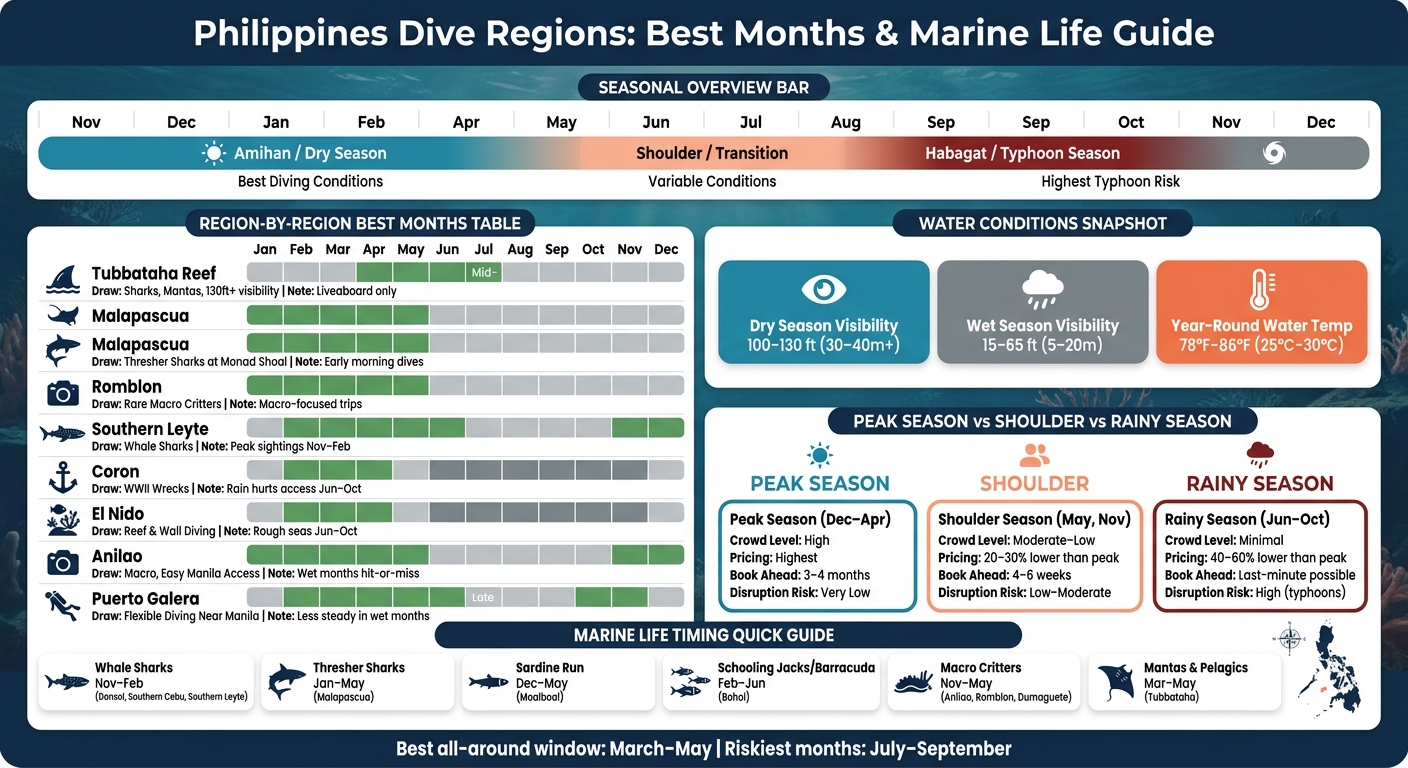
Philippines Dive Regions: Best Months & Marine Life Guide
Best time to dive in the Philippines
sbb-itb-6675d37
Quick Comparison
| Region | Best Months | Main Draw | Watch Out For |
|---|---|---|---|
| Tubbataha | Mid-March to mid-June | Sharks, mantas, very clear water | Liveaboard only, short season |
| Malapascua | January to May | Thresher sharks | Early dives work best |
| Romblon | January to May | Macro life | Better for macro-focused trips |
| Southern Leyte | November to May | Whale sharks | Peak sightings are November to February |
| Coron | December to April | WWII wrecks | Rain can hurt access and visibility in summer/fall |
| El Nido | December to April | Reefs and walls | Rougher seas June to October |
| Anilao | November to May | Macro, easy access from Manila | Wet months can be hit or miss |
| Puerto Galera | October to early June | Flexible diving near Manila | Less steady in wetter months |
My takeaway: if your dates are fixed, pick the region that fits that month. If your goal is fixed, like threshers, whale sharks, macro, or wrecks, pick the month that gives you the best shot.
That simple rule will save you time, money, and missed dives.
Know the Seasons Before You Book
Amihan, Habagat, and Typhoon Season
The Philippines has two main wind seasons: Amihan and Habagat. The smart way to plan is simple: start with the season, then line it up with the part of the country you want to visit.
Amihan, the northeast monsoon, runs from November through May. This stretch usually brings drier weather, calmer seas, and better visibility. Habagat, the southwest monsoon, runs from June through October and tends to bring more rain, rougher water, and short-term site closures.
Typhoon risk is highest from July through September. That can affect flights, ferries, and liveaboards, with delays or cancellations all on the table. And if Tubbataha Reef is on your list, timing matters even more. This remote site is only reached by liveaboard from March through mid-June, and trips often sell out fast, so it pays to book early.
Water Temperature, Visibility, and Sea State by Season
Water temperatures stay warm all year, usually between 78°F and 86°F (25°C to 30°C). The coolest period is December through February, when the water sits around 79°F to 82°F (26°C to 28°C). That’s still comfortable for most divers, but a 3mm full wetsuit is a good call if you’re doing several dives a day.
Visibility changes with the season too. During the dry months, it often pushes past 100 feet (30 meters), and in Tubbataha it can hit 130 feet (40 meters). During Habagat, visibility may drop to around 15 to 65 feet (5 to 20 meters).
Here’s the quick snapshot:
| Season | Months | Water Temp | Visibility | Sea State |
|---|---|---|---|---|
| Amihan (Dry) | Nov – May | 77–86°F (25–30°C) | 20–40m+ | Calm, sunny |
| Habagat (Rainy) | Jun – Oct | 80–84°F (27–29°C) | 5–20m | Rough, typhoon risk |
| Tubbataha liveaboard season | Mar – Jun | 82–86°F (28–30°C) | 40m+ | Very calm |
How to Read Conditions for Your Travel Dates
Before you book one of our travel packages, check three things:
- Past weather patterns for your target region
- Current weather and sea forecasts
- Direct updates from local dive operators
That last part matters more than many people think. Forecasts give you the big picture, but local operators usually know what conditions look like on the ground right now.
If you’re traveling between June and October, add buffer days to your trip. That gives you room to deal with weather delays without wrecking the whole plan. Those extra days can easily turn into land time for waterfalls, hiking, or other inland stops. Use this baseline to narrow your dates by region next.
Best Months for the Philippines’ Lesser-Known Dive Regions
Once you know the seasonal pattern, it gets much easier to line up each dive area with the time it tends to shine.
Tubbataha, Malapascua, and Romblon
Tubbataha has one of the shortest dive seasons in the Philippines. Its peak window runs from mid-March through mid-June. During that stretch, visibility can top 100 feet, and divers often see sharks, manta rays, and big schools of fish. Because the season is so short, it helps to book months in advance.
Malapascua is best known for thresher sharks. The strongest conditions usually fall between January and May. If seeing threshers is the goal, the most dependable plan is an early morning dive at Monad Shoal, where sunrise sightings are most common. Thanks to its sheltered location, Malapascua often stays diveable later than many other spots.
Romblon is a go-to pick for macro photographers. It’s known for rare critters, and its best diving window also runs from January through May.
Southern Leyte, Coron, and El Nido
Southern Leyte generally works best from November through May. Whale shark sightings are at their peak from November through February.
In Palawan, both Coron and El Nido are usually most dependable from December through April. Coron is best known for WWII wreck diving. El Nido stands out for reef and wall diving, which is best planned in the dry season. From June through October, conditions are usually less dependable because heavy rain can affect both visibility and access.
| Region | Best Months | Best For | Main Limitation |
|---|---|---|---|
| Tubbataha | Mid-March to Mid-June | Sharks, mantas, 100+ ft visibility | Liveaboard only; very short window |
| Malapascua | January to May | Thresher sharks at Monad Shoal | Early morning dives are best |
| Romblon | January to May | Rare macro critters | Best for dedicated macro trips |
| Southern Leyte | November to May | Whale sharks | Whale shark sightings peak November to February |
| Coron | December to April | WWII wrecks | Heavy rain and poorer visibility June to October |
| El Nido | December to April | Reef and wall diving | Heavy rain and rougher seas June to October |
Puerto Galera and Anilao as Flexible Options
Puerto Galera and Anilao are both easy to reach from Manila, which makes them handy backup options when weather hits more remote regions. Puerto Galera has a long diving window from October through early June. Anilao is strongest from November through May and is especially well known for macro photography.
Even during the wet season, both places can still be diveable, especially in the morning before afternoon rain moves in. That makes them useful if you want a bit more room to adjust plans on the fly.
If you’re trying to avoid bigger crowds and maybe get better rates, November, February, and June can be smart months to look at. The trade-off is slightly less steady weather. For flexible trips or multi-region itineraries, both areas work well as backup bases.
Next, match those windows to the species and dive experience you want most.
Match Your Travel Window to Marine Life and Trip Style
Best Times for Sharks, Whale Sharks, and Schooling Fish
If your dates are locked in, start with the marine life you want to see and pick the dive area after that.
Whale shark encounters are strongest from November through February in Donsol and southern Cebu. If thresher sharks in Malapascua are at the top of your list, the most dependable window is December through May. Early-morning dives at Monad Shoal give you the best odds.
For any shark-led trip, it usually makes more sense to stay put in one area instead of bouncing between regions. Sharks don’t work on a timetable, and extra days in the same place can make a big difference.
If you’re after schooling fish, Moalboal‘s sardine run is most dependable from December through May. In Bohol, schooling jacks and barracuda are strongest from February through June. Since both thresher sharks and whale sharks are unpredictable by nature, adding extra dive days at one site gives you a better shot at a sighting.
Best Times for Macro Photography and Calmer Diving Days
Macro diving runs on a different schedule.
Places like Anilao, Romblon, and Dumaguete are strong picks for nudibranchs, pygmy seahorses, frogfish, and other rare critters. Anilao is also one of the country’s top sites for pygmy seahorses.
The September to October transition period is well worth a look for dedicated macro photographers. Reef life is active, dive sites are quieter, and fewer people are crowding the same subjects. The catch? Weather is less predictable.
If your goal is clearer water along with strong macro diving, November through May in Anilao or Romblon works well. Plankton can cut visibility, but there’s a silver lining: it can also draw mantas and whale sharks.
A Month-by-Month Planning Overview
Your travel dates, trip style, and target species all come together here. Use the table below as a quick guide for matching your vacation window to the kind of trip you want.
| Month | Best Regions | Marine Life Focus | Key Consideration |
|---|---|---|---|
| November | Southern Cebu, Donsol, Anilao | Whale sharks, macro critters | Fewer crowds, lower costs |
| December | Moalboal, Malapascua, Coron | Sardine run, thresher sharks, wrecks | Dry season conditions improve |
| January – February | Southern Cebu, Donsol, Malapascua, Bohol | Whale sharks, thresher sharks, schooling fish | Strong conditions |
| March – May | Tubbataha, Bohol, Dumaguete, Anilao | Pelagics, mantas, schooling jacks, macro | Peak season; best visibility |
| June | Malapascua, Anilao | Thresher sharks (encounters are more likely), macro | Good value, slightly variable weather |
| September – October | Anilao, Romblon, Dumaguete | Macro photography, nudibranchs | Quietest sites; transition weather |
For couples or milestone trips, March through May brings the calmest seas, warm dry days, and the best overall travel conditions across the islands. If you’re traveling solo or trying to keep costs down, November, February, and June tend to offer a good mix of solid conditions and lower demand. Once you’ve picked the month, the next call is simple: stay in one region or turn it into a two-stop trip.
How to Build a Smooth Dive Itinerary
How to Combine Regions Without Overloading the Trip
After you’ve picked your travel month, make the route simple. The biggest mistake is trying to do too much in one trip. A better move is to start with one anchor booking and build the rest of the itinerary around it.
If you’re traveling between mid-March and mid-June, a Tubbataha Reef liveaboard is the obvious anchor. Most boats leave from Puerto Princesa, Palawan, so it usually makes sense to pair that trip with Coron before or after. Outside that season, Tubbataha is completely closed.
The same idea applies in the Visayas, where connections are easier. Malapascua, Bohol, and Moalboal fit well together because they link through Cebu and usually follow the same broad weather pattern. That means fewer transfer headaches and less guesswork.
One rule matters every time: leave a full non-dive day between your last dive and your departure flight. If your dates are flexible and you need a backup plan near Manila, Anilao and Puerto Galera are usually the easiest bases to work with.
Peak Season vs. Shoulder Season Tradeoffs
The best season depends on what matters most to you: price, crowd levels, or how far ahead you need to book. Here’s the side-by-side view:
| Feature | Peak Season (Dec–Apr) | Shoulder Season (May, Nov) | Rainy Season (Jun–Oct) |
|---|---|---|---|
| Crowd Levels | High | Moderate to low | Minimal |
| Pricing | Highest | About 20% to 30% lower than peak | About 40% to 60% lower than peak |
| Booking Lead Time | 3 to 4 months ahead | 4 to 6 weeks ahead | Last-minute is often possible |
| Disruption Risk | Very low | Low to moderate | High during typhoon season |
Mid-to-late November often hits a nice middle ground: conditions can feel close to peak season, but demand is lower.
There’s also one period worth avoiding if you want a quieter trip: Holy Week, the week before Easter. Domestic travel spikes at that time, and even far-off dive resorts can book up fast.
If you’re traveling in shoulder season or during the wetter months, travel insurance is a must. Typhoon-related disruptions are a real risk from June through November, so coverage for cancellations and trip interruptions can help protect the money you’ve already put into the trip.
When End-to-End Planning Support Adds Value
A single-base dive trip is usually pretty easy to sort out. A multi-stop route is a different story.
Once you start mixing a liveaboard, several land-based dive stays, domestic flights from hubs like Manila or Cebu to remote islands, and dive gear movement, things can get messy fast. Tubbataha liveaboard spots can fill months ahead. Smaller regional flights may have tight baggage limits, which can be a problem if you’re traveling with dive gear. And weather changes can force last-minute route changes.
That’s where careful trip planning can pay off. When flights shift or weather cuts into dive days, the details matter. Jo Vacations can help manage routing, surface intervals, gear transfers, and weather-related changes so the trip stays smooth.
Conclusion: The Best Dive Timing Depends on the Region and Your Goals
There’s no single best month to dive the Philippines. The country is spread across a huge area, and each region has its own seasonal rhythm. A Tubbataha liveaboard in April might be a great fit, but that same timing won’t always work for Malapascua. Each area plays by a different weather pattern, so the smart move is simple: match the destination to the season that suits it best.
Remote dive sites often come with tighter timing. Tubbataha Reefs Natural Park is only open from mid-March through mid-June, and liveaboard spaces often need to be booked 9 to 12 months ahead. If you want more room to adjust your plans, near-Manila destinations are a much easier place to start.
Anilao and Puerto Galera give you flexible diving close to Manila, with peak conditions from December to May. They’re strong picks for macro diving and easy access, and they fit nicely into a broader trip.
A good way to plan is to build your trip around the site with the narrowest season, then add more flexible regions and destinations around it. If Tubbataha is the main goal, shape the rest of the itinerary around that March to June window. If you’re heading to Donsol for whale sharks, aim for November through February. If macro is your main focus, Anilao from November to May brings the calmest water and the best visibility. Pick your dates, line them up with the right region, and let your dive goal lead the plan.
FAQs
How far in advance should I book Tubbataha?
Book Tubbataha several months in advance. Many liveaboard schedules run only during the peak season, from mid-March to mid-June, and spots fill up fast.
Which dive spots are easiest from Manila?
The easiest dive spots to reach from Manila are Anilao, a few hours south of the city, and the Visayas region, including Cebu and Moalboal.
Anilao is the top pick for macro and muck diving, with the best conditions from November to May. Cebu and Moalboal are usually best from December to May, when the seas are calmer and visibility is better.
What should I do if I’m traveling in typhoon season?
During typhoon season, it’s best to skip diving. Heavy rain and storms can make the sea rough and cut visibility, which makes conditions far less safe and much harder to manage.