If I were planning a Great Migration safari, I’d start with one thing: the month. That single choice shapes what I see most – calving in January to February, westward herd movement in May to June, or Mara River crossings from July to October.
Here’s the short version:
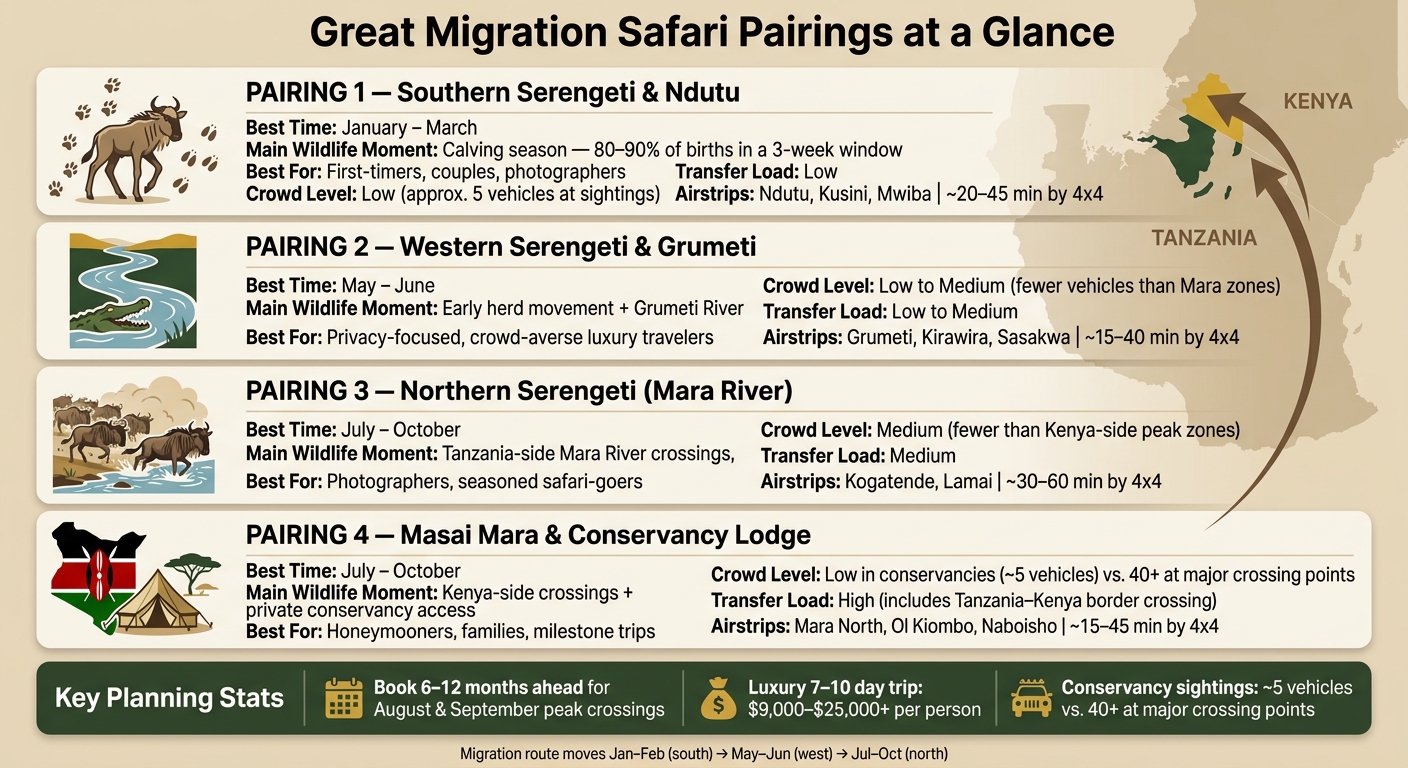
- Pairing 1: Southern Serengeti + Ndutu
Best for calving season, newborn wildebeest, and heavy predator activity. Around 80% to 90% of births happen in about three weeks. - Pairing 2: Western Serengeti + Grumeti
Best for early herd movement and Grumeti River action with fewer vehicles than peak Mara crossing zones. - Pairing 3: Northern Serengeti
Best for Tanzania-side Mara River crossings from July to October, with a more remote feel and short access to river areas. - Pairing 4: Masai Mara + conservancy lodge
Best for Kenya-side crossings, lower vehicle density in conservancies, and trips that mix reserve viewing with more private stays.
I’d also weigh crowds, camp style, and transfer time. In busy reserve areas, a sighting may draw 8 to 15 vehicles, while major crossing points can pull in 40+. By contrast, nearby conservancies often keep sightings to about five vehicles.
Prime crossing months – especially August and September – often need booking 6 to 12 months ahead. And for budget planning, a 7- to 10-day luxury migration trip usually lands around $9,000 to $25,000+ per person.
Great Migration Safari Pairings: Which Camp Route Is Right for You?
Masai Mara Great Migration at Mara Nyika Luxury Camp – Absolutely amazing! – $3500/night
sbb-itb-6675d37
Quick Comparison
| Pairing | Best Time | Main Wildlife Moment | Best For | Transfer Load |
|---|---|---|---|---|
| 1. Southern Serengeti + Ndutu | Jan–Feb | Calving and predator action | First-timers, couples, photographers | Low |
| 2. Western Serengeti + Grumeti | May–Jun | Early movement and Grumeti crossings | Privacy-focused travelers | Low to medium |
| 3. Northern Serengeti | Jul–Oct | Mara River crossings in Tanzania | Photographers, repeat safari guests | Medium |
| 4. Masai Mara + Conservancy | Jul–Oct | Kenya-side crossings and lighter-use conservancies | Families, luxury-first trips | High |
If I had to sum it up in one line, I’d say this: pick the wildlife moment first, then match it to the stay style and the easiest route.
Pairings 1 and 2: Southern Serengeti Calving and Western Corridor Movement
These two pairings create a clean south-to-west route with very little backtracking. You start in the south during calving season, then move northwest as the herds head toward Grumeti. It’s a smart fit for travelers who want strong wildlife viewing without the transfer hassle that often comes with the far-north crossing areas. Together, these stops cover the south-to-west arc before the trip moves into the northern river-crossing zones.
Pairing 1: Southern Serengeti and Ndutu for Calving Season
Calving peaks in February, when hundreds of thousands of wildebeest calves are born on the open short-grass plains around Ndutu. Around 80% to 90% of births take place in a tight three-week window, which fills the plains with newborns and pulls in lions, cheetahs, hyenas, and jackals for near-constant predator action.
The best setup here is usually a fixed lodge plus a mobile camp. The lodge gives you steady comfort and strong service. The mobile camp keeps you close to the herds as they shift across the plains. That mix works well because conditions can change fast, even in a phase that’s easier to plan than most.
The short-grass terrain is a big plus for photographers. Sightlines stay open, which makes it easier to get clean views of births, first steps, and hunts without brush getting in the way. That’s part of why this is the most predictable phase of the migration to plan around.
This pairing works especially well for couples, photographers, and repeat safari guests who want more than a standard Big Five trip. The draw here isn’t just the animal count. It’s the behavior, the timing, and the sense that something is always about to happen.
From here, the migration begins pushing toward the western corridor, and the safari starts to feel more mobile.
Pairing 2: Western Serengeti and Grumeti Corridor for Early Migration Movement
By late May through June, the herds have moved northwest into the western corridor and start nearing the Grumeti River. Crossings here come with steep banks and Nile crocodiles, but they usually attract far fewer vehicles than the Mara River crossings later in the season. If you care about photography or just want less traffic around sightings, that gap matters.
The western corridor also looks and feels different from Ndutu. Instead of tight calving drama on short grass, you get long files of wildebeest moving across open plains, dust lifting into the air, and herds running all the way to the horizon. It has a bigger, more sweeping feel.
A stay of four to six nights in the corridor gives you a realistic shot at seeing a major crossing event. One well-known private concession in this area is Singita Grumeti, which spans about 350,000 acres and hosts the migration between May and July along an age-old route.
Mornings often start near 62°F (17°C), so bring a light layer for early drives.
That makes Ndutu-to-Grumeti an easy south-to-west progression. After that, the route shifts north toward the Mara River crossing zones.
Pairings 3 and 4: Northern Serengeti Mara River and Masai Mara Crossings
Once the herds move north, the trip starts to revolve around one thing: river crossings. At that point, you’re usually choosing between staying fully in Tanzania or ending with a split between Tanzania and Kenya. Bush flights and short road transfers make this northbound shift pretty smooth, especially when you’re moving between Kogatende, Lamai, and the Mara.
Pairing 3: Northern Serengeti for Mara River Crossings
This pairing works best for photographers and travelers who want a more remote safari feel during the July to October crossing season from Kogatende or Lamai. A high-end tented camp paired with a nearby luxury lodge gives you a smart mix of access, comfort, and flexibility.
The big draw here is simple: you get direct Mara River access without crossing into Kenya. That keeps the plan focused on Tanzania-side crossing action and cuts out extra movement. Because camps in this corridor sit in a more remote part of the Northern Serengeti, sightings often come with fewer vehicles, and you’re closer to the riverbanks where many crossings happen.
If your top goal is lower vehicle density and access to private conservancies, the Kenya side may be a better fit.
Pairing 4: Masai Mara for Kenya-Side Crossings and Conservancy Access
This option fits travelers who want easier conservancy access, fewer vehicles, and a split-country ending after time in Tanzania. Our bespoke travel packages can help you navigate these cross-border logistics seamlessly. A classic Mara camp paired with a private conservancy lodge gives you more privacy and a calmer wildlife rhythm.
It also adds Kenya-side conservancy access with a smooth transfer from the Tanzania leg. Conservancies next to the reserve, including Naboisho, Olare Motorogi, and Mara North, limit vehicle density and offer a quieter option than the busier crossing points inside the main reserve.
Flight and Transfer Flow: Keeping a Two-Country Safari Low-Friction
Once you’ve picked the right migration window, transfers decide how much safari time you actually get to keep. How you move between camps matters almost as much as the camps themselves. A badly timed transfer can eat up a big part of your game-viewing day. A smart one can turn even a bush flight into one more wildlife moment before you arrive.
Bush Flights, Private Charters, and Short Ground Transfers
Regional carriers – Coastal Aviation and Auric Air in Tanzania, Safarilink and Air Kenya on the Kenya side – run multi-stop hop routes between airstrips on fixed schedules during peak migration windows. Expect 33–44 lbs in soft-sided bags. Scheduled flights work well, but they run on set timetables. They often stop more than once, and they don’t always fit a tight itinerary.
That’s where a private charter can make a big difference.
Families moving between Ndutu and a private Grumeti reserve, for example, can fly direct instead of stopping at Seronera. Private charters are a strong fit for honeymoons, anniversaries, and tighter schedules. They can also get you closer to camp on a quieter airstrip. Jo Vacations usually suggests scheduled flights for most legs, then adds one or two charter segments where the time saved or added privacy matters most.
Airstrip Positioning and Seasonal Access Windows
Each pairing follows a different airstrip pattern, so the best route shifts with the season and the location. Airstrip position shapes how much of your arrival day stays in camp. Across all four pairings, transfers from strip to camp are usually short – most take 15 to 60 minutes by 4×4 – and that drive often works as a game-viewing leg too.
| Pairing | Typical Airstrip(s) | Strip-to-Camp Transfer | Seasonal Access Window |
|---|---|---|---|
| 1. Southern Serengeti & Ndutu | Ndutu, Kusini, Mwiba | ~20–45 min by 4×4 | Dec–Mar (calving season) |
| 2. Western Serengeti & Grumeti | Grumeti, Kirawira, Sasakwa | ~15–40 min by 4×4 | May–Jun (early crossings) |
| 3. Northern Serengeti (Mara River) | Kogatende, Lamai | ~30–60 min by 4×4 | Jul–Oct (river crossings) |
| 4. Masai Mara & Conservancies | Mara North, Ol Kiombo, Naboisho | ~15–45 min by 4×4 | Jul–Oct (peak crossings) |
One detail to flag: Ndutu’s scheduled flights usually run from around mid-December through March, in line with calving season, and then start to taper off. Kogatende and Lamai get their highest flight frequency from July through October during crossing season. Travel outside those windows usually means fewer daily choices and, in some cases, longer connections through Seronera or Arusha.
Where Jo Vacations Adds Value

The main difference between Pairing 3 and Pairing 4 comes down to routing. Pairing 3 stays fully within Tanzania. Pairing 4 adds a Tanzania-Kenya border transfer.
That border leg is often the hardest part of a Tanzania-Kenya safari. The usual route runs via Migori and Tarime, with a road crossing at Isebania. If it’s handled well, it stays a one-day transfer. If not, it can cost you a safari day.
Jo Vacations coordinates visas, border timing, handoffs, and live trip support.
With those logistics in place, the next step is figuring out which pairing lines up best with your priorities.
Choosing the Right Pairing for Your Travel Style
If your dates are locked in, start with the wildlife moment you want to see most. If your schedule has some wiggle room, narrow your options by camp style and how easy the transfers are.
Best Pairing by Priority: Calving, River Crossings, Privacy, or Photography
| Priority | Pairing | Best Months | Ideal Traveler |
|---|---|---|---|
| Calving, predators | Pairing 1 – Southern Serengeti & Ndutu | Late Jan–Mar | Wildlife-focused families, photographers |
| Early movement and fewer vehicles | Pairing 2 – Western Serengeti & Grumeti | May–Jun | Crowd-averse luxury travelers |
| River crossings, remote feel | Pairing 3 – Northern Serengeti | Jul–Oct | Photographers, seasoned safari-goers |
| Crossings, privacy, and romance | Pairing 4 – Masai Mara & conservancies | Jul–Oct | Honeymooners, families, milestone trips |
This table is the fastest way to find your fit. The notes below help explain the trade-offs.
Pairing 1 delivers the most intense calving-season predator action. Pairing 4 gives up some of that raw drama in exchange for more privacy and off-road freedom. Pairing 3 sits in the middle, with strong river-crossing odds and a remote tented-camp feel.
Final Takeaways for Planning a Migration Safari
Pick your main priority first: wildlife, comfort, privacy, or transfer ease.
Then match that with the right stay style:
- A mobile camp keeps you close to the action.
- A permanent lodge usually gives you more room, a pool, and steadier service.
A 7–10-day luxury migration trip across Africa usually costs $9,000–$25,000+ per person, with August and September often landing at the top end.
Jo Vacations can help with the parts that often trip people up: matching camp availability to the migration window and lining up flights and transfers so you don’t lose a game-viewing day. That matters even more for milestone trips, honeymoons, and multi-generational itineraries, where losing a day can sting.
The best pairing is the one that fits your dates, your wildlife priority, and the transfer route that takes the smallest bite out of your safari time.
FAQs
How many nights should I spend in each migration area?
Plan 3 to 5 nights at each lodge. That usually gives you enough time for meaningful wildlife sightings and about eight game drives without turning the trip into a blur.
If you want to follow the wider migration route, set aside at least 9 days in total. That gives you time to take in both the Serengeti and Masai Mara at a pace that feels relaxed, not rushed.
Jo Vacations can also arrange private flights and transfers, which helps keep the trip smooth from one stop to the next.
Should I choose a mobile camp or a permanent lodge?
It comes down to what matters more to you: flexibility or comfort.
Mobile camps, such as Roving Bushtops, move with the Great Migration. That keeps you close to the wildlife action and makes the whole trip feel more immersive.
Permanent lodges lean more toward comfort and consistency. They often come with amenities like plunge pools, large decks, and fixed structures that feel a bit more settled.
Jo Vacations can help tailor an itinerary that includes both.
Is a Tanzania-only safari easier than combining Tanzania and Kenya?
Yes. A Tanzania-only safari is usually easier to plan because it skips the extra moving parts that come with crossing a border.
When you combine Tanzania and Kenya, you have more to line up, like flights, lodge bookings, and transfers. If you work with Jo Vacations, those details can be handled smoothly, whether you choose one country or both.