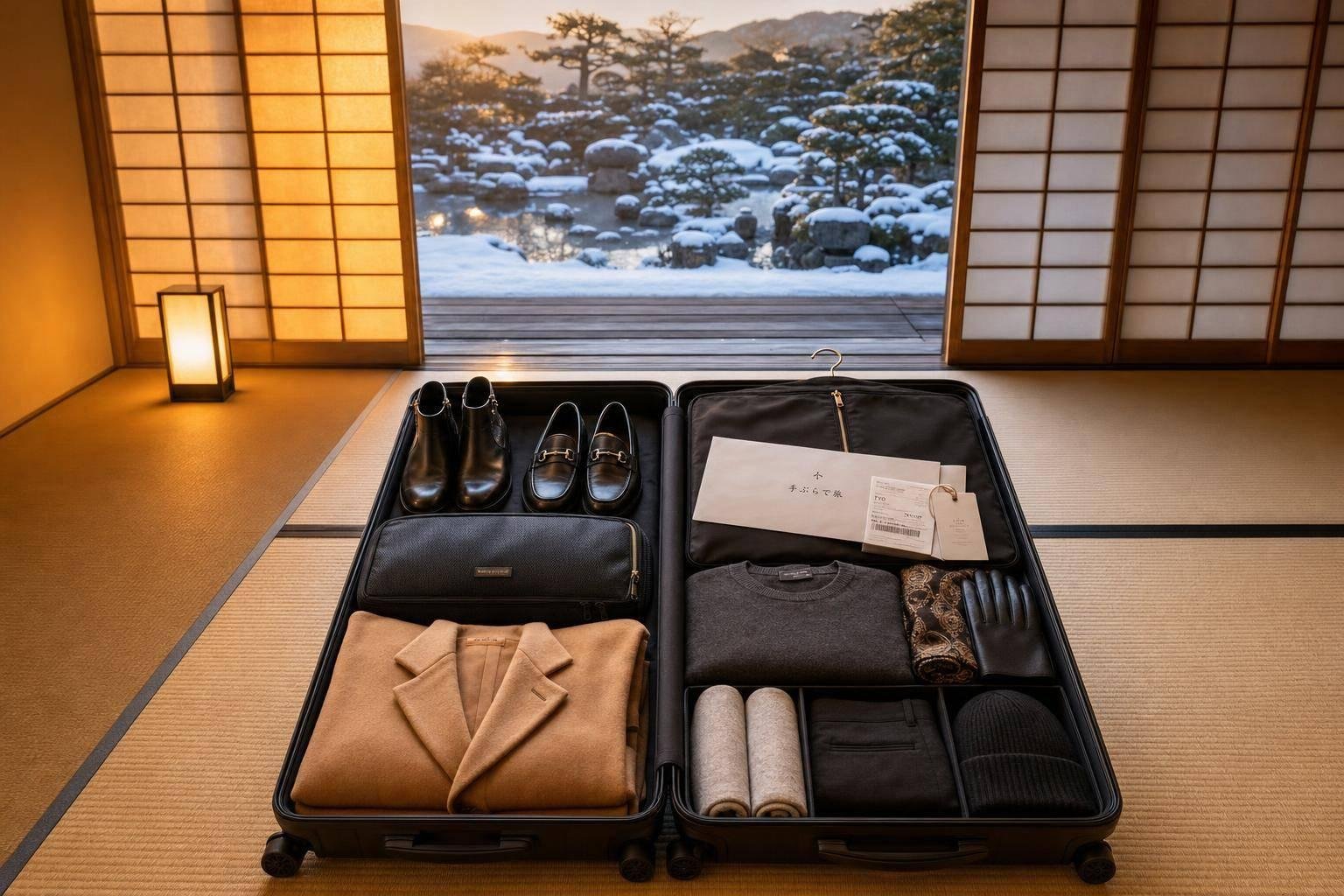
Japan winter packing is simple once I pack for the coldest stop on my route, not for Japan as a whole. Tokyo in January averages about 41.7°F, Sapporo about 26.2°F, and Naha, Okinawa, about 63.1°F. That gap changes everything: coat weight, shoe choice, luggage size, and even what I wear to dinner.
Here’s the short version:
- I build my bag around layers, not one heavy coat.
- I bring two shoes: one polished pair and one waterproof pair with grip.
- I keep one dinner outfit for kaiseki, hotel bars, and polished evenings.
- I check what my ryokan already provides so I don’t pack doubles.
- I use luggage forwarding if my trip includes cities, inns, and snow areas.
- I pack by region: Tokyo/Kyoto/Osaka, Hokkaido/Japan Alps, or Okinawa.
A few points matter most before I start:
- Cities like Tokyo, Kyoto, and Osaka usually need a wool coat, knit layers, scarf, and weather-safe walking shoes.
- Snow regions like Hokkaido, Nagano, and Shirakawa-go need insulated boots, warmer gloves, and a waterproof outer layer.
- Ryokan stays call for easy-to-remove shoes, modest sleepwear, and a small bath pouch.
- Formal meals do not need a full extra wardrobe. One polished outfit is enough.
- Trains punish oversized luggage. On some Shinkansen lines, bags from 63 to 98 inches total size need a reservation, and larger ones are not allowed.
Japan WINTER Essentials Packing List, What to Wear in Tokyo vs Hokkaido
sbb-itb-6675d37
Quick Comparison
| Trip Type | What I Prioritize | Outerwear | Shoes | Extra Notes |
|---|---|---|---|---|
| Tokyo / Kyoto / Osaka | Polished city layers | Wool or cashmere coat | Walking shoe or ankle boot | Good for dinners and temple visits |
| Hokkaido / Japan Alps | Warmth, grip, waterproofing | Insulated winter jacket or shell | Insulated traction boots | Add thicker gloves, hat, wool socks |
| Ryokan / Onsen stay | Easy transitions, light bath kit | Warm layer for outdoor paths | Easy-to-remove shoes | Check if towels, yukata, and toiletries are provided |
| Okinawa winter add-on | Light layers only | Cardigan or light rain layer | Loafers, sneakers, or sandals | Pack sunglasses and sunscreen |
| Multi-city luxury route | Smaller main wardrobe, smart luggage plan | Layered system | Two-shoe setup | Forward luggage when possible |
If I keep those rules in mind, I pack less, move through Japan more easily, and still have the right clothes for trains, dinners, inns, and snow.
Core Winter Packing Checklist for City-to-Country Luxury Travel
Japan winter trips can change fast. You might start with a crisp city morning, move through a train transfer, and end the day at a polished dinner or a quiet ryokan. So your packing list needs to do more than keep you warm. It should help you move easily between settings without looking over- or underdressed.
Clothing That Works from Tokyo Dinners to Kyoto Mornings
Pack two or three merino or cashmere base layers. They add warmth without making tailored outfits feel bulky. Then bring one or two fine-knit sweaters, plus a lightweight insulated vest or jacket for your mid-layer. The goal is simple: clothes that look sharp in the city and still hold up during snow-country transfers.
For daytime plans and city dinners, bring tailored trousers, one pair of dark, polished denim, and one elegant dinner outfit. A silk or satin blouse with slim trousers, a clean knit dress, or a sharp blazer all fit the bill for fine dining, a private culinary experience, or a hotel restaurant. Your wool or cashmere coat should look polished at hotel check-in and still leave room for a sweater underneath. Dark denim works well for daytime sightseeing, but it fits relaxed venues better than formal ones.
For ryokan stays, pack modest long-sleeve sleepwear for moving between your room, the bath, and dinner. Add thermal leggings if your trip includes cold corridors, unheated passageways, or outdoor walks between buildings. Most ryokan provide yukata and slippers, but it’s smart to confirm what’s included before you pack extras. For ryokan dining, bring one modest, elegant outfit that stays comfortable through a long meal and doesn’t drag across tatami flooring.
| Item | Best Use | When to Adjust |
|---|---|---|
| Merino or cashmere base layers (×2–3) | Temple walks, private tours, train transfers | Add a third layer for Hokkaido or the Japan Alps |
| Fine-knit sweater (×1–2) | Hotel breakfasts, daytime sightseeing | Swap for an insulated vest in snowy regions |
| Tailored trousers (×2) | Kaiseki dinners, private cultural experiences | Add thermal leggings underneath in colder regions |
| Dark, polished denim (×1) | City sightseeing, casual restaurant stops | Avoid for formal evenings |
| Wool or cashmere coat | Hotel arrivals, evening dining, urban walks | Upgrade the outer layer for Hokkaido or mountain stays |
| Elegant dinner outfit (×1) | Kaiseki, chef-led dinners, private culinary events | Pair with a warmer outer layer when walking to dinner |
| Modest long-sleeve sleepwear | Ryokan stays, onsen transitions | Add thermal leggings in cold corridors or mountain properties |
| Thermal leggings (×1–2) | Early temple visits, snowy resort arrivals | Optional for Tokyo, Kyoto, and Osaka; essential for Hokkaido or Japan Alps |
Cold-Weather Accessories and the Two-Shoe Rule
A few small items make a big difference in winter. Pack a cashmere scarf, touchscreen gloves, and a warm hat or headband to protect exposed skin during early departures and evening walks. Wool socks – two or three pairs – deserve space in your bag because you’ll be taking your shoes off often. Insulated insoles can make your current shoes more comfortable on long city days, which may save you from packing a third pair. Add a compact umbrella for rain or wet snow, especially in places where winter weather shifts fast, and bring sunglasses for bright days and snowy views.
For shoes, keep it to two types: one waterproof, traction-focused pair for snow, icy sidewalks, rural paths, and resort arrivals, and one refined, easy-to-remove pair like a polished loafer, ankle boot, or weather-resistant walking shoe for city restaurants, temples, and inns. Break in both before you leave. That matters more than people think. In Japan, you’ll remove your shoes at ryokan entrances, many temples, some restaurants, and other more old-school settings. In Tokyo, Kyoto, and Osaka, a weather-resistant walking shoe can often handle both jobs. In Hokkaido or the Japan Alps, though, your waterproof pair needs insulation and much better grip.
Why Layering Beats One Heavy Winter Coat
One heavy coat sounds smart until you step indoors. Japan’s trains, shops, hotels, and restaurants are usually well heated, so you’ll end up taking off a bulky coat again and again during the day. A three-layer system works better: a breathable merino base, a fine-knit or insulated mid-layer, and a polished wool, cashmere, or weather-resistant outer layer that opens easily and still looks put-together when it’s draped over your arm.
If you’re heading to Hokkaido or the Japan Alps, keep the same setup but change the weight of the materials. You’ll want a warmer outer layer, heavier insulation, better gloves, thicker socks, and footwear built for subfreezing weather and snow. The structure stays the same. The cold just asks more from each piece.
From there, refine the list for onsen, ryokan, and dinner dress codes.
Onsen, Ryokan, and Dinner Packing for Winter Luxury Stays
Once your cold-weather layers are sorted, the next choices come down to bath rules, dinner dress codes, and what a ryokan already has waiting for you.
Onsen and Ryokan Kit: What to Bring and What Is Provided
Most ryokans provide bath towels, face towels, yukata, slippers, and basic toiletries. That means you usually don’t need a big bath bag.
What helps most is a small pouch with the few things you’ll want on hand:
- Washcloth
- Hair ties
- Travel-size moisturizer
- Lip balm
- Clean underwear
- Any skin care you rely on
Hot water and dry indoor air can be hard on skin, so simple, fragrance-free products tend to work best.
Bring a waterproof pouch for keys or room cards, and leave jewelry in the room safe. Before your trip, check the property’s amenity list. Some places ask guests to bring towels from their rooms to the public bath. Jo Vacations confirms each property’s bath setup and amenity list in advance, so packing stays exact.
Bath etiquette matters. Wash before entering the bath, keep hair and washcloths out of the water, and dry off before heading back to the changing area. Tattoo rules can vary, so check ahead. If tattoos may be an issue, a private or reservable onsen is often the easiest pick.
What to Wear for Winter Evenings in Japan
A knit dress or tailored trousers with a fine-gauge top works for most winter evenings. Add a blazer or cashmere layer, and you’re set for kaiseki, a private dining experience, or a hotel cocktail bar.
For men, dark tailored trousers, a collared shirt, a fine knit, and an unstructured blazer cover most plans. A tie usually isn’t needed unless the restaurant asks for one.
For kaiseki, go with quiet, polished pieces that still feel good during a long seated meal. Opaque tights or a thin thermal base layer under tailored trousers help with winter temperatures without adding bulk. Keep hems easy to manage in places where shoes may come off. Skip statement jewelry and heavy fragrance too. In small dining rooms and during tea ceremonies, strong scent can feel out of place. A garment folder or wrinkle spray can help keep things sharp across a multi-city itinerary.
Temple visits and tea ceremonies call for modest layers that cover shoulders and upper legs. Understated pieces work best. Avoid long, loose sleeves and dangling accessories that can get in the way during floor-level seating or in more formal settings. For theater evenings, wear the most polished version of your dinner outfit.
Use one core wardrobe and adjust it for the setting, not for each day.
Occasion-to-Outfit Planning Table
Build around a few flexible pieces: one blazer, two refined tops, one dinner outfit, and one pair of polished removable shoes. This table ties each part of your itinerary to what it calls for.
| Setting | Recommended Clothing | Footwear | Modest Coverage or Extra Layers |
|---|---|---|---|
| Kaiseki dinner | Refined knit dress or tailored trousers, fine-gauge top, blazer or cashmere layer | Polished, easy-to-remove shoes; clean socks or opaque tights | Opaque tights or warm base layer recommended |
| Temple or shrine visit | Quiet, modest outfit; tailored trousers or below-the-knee skirt with a warm coat | Comfortable walking shoes; possible shoe removal indoors | Cover shoulders and upper legs; add a scarf or thin thermal layer |
| Ryokan stay | Provided yukata for indoor movement; thin personal underlayers and a cardigan | Provided slippers indoors; warm slip-on shoes for outdoor paths | Add a coat, hat, and socks in cold or snowy resort areas |
| Private guided experience | Polished casual layers, weatherproof outerwear, compact day bag | Supportive walking shoes or weatherproof boots | Extra midlayer for early starts, rural areas, or exposed viewpoints |
| Hotel cocktail bar | Elevated dress or tailored separates with a blazer and restrained jewelry | Dress shoes or sleek ankle boots | A cashmere wrap or tailored jacket adds warmth without bulk |
Travel Essentials and Luggage Strategy for Multi-City Japan Trips
Once your clothing is sorted, keep the rest tight: documents, tech, health items, and the smallest bag your itinerary can handle. A trip that moves through Tokyo, Kyoto, a mountain resort, and a ryokan asks a lot from your luggage. A suitcase that feels perfectly fine in a hotel lobby can suddenly feel clumsy in a narrow inn hallway.
Documents, Tech, Health, and Daily-Carry Items
Keep your passport, travel insurance details, hotel confirmations, rail reservations, and any private transfer instructions in a slim document wallet. Save encrypted copies on your phone and in the cloud. It also helps to download hotel addresses in Japanese script, since drivers and inn staff can read them more quickly.
For payments, bring at least two credit cards from different networks and alert your bank before you leave. Start the trip with a small yen reserve as well. Cash still matters more than many travelers expect. Smaller restaurants, rural shops, temples, and some ryokan may still be cash-only, even though cards and contactless payments are common in major hotels, department stores, and city businesses.
On the tech side, Japan uses 100-volt AC electricity with Type A outlets, so check that each charger accepts 100–240 volts before you plug it in. Pack a small power bank, a backup charging cable, and set up an eSIM or international data plan before boarding. Download offline maps and translation apps while you still have solid Wi-Fi.
For health items, keep all prescription medication in its original, clearly labeled packaging in your carry-on. Japan restricts some medications, including certain common stimulants and controlled substances, so check the rules for anything you take on a regular basis before departure. Bring a small pouch with pain relief, lip balm, hand cream, tissues, and sanitizer.
Your day bag should be a compact crossbody that stays hands-free and closes securely. Pack it with your passport, phone, wallet, a small yen reserve, your power bank, and a packable tote for purchases or an extra layer. A refillable water bottle is also worth carrying. Skip open totes. They’re awkward in train stations and even more awkward in inns.
How Much Luggage to Bring for Winter Luxury Travel in Japan
For most travelers, one medium checked suitcase and one compact personal item is the sweet spot. A medium case, usually 60 to 80 liters, gives you enough room for cashmere layers, a dinner outfit, winter accessories, and toiletries without turning every station transfer into a hassle. Packing cubes help. So do a waterproof onsen pouch, shoe bags, and a foldable duffel.
Your route should shape your suitcase size more than the season does. Big luggage can cause real headaches on Japanese trains. On the Tokaido–Sanyo–Kyushu Shinkansen, any bag with combined dimensions of 63 to 98 inches (160 to 250 cm) needs an advance reservation for a seat with an oversized-baggage area. If you bring one without that reservation, there’s a ¥1,000 fee. Anything over 98 inches (250 cm) combined is not allowed on board at all. Measure your suitcase before you leave home.
Luggage forwarding can make the trip much easier. You send your main suitcase ahead and travel with only a small overnight bag. That setup works especially well when your itinerary mixes city hotels, mountain resorts, and ryokan stays. Jo Vacations coordinates forwarding and private transfers, so travelers can move between stops with just an overnight bag in hand.
Suitcase Size Comparison Table
| Suitcase Type | Approx. Capacity | Ease on Trains | Room for Formalwear | Winter Layers |
|---|---|---|---|---|
| Large checked suitcase | 90–120 liters | Lowest; may exceed the 160 cm / 63 in. Shinkansen threshold and require a reserved oversized-baggage seat | Excellent, especially with a garment folder | High capacity, but best when forwarded between hotels |
| Medium checked suitcase | 60–80 liters | Best balance for airports and most rail journeys | Good for one dinner outfit and shoes | Usually the right choice for a city-to-country itinerary |
| Carry-on only | 35–45 liters | Easiest through stations | Limited; requires a tightly edited wardrobe | Challenging with winter boots and a coat; works for short trips or laundry-supported itineraries |
Route matters more than raw capacity. A large case can work if private transfers and forwarding are already arranged. A medium case is often the better fit if you’re moving on your own through rail stations and older inns. It also helps to adjust your load by destination, since winter in Tokyo, Hokkaido, and Okinawa calls for very different packing weights.
Region-by-Region Winter Packing Adjustments and Final Summary
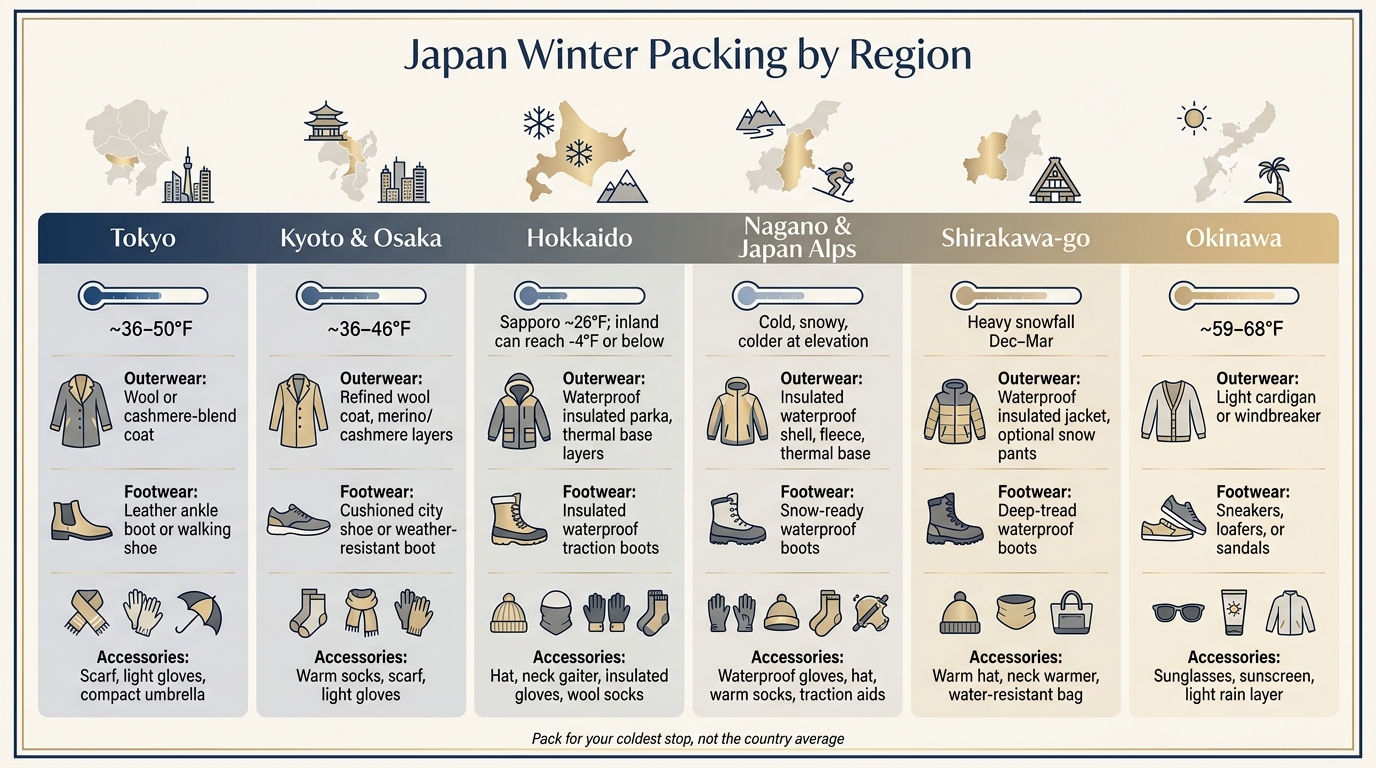
Japan Winter Packing Guide by Region: Tokyo, Hokkaido & Okinawa
Once you’ve settled on suitcase size, the next step is simple: pack for the coldest place on your itinerary. Not the month. Not the average for the country. The coldest stop.
What to Pack for Tokyo, Kyoto, Osaka, Hokkaido, the Japan Alps, and Okinawa
For city stays, winter dressing should look polished without feeling heavy. Tokyo usually sits around 36–50°F, while Kyoto and Osaka tend to run 36–46°F in winter. That means a wool or cashmere-blend coat, neat layers, and a weather-resistant city shoe will usually do the job. You can go from a temple visit to a nice dinner without heading back to change.
Snow regions are a different story. Hokkaido and the alpine areas call for gear that can handle cold, snow, and slush. Sapporo averages 26°F in January, and inland Hokkaido can fall to -4°F or below. Shirakawa-go gets heavy snowfall from December through March. In these areas, insulated waterproof boots and a proper winter shell matter. If you have resort dinners planned, one lightweight, wrinkle-resistant evening outfit is enough.
Okinawa sits in its own lane. Naha’s January mean is 63°F. So instead of bulky winter gear, pack light layers. A breathable long-sleeve top, a fine merino or cashmere cardigan, and a light rain jacket make more sense than a heavy coat. Add sunglasses, sunscreen, and a swimsuit if your plans include the beach or a resort.
Region-by-Region Winter Packing Comparison Table
Use this table to match your outerwear, shoes, and small extras to each stop.
| Destination | Typical Winter Conditions | Core Outerwear | Footwear | Must-Have Accessories |
|---|---|---|---|---|
| Tokyo | Cool and dry; ~36–50°F | Wool or cashmere-blend coat | Leather ankle boot or walking shoe | Scarf, light gloves, compact umbrella |
| Kyoto & Osaka | Chilly mornings and evenings; ~36–46°F | Refined wool coat, merino or cashmere layers | Cushioned city shoe or weather-resistant boot | Warm socks, scarf, light gloves |
| Hokkaido | Snowy; Sapporo ~26°F; inland can reach -4°F or below | Waterproof insulated parka, thermal base layers | Insulated waterproof traction boots | Hat, neck gaiter, insulated gloves, wool socks |
| Nagano & Japan Alps | Cold, snowy, colder at elevation | Insulated waterproof shell, fleece, thermal base | Snow-ready waterproof boots | Waterproof gloves, hat, warm socks, traction aids |
| Shirakawa-go | Heavy snowfall December–March | Waterproof insulated jacket, optional snow pants | Deep-tread waterproof boots | Warm hat, neck warmer, water-resistant bag |
| Okinawa | Mild; ~59–68°F | Light cardigan or windbreaker | Sneakers, loafers, or sandals | Sunglasses, sunscreen, light rain layer |
That region-by-region approach is what helps a winter Japan trip stay polished, warm, and easy to handle.
Final Checklist: Pack Less, Pack Better, Pack for Your Exact Itinerary
Pack for the coldest stop, not every stop. Lean on layers. Bring one polished city shoe and one waterproof traction shoe. Keep dressier clothing to one dinner outfit, then change the look with a few flexible accessories. Before you leave, check the forecast for your exact travel dates.
If your route crosses several regions, Jo Vacations builds bespoke winter Japan itineraries that match your packing list to your exact stops.
FAQs
How cold does Japan feel in winter?
Winter evenings in Japan usually sit in the 30s°F to 40s°F. Head farther north, and it gets colder. In mountain areas, temperatures can drop fast after sunset, so wearing layers makes a big difference if you’ll be outside.
If you’re heading to mountain regions or onsen towns, plan for heavy snowfall and icy streets or paths. Bring warm layers and shoes with good grip so you stay comfortable and safe.
Do I need snow boots for all of Japan?
No. Snow boots are mainly needed in snowy places like Ginzan Onsen from December to March, when streets can get icy and narrow.
For Tokyo, Kyoto, or Osaka, comfortable walking shoes are usually enough. If your trip includes rough terrain or mountain hiking, mid-cut hiking or mountaineering boots are a better pick because they give you more ankle support.
What should I wear to a ryokan dinner?
At a ryokan dinner, you’ll usually be served a multi-course kaiseki meal in a tatami-floored room.
Many ryokans give guests a yukata to wear, and that’s a common choice for dinner. If you’d rather not wear one, refined, comfortable clothing is also appropriate and shows respect for the inn’s traditional setting.