

The room rate is not the hotel bill. In this guide, I’d boil the whole article down to one point: in 2026, places like New York City, Hawaii, Amsterdam, Dubai, Bali, and the Maldives can add a big extra layer to the price, while Paris, Rome, Athens, Tokyo, and Barcelona are usually easier to estimate before you book.
If I were budgeting a luxury trip, I’d focus on the all-in nightly cost, not the headline rate. That means looking at:
- government taxes
- VAT or sales tax
- per-room or per-person tourist taxes
- hotel service charges
- resort or destination fees
A few fast takeaways from the article:
- New York City stacks about 14.75% in tax plus $3.50 per room, per night, and many hotels add $25 to $50+ destination fees.
- Hawaii lands near 18% to 19% once state, county, and GET charges are added.
- Amsterdam is one of the heaviest European percentage-tax markets in the piece, with 12.5% tourist tax plus 21% VAT.
- Dubai mixes a flat AED 20 nightly fee at top hotels with 7% municipality fee, 10% service charge, and 5% VAT.
- Maldives often adds about 27% before the $12 per person, per night Green Tax.
- Bali often uses “++” pricing, where about 21% to 22% may sit on top of the listed rate.
- Paris, Rome, Athens, Tokyo, and Barcelona lean more on fixed charges, so the math is usually easier.
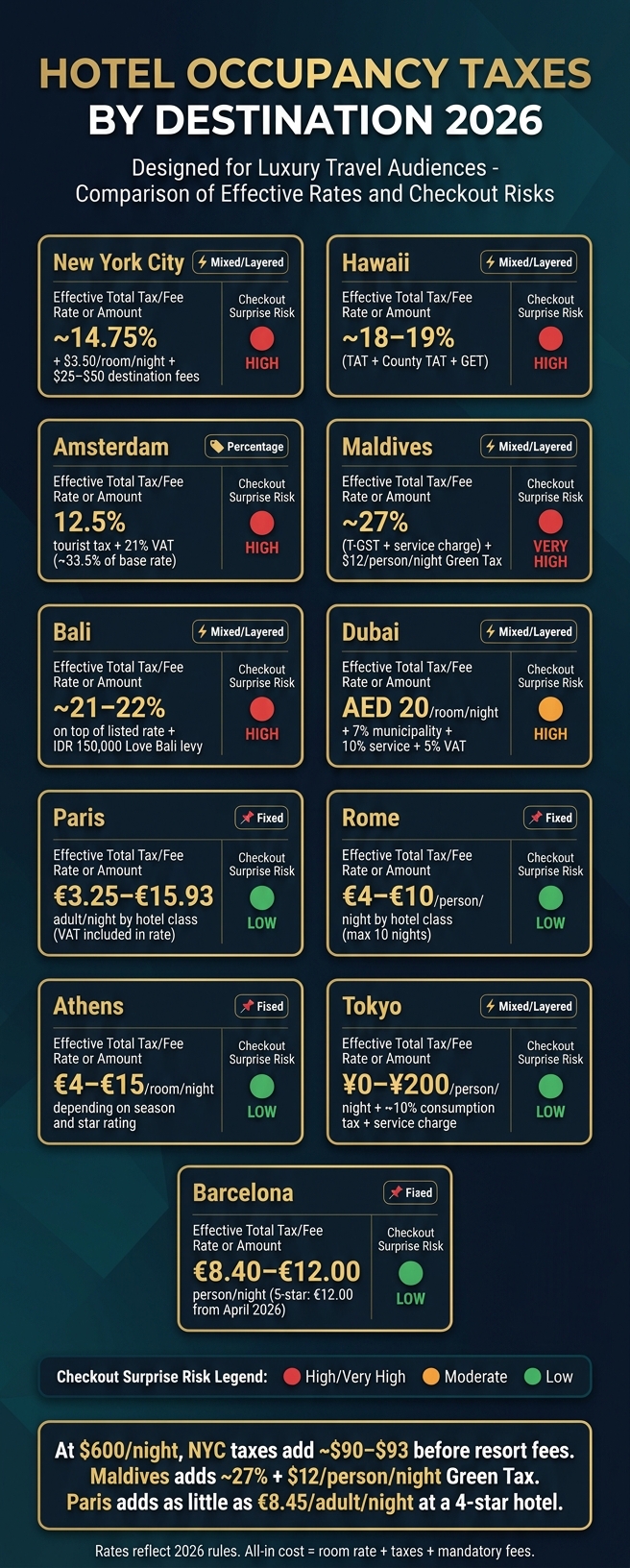
Hotel Occupancy Taxes by Destination 2026: All-In Cost Comparison
Quick Comparison
| Destination | Main tax style | What drives cost up most | Checkout surprise risk |
|---|---|---|---|
| New York City | Percent + flat nightly fee | Room rate and hotel fees | High |
| Paris | Fixed per adult, per night | Guest count and hotel class | Low |
| Rome | Fixed per person, per night | Guest count and length of stay | Low |
| Amsterdam | Percent tax + VAT | Higher room rates | High |
| Athens | Fixed per room, per night | Season and hotel class | Low |
| Dubai | Flat fee + percent charges | Room rate and service charge | High |
| Tokyo | Fixed per person, per night | Service charge and consumption tax | Low |
| Maldives | GST + service charge + Green Tax | Almost every part of the stay | High |
| Bali | Hotel tax + service charge + local levies | “++” pricing and add-ons | High |
| Hawaii | Stacked percentage taxes | Room rate and taxable resort fees | High |
| Barcelona | Fixed per person, per night | Guest count and stay dates | Low |
Bottom line: if you only compare base room rates, you can miss hundreds of dollars over a weeklong stay. I’d check the final checkout total every time, especially for multi-city trips where each stop uses a different tax setup, or when booking exclusive travel packages that bundle these costs.
sbb-itb-6675d37
1. New York City
Tax model
In New York City, the bill stacks up fast. Hotels charge 8.875% in state and local sales tax, then add a 5.875% city hotel occupancy tax, which brings the percentage-based total to about 14.6% to 14.8% before flat fees.
Then come the fixed charges: $3.50 per room, per night. That includes a $2 city fee for rooms priced at $40 or more and a $1.50 state unit fee.
This makes NYC a useful benchmark for luxury travel destinations where the tax bill climbs as room rates climb.
All-in nightly cost
At $600 per night, those percentage-based taxes add about $87 to $89. Add the $3.50 flat fee, and the nightly tax hit lands at roughly $90 to $93 before any resort or destination charges show up.
Resort fee exposure
Taxes aren’t the whole story. In Manhattan, many hotels also tack on destination or resort fees of around $25 to $50+ per night. These are hotel charges, not government taxes, and they may be taxed too.
So a room advertised at $450 per night with a $40 destination fee can end up costing more like $550 to $560 per night once everything is added in.
That gap is where travelers often get burned. The listed rate looks one way; the final total tells a different story.
Booking transparency
This is where booking pages can get slippery. Many sites lead with the base room rate and only show the full breakdown at checkout. You may not see the occupancy tax, city tax, state hotel unit fee, and resort fee until the payment or confirmation page.
Some sites roll everything into a single taxes and fees line. That makes it tough to sort out what the government requires and what the hotel added on its own.
Compare the final checkout total, not the headline rate.
Paris uses a simpler fixed tourist tax, so it’s easier to estimate the bill before checkout.
2. Paris
Tax model
Paris is one of the easier cities to price out in advance. The city uses a fixed taxe de séjour charged per person, per night, based on the hotel’s category. So once you know whether the property is 3-star, 4-star, 5-star, or Palace, the math is pretty simple.
| Hotel Category | Tax per Adult, per Night |
|---|---|
| Palace | €15.60–€15.93 |
| 5-star | €11.38–€11.70 |
| 4-star | €8.45 |
| 3-star | €5.53 |
| 2-star | €3.25 |
Hotels collect this as a separate line item. In France, hotel stays also carry 10% VAT, and that VAT is already built into the displayed room rate.
All-in nightly impact
For two adults staying in a 5-star Paris hotel, the tourist tax usually adds about €23–€24 per night. At a Palace property, that jumps to about €31–€32 per night.
Over a 7-night stay, that adds up fast. A couple at a Palace hotel can pay more than €215 in tourist tax alone, before VAT and any extra on-property charges.
Resort fee exposure
Paris does not have a standard mandatory resort fee. That’s a big plus if you’re trying to avoid surprise add-ons.
That said, some luxury hotels may still charge separate property fees for things like spa access, club lounge entry, parking, or valet service. Our team can help you navigate these bespoke luxury experiences to ensure your itinerary is seamless. Those charges depend on the hotel. They aren’t citywide or built into a common fee system.
Booking transparency
This is where travelers can still get tripped up. VAT is usually built into the displayed rate, but taxe de séjour often shows up later in the booking flow. On many booking sites, you’ll see a price that already includes VAT, while the tourist tax appears only at checkout or when you arrive.
So it’s worth checking the fine print. If the hotel category is clear, the tourist tax itself isn’t hard to estimate. The problem is that many people look only at the headline nightly rate and miss that extra charge.
Paris is one of the simpler cities to model before checkout. Once you know the hotel category, pricing is fairly clean. Rome, by comparison, is less tidy.
3. Rome
Tax model
Rome uses a fixed municipal tourist tax, called the contributo di soggiorno. But there’s a catch: it’s charged per person, per night, which can make total trip cost harder to predict for groups.
In 2026, the tax ranges from €4 to €10 per person, per night, based on hotel class. It applies for up to 10 consecutive nights at the same property, and children under 10 are generally exempt.
That means the room price might stay the same, while the tax bill climbs with each extra guest. For families, multi-room trips, and longer stays, that can add up fast.
| Hotel Category | Tax per Person, per Night |
|---|---|
| 5-star / luxury | €10.00 |
| 4-star | €7.50 |
| 3-star | €6.00 |
| 2-star | €5.00 |
| 1-star | €4.00 |
Nightly cost impact
For a couple staying at a 5-star hotel, the city tax comes to €20 per night. Over 10 nights, that adds up to €200 total. At the luxury end of the market, the number of guests matters just as much as the nightly rate.
Resort fee exposure
Rome does not usually charge mandatory resort fees. If there are extra charges, they’re typically set by the hotel itself rather than imposed citywide as part of the tax system.
So the issue isn’t just the tax amount. It’s also whether the full cost is clear before you book.
Booking transparency
Rome’s tourist tax is usually not built into the headline room rate shown on booking sites. Most hotels and platforms list it separately, with payment due on arrival or at checkout.
Italy’s hotel VAT is usually included in the quoted room rate, while the tourist tax is added on top as a separate municipal charge.
4. Amsterdam
Amsterdam works the opposite way from Rome: while other popular destinations use flat per-night fees, the tax bill climbs with the room price, not the number of guests.
Tax model
Amsterdam taxes the room, not the guest. The city applies a 12.5% tourist tax to the pre-VAT room rate, and as of Jan. 1, 2026, accommodation VAT is 21%. That pushes the combined government charge to about 33.5% of the base rate.
Since both charges rise with the room price, your tax bill goes up as your nightly rate goes up. So if you book a high-end suite, the final total can land far above the headline price.
All-in nightly impact
Because both charges are percentage-based, the added cost grows fast at the luxury end.
- On an €80/night room, the 12.5% tourist tax adds €10.
- On a €500 suite, the tourist tax alone jumps to €62.50 per night – before VAT.
The 2026 VAT jump from 9% to 21% adds even more weight to the final bill, especially on pricier rooms. In plain English: a high-rate stay in Amsterdam now carries a much bigger tax load than it did before.
Resort fee exposure
Amsterdam does not have a standard citywide resort fee. Still, some luxury hotels may add separate facility or service charges for things like spa access, lounge use, or bike rentals.
These usually show up as their own line items on the final bill, separate from the tourist tax. So you might see the total broken out into room rate, VAT, tourist tax, and a facility fee.
Booking transparency
Many Amsterdam hotels and booking sites show a base room rate that does not include the tourist tax. That tax often shows up in the fine print or only at checkout, and it may be listed as payable at the property.
Before you book, check the final confirmation for the full breakdown: room charge, VAT, tourist tax, and any separate hotel fees.
5. Athens
Athens uses a fixed nightly hotel fee based on star rating, not room price.
Tax model
Athens applies Greece’s Climate Crisis Resilience Fee, charged per room, per night. In 2026, 5-star hotels charge €15 per room per night in peak season (April–October) and €4 in off-season (November–March). 4-star properties charge €10 and €3.
That setup makes Athens pretty easy to predict. If room rates go up, the climate fee doesn’t move with them.
The final cost structure is:
- Base rate
- 13% VAT
- Fixed nightly climate fee
All-in nightly impact
A €15 nightly fee barely moves the needle on an €800 suite, but it hits harder on a €200 room. On a 7-night July stay at a 5-star hotel, that adds €105 per room before VAT and hotel charges.
Resort fee exposure
Athens doesn’t commonly use U.S.-style resort or destination fees at city hotels. That said, some properties may add separate amenity fees for things like rooftop access, private club floors, or spa packages. Those charges come from the hotel, not the government.
Booking transparency
The climate fee is often listed separately and paid at the hotel, usually at checkout, instead of being built into the prepaid room rate. So the headline rate may leave it out.
In plain English: the rate you first see isn’t always the rate you end up paying. Athens is still simpler than percentage-tax markets, but the final bill can change based on room class, season, and any hotel add-ons.
Next comes Dubai, where the tax structure is flatter but still built into the stay in a different way.
6. Dubai
Unlike Athens, which sticks to a flat fee, Dubai stacks a fixed nightly charge on top of percentage-based fees.
Tax model
Dubai uses a layered setup. You pay one fixed nightly fee, then a set of percentage charges tied to the room rate. The fixed part is the Tourism Dirham, a government fee charged per room, per night. At 5-star hotels and luxury resorts, it comes to AED 20 per room, per night. It applies for up to 30 consecutive nights, then stops.
On top of that, Dubai adds three more charges:
| Charge | Rate | Who Gets It |
|---|---|---|
| Municipality fee | 7% of room rate | Local government |
| Service charge | 10% of room rate | The hotel |
| UAE VAT | 5% on room rate + service charge | Federal government |
Government fees like the Tourism Dirham and municipality fee are usually VAT-exempt. So VAT is generally charged only on the room rate plus the service charge. That detail hits hardest at high-end hotels, where the percentage-based fees climb as the nightly price goes up.
All-in nightly impact
These charges stack up fast. On an $800-per-night suite, the municipality fee, service charge, and VAT can push the effective add-on into the mid-20% range even before the Tourism Dirham is added.
Resort fee exposure
Dubai usually doesn’t call out a separate resort fee. Instead, the 10% service charge often fills a similar role, and it climbs with the room rate. Some luxury properties, especially integrated resort-style hotels on Palm Jumeirah and along the beach, may fold in beach club or spa access instead of listing those items on their own. That can make the nightly total look lower than it ends up being before checkout.
Booking transparency
The Tourism Dirham and other charges often show up only at checkout or as a separate line item due at the property. So the first price you see online may not include them. Check the final payment page for the full breakdown, and confirm whether the Tourism Dirham is built into the total or due at check-in.
7. Tokyo
Tokyo goes back to a low fixed-fee setup. But the total you pay can still climb once national tax and service charges get added.
Tax model
Tokyo uses a fixed accommodation tax per person, per night, based on the room price before meals and tax. For 2026, the tiers look like this:
| Per-Person Nightly Rate (Room Only) | Accommodation Tax |
|---|---|
| Under ¥10,000 | None |
| ¥10,000–¥14,999 | ¥100 per person |
| ¥15,000 and above | ¥200 per person |
At most luxury hotels, guests land in the ¥200 tier. And that’s where the accommodation tax stops, even if the room rate goes much higher.
That makes Tokyo simpler to budget for than cities that use a percentage-based lodging tax. Still, room price matters because Japan stacks other charges on top. Consumption tax and hotel service charge are percentage-based, and those two usually account for most of the jump in the final bill.
All-in nightly impact
For a couple staying in a ¥60,000 suite, the accommodation tax adds ¥400 per night. Over seven nights, that comes to ¥2,800. Compared with the room cost, that’s not much.
The larger hit comes from the service charge and consumption tax, which can push the added cost to about 20% or more.
One detail matters when you’re planning: Tokyo’s accommodation tax changes with the number of guests and the number of nights, not with the total room price. So a family of four in an ¥80,000 suite would pay ¥800 per night in accommodation tax, since each guest is charged ¥200.
Resort fee exposure
Tokyo does not often tack on mandatory resort-style fees. Most luxury hotels in central areas fold standard amenities into the room rate. Things like spa access, club-level lounge access, or onsen use are more often sold as optional extras instead of required nightly charges. Compared with many other markets, Tokyo has lower resort-fee exposure.
Booking transparency
Transparency depends on where you book. Major hotel brands and large OTAs usually show Tokyo accommodation tax, consumption tax, and service charge during checkout.
Jo Vacations can pre-calculate the tax portion and the total stay cost before booking.
8. Maldives
If Tokyo is fairly easy to map out, the Maldives is the exact opposite. The base rate is just the starting point.
In the Maldives, resorts stack taxes and mandatory charges on top of the nightly room price. A standard bill usually includes a percentage-based Tourism GST, a mandatory service charge, and a fixed Green Tax charged per person.
Tax model
Three charges apply to most luxury resort stays in 2026:
- Tourism Goods and Services Tax (T-GST): 17% on accommodation, meals, spa services, and most on-property spending
- Service charge: 10%, mandatory at most tourist resorts
- Green Tax: $12 per person, per night at resorts and larger tourist properties; $6 at smaller guesthouses and hotels on inhabited islands
Put those together, and the T-GST plus service charge add about 27% to most published prices before Green Tax even enters the picture. That’s why many resort sites use “++” next to the rate. It means T-GST and service charge are extra.
There is one helpful exception: children under 2 years old at check-in are exempt from Green Tax, effective January 1, 2025.
All-in nightly impact
The math gets expensive fast. If two adults book an overwater villa at $1,500 per night, the 27% uplift adds about $405, bringing the subtotal to $1,905 before Green Tax. Then Green Tax adds $24 (2 × $12), which pushes the effective nightly cost to about $1,929 before any taxable extras.
Resort fee exposure and booking transparency
The Maldives usually doesn’t use a separate resort-fee line item. Instead, the 10% service charge and 17% T-GST fill that role, and they apply to a lot more than the room. Dinner, spa treatments, and excursions can all pick up those charges.
This is where booking gets tricky. Resort booking engines often show a base nightly rate with “+ taxes and service charges” tucked into fine print. The full breakdown – 17% T-GST, 10% service charge, and the per-person Green Tax – may not show up until the last checkout screen or even after booking in the confirmation invoice.
Mandatory festive supplements around Christmas and New Year can add another layer. Those charges are often taxable too, and they may not be spelled out clearly in the first quote.
Before paying a deposit, ask for an itemized pre-stay quote that covers:
- room rate
- Green Tax
- transfers
- service charge
- T-GST
Jo Vacations can prepare itemized pre-booking cost breakdowns for Maldives stays.
Island resorts can look simple on the booking page, but the final bill depends on how each tax and property charge stacks up.
9. Bali
Like the Maldives, Bali often comes with mandatory charges on top of the room rate. The good news is that Bali is easier to price once you know how the math works. You start with the base rate, then add the required charges.
Tax model
Bali adds a 10% local hotel tax (PBJT/PHR) to room revenue. Upscale hotels also tend to add a mandatory 5%–10% service charge, with 10% being common. Put together, these charges usually add about 21%–22% to the advertised rate. Room nights usually face the local hotel tax instead of national VAT on room nights.
There’s also the one-time Love Bali levy: IDR 150,000 per person per entry, or about $9–$10.
So a rate that looks modest at first glance can end up much higher by the time you get to the full nightly total.
| Base nightly rate | ~21%–22% uplift | Estimated all-in cost |
|---|---|---|
| $500 | ~$105–$110 | ~$605–$610 |
| $1,000 | ~$210–$220 | ~$1,210–$1,220 |
| $1,500 | ~$315–$330 | ~$1,815–$1,830 |
Resort fee exposure and booking transparency
Most Bali hotels roll resort-style costs into the mandatory service charge. But some properties also tack on fixed local levies, sometimes around IDR 75,000–250,000 per room per night, on top of the percentage-based charges.
The main problem usually isn’t the tax rate. It’s how the rate is shown.
Many Bali properties use ++ pricing, which means the posted rate does not include all required charges. Others show rates that are already inclusive. That small detail can make a big difference, so check whether the quote is base-only or already inclusive before you book.
Jo Vacations can pre-screen Bali hotels and villas to separate actual all-in nightly rates from ++ rates and flag any fixed local levies before you pay a deposit.
10. Hawaii
Tax model
Hawaii is the clearest U.S. case of a stacked lodging-tax setup. As of January 1, 2026, the state’s Transient Accommodations Tax is 11%, each county adds 3%, and the General Excise Tax (GET) passed on to guests can bring the nightly total to about 18% to 19%.
This is different from places that rely on fixed nightly charges. In Hawaii, the tax bill goes up as the room rate goes up. The same applies to any mandatory hotel fee passed on to the guest.
All-in nightly impact
At $500 per night, the lodging tax alone comes to about $93.56 before any resort fees.
| Tax component | Rate | Amount on $500/night |
|---|---|---|
| State TAT | 11% | $55.00 |
| County TAT surcharge | 3% | $15.00 |
| GET pass-through | ~4.712% | ~$23.56 |
| Total lodging tax | ~18.7% | ~$93.56 |
Resort fee exposure
Mandatory resort fees are taxable in Hawaii, so a $50 nightly fee gets hit with that same lodging-tax stack. That matters because the total cost of the stay can climb fast, even when the base room rate looks fine at first glance. A mandatory fee isn’t just an extra line item. It gets taxed the same way the room rate does.
Booking transparency
Some hotels break out TAT, county TAT, and GET as separate charges. Others roll them into a single taxes-and-fees line. Before you book, check whether the quoted nightly rate is before tax or after tax. Also look closely at whether the GET is already built in or added later.
Bali comes next with a similar stacked-fee setup, but the way its taxes and service charges are packaged is different.
11. Barcelona
Tax model
Like Paris and Rome, Barcelona uses a fixed tourist tax per person, per night. But here, the city surcharge makes the total stand out more. The tax combines two parts: the Catalonia IEET and a municipal surcharge.
Starting April 1, 2026, the city surcharge is €5.00 per person, per night. It then goes up by €1.00 each year until it hits €8.00 in 2029. For 5-star and luxury hotels, the regional IEET adds €7.00, which brings the total to €12.00 per person, per night. Children under 16 don’t pay this tax, and it only applies to the first 7 consecutive nights of a stay.
| Accommodation type | Regional IEET | Municipal surcharge | Total per person/night |
|---|---|---|---|
| 5-star / luxury hotel | €7.00 | €5.00 | €12.00 |
| 4-star / 4-star superior hotel | €3.40 | €5.00 | €8.40 |
| Tourist apartment (short-term rental) | €4.50 | €5.00 | €9.50 |
Effective April 1, 2026.
All-in nightly impact
Because the tax is charged per guest, Barcelona can get expensive fast for couples and families. The more people in the room and the more nights on the booking, the higher the total. A couple staying five nights in a 5-star hotel would owe €120.00 in tourist tax alone. Spain also applies 10% VAT to both the stay and the tourist tax.
Here’s the key budgeting detail: Barcelona’s charge is based on occupancy and length of stay, not the room price. In plain English, the final bill is driven by the hotel category, the number of guests, and the stay dates.
Resort fee exposure
Barcelona generally does not add mandatory resort fees. In most cases, the tourist tax is the main required lodging add-on. Some luxury hotels may have optional spa or facility charges, but those are usually tied to services you choose to use.
Booking transparency
Booking sites often list the tax separately or note that it’s payable at the hotel, which means the full lodging cost may not show up until checkout. Jo Vacations can include the tourist tax in your upfront lodging estimate. And timing matters: nights stayed on or after April 1, 2026 will be charged at the higher surcharge, even if the booking was made earlier.
For that reason, Barcelona is one of those cities where an all-in lodging estimate matters before a luxury trip is set.
12. Jo Vacations Luxury Itineraries

Different places tax lodging in different ways, so Jo Vacations prices each stop based on the actual all-in cost before anything is confirmed. That’s why the next step is to model each stay before it’s booked.
Each property gets its own cost profile. That includes the room rate, occupancy tax, fixed fees, VAT or service charges, and resort or destination fees, all converted to USD. Once those pieces are separated out, it becomes much easier to compare tax setups side by side.
Jo Vacations uses side-by-side comparisons to show the real cost of moving from a standard room to a suite in percentage-tax markets before booking.
For multi-room and multi-generational trips, pricing is worked out property by property and, when needed, guest by guest. That way, per-person taxes and age exemptions are counted the right way. The comparison below shows how those rules can affect actual trip budgets.
How These Tax Structures Compare in Practice
Once you know the rules in each place, the next step is simple: look at how those rules change what you actually pay.
Percentage taxes, fixed fees, and mixed systems
Hotel taxes usually show up in three forms: percentage-based, fixed-fee, and mixed.
A percentage tax moves with the room price. Amsterdam’s 12.5% tourist tax, for example, goes up as the room gets more expensive. A fixed fee does the opposite. Rome’s €10 per night charge for 5-star hotels stays the same whether the room costs $400 or $2,000. Then there are mixed systems, which stack one charge on top of another. New York City adds a percentage-based occupancy tax plus a flat nightly unit fee.
That one difference can change the final total more than many travelers expect. Two rooms with the same nightly rate can land at very different totals depending on the city.
Why nightly tax costs rise faster at higher room rates
The math is easy. The bill is where it starts to sting.
If a percentage tax applies to a $500 room, the added charge is half of what it would be on a $1,000 room. That means luxury suites and villas get hit on a much larger base. As the room rate climbs, the spread between the advertised rate and the amount due can grow fast. Fixed fees don’t work that way. They take up a smaller share of the total as room prices go up.
Where resort and destination fees change the math
Mandatory hotel fees can end up being bigger than the tax itself.
In U.S. resort areas and island markets, hotels often list required property charges separately from the base rate, and those charges may not show up until late in the booking process. In some places, those fees are taxed too. So you’re not just paying the fee – you’re paying tax on the fee. That can push the nightly cost well past the headline rate.
In plain terms, the fee setup matters just as much as the tax rate.
Which destinations are easiest to price before checkout
Some markets are much easier to budget for than others.
Fixed-fee destinations like Paris, Rome, Barcelona, Athens, and Dubai are usually simpler to price ahead of time because the charge is a set amount per person or per room. Layered-fee markets like New York, Hawaii, the Maldives, and Bali are tougher. Percentage taxes, required property fees, and service charges can stack up, and the full picture often doesn’t show until checkout.
That’s why some destinations are fairly easy to budget, while others can throw a wrench into the total at the last minute.
Pros and Cons by Destination Type
Once you compare destinations one by one, the next move is to group them by how they tax hotel stays.
This matters most at luxury price points. A small tax gap may look minor at first, but at high nightly rates, it can snowball fast.
Percentage-tax cities
Percentage-based taxes are simple on the surface. You can usually estimate them without much trouble.
The catch is pretty clear: they climb as room rates climb. So while they may feel manageable on shorter stays, they can get expensive on longer luxury trips.
Fixed-fee European capitals
Fixed fees are more predictable. You know the charge upfront, and it doesn’t change with the room price.
But there’s a trade-off. These fees can hit families and longer stays harder because the cost stacks up per person, per night. Even if you book a lower-priced room, the fee keeps adding up night after night.
Asia and Middle East markets with layered service charges
These markets often combine hotel charges, government levies, and VAT. That means the listed room rate may show only part of the story.
Two hotels can start with the exact same base rate and still end up with very different final totals once every layer gets added in. That’s where people get caught off guard.
Island resort destinations with layered fees
These destinations are the toughest to forecast and the most likely to bury extra charges. Mandatory fees often apply to much more than the room itself, and the full amount may not show up until the last checkout screen.
That’s why this group carries the highest checkout risk in the comparison below.
At the end of the day, the biggest differences come down to three things: predictability, how much taxes react to room price, and whether extra charges stay hidden until late in the booking process.
| Destination Type | Predictability | Rate Sensitivity | Long-Stay Value | Hidden Extras Risk |
|---|---|---|---|---|
| Percentage-tax cities (e.g., NYC, Amsterdam) | Moderate | High | Lower | Low–Moderate |
| Fixed-fee European capitals (e.g., Rome, Paris) | High | None | High | Low |
| Asia & Middle East layered markets (e.g., Dubai) | Low | High | Moderate | High |
| Island resort destinations (e.g., Maldives, Hawaii) | Low | Variable | Moderate | Very High |
FAQ
These quick answers cover the booking details that tend to shape your final lodging total the most.
Are hotel occupancy taxes included in the room rate shown at booking?
Usually, no. Most booking sites lead with the base room rate, then add taxes and fees during checkout. In the U.S., mandatory hotel fees need to show up early, but government taxes can still appear later. In Europe, VAT is often included in the rate you first see, while city taxes are added on top. Before you pay, check the full total.
Another thing to watch: some places use flat hotel taxes, while others use percentage-based taxes.
Which destinations use fixed hotel taxes instead of percentage taxes?
Paris, Rome, Athens, Barcelona, and Tokyo use fixed per-night taxes. Amsterdam works a bit differently because it applies a percentage tax plus VAT. New York City and Hawaii use percentage-based occupancy taxes tied to the room rate. Dubai combines a flat fee with percentage charges.
Flat per-night taxes are easier to map out. Percentage-based taxes go up as the room rate goes up.
How are resort fees different from hotel occupancy taxes?
Occupancy and tourist taxes are charged by governments. Resort fees are mandatory charges set by the hotel. In many cases, you may pay tax on both the room and the resort fee.
Why do multi-stop luxury trips make hotel tax planning harder?
Each stop can come with its own taxes, fees, currency, and pricing rules. A base rate that looks manageable in one city can shift quite a bit once every layer gets added, especially on luxury stays where percentage-based charges climb with the room rate.
If you total up nightly base rates across a multi-week trip, you’ll almost always come in under the actual lodging cost.
That’s why itinerary-level cost estimates matter before you lock in a multi-stop trip.
Can a luxury travel advisor help estimate true lodging costs before booking?
Yes, especially for complex itineraries. Jo Vacations can model the base rate, occupancy tax, resort fee, service charge, and per-person surcharges before booking, then show an all-in estimate in USD and flag which charges are due locally at check-in or checkout.
Conclusion
New York City, Hawaii, and the Maldives bring the heaviest lodging costs because taxes and mandatory fees pile onto already high room rates. Paris, Rome, Athens, Amsterdam, and Barcelona are simpler to budget for because their lodging taxes are usually fixed by person or by night.
For luxury travel, the metric that matters is the all-in nightly total: room rate, taxes, service charges, and mandatory fees. Jo Vacations can price the full stay upfront, including taxes and mandatory fees, so your itinerary budget matches the amount due at checkout, not just the headline rate.
Taken together, these markets fall into four budgeting patterns.
| Destination | Tax Structure | Predictability |
|---|---|---|
| Paris, Rome, Athens, Amsterdam, Barcelona | Fixed per-person, per-night city tax | High |
| Dubai, Tokyo | Flat fee per room/person per night | High |
| Bali | Stacked fees and tax layers | Moderate |
| New York City, Hawaii | Percentage-based, stacked layers | Low |
| Maldives | GST + service charge + Green Tax | Low |
For luxury itineraries, the best comparison point isn’t the nightly rate by itself. It’s the total stay cost across every stop. That’s why pre-booking cost modeling matters so much for multi-stop luxury itineraries.