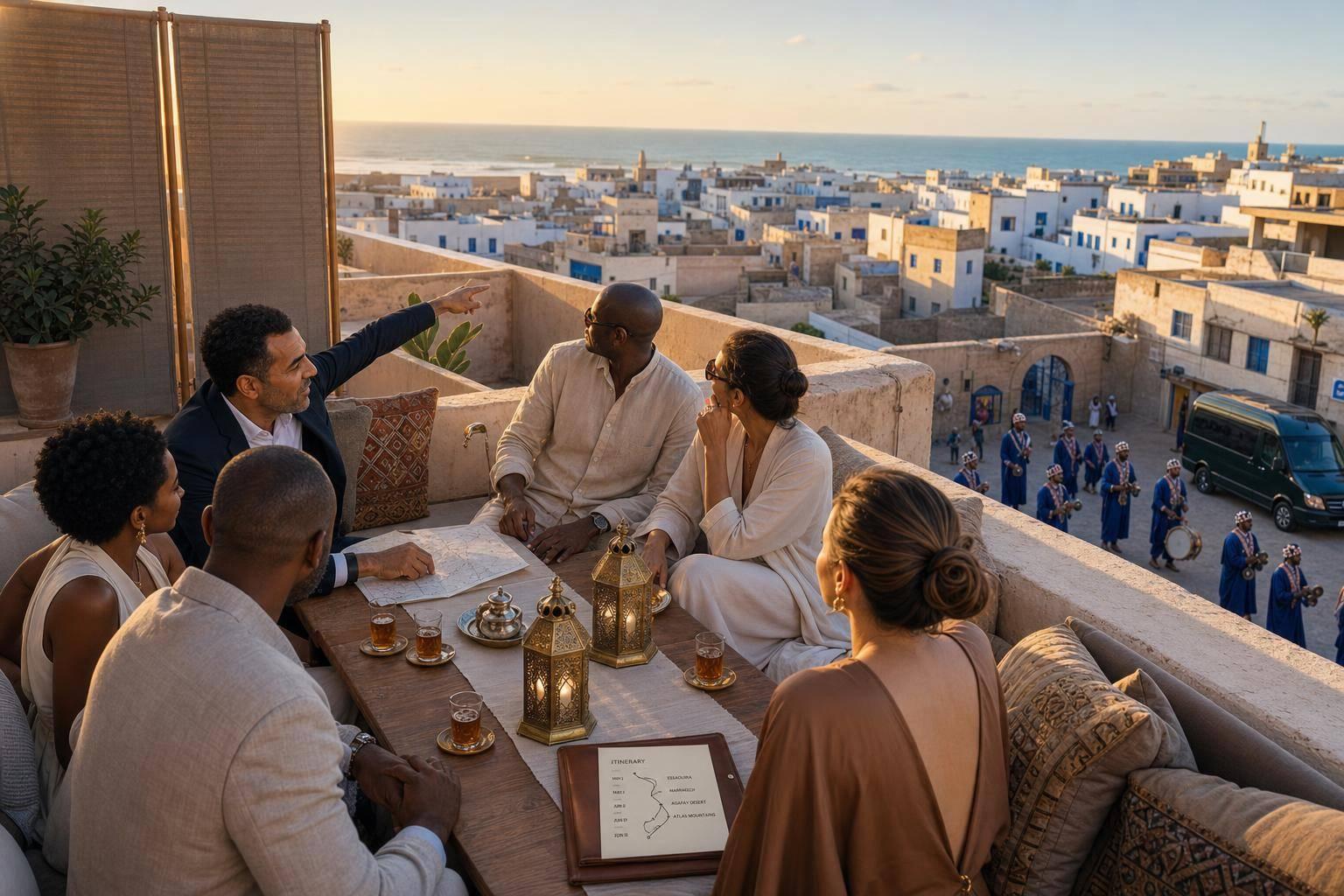
If I were planning group trips to Morocco, I’d start with 1–2 festival dates, then build the route around them. That one move cuts down on long backtracks, sold-out stays, and stressful day-of changes.
Here’s the short version:
- Best times to go: spring (March–May) and fall (September–November)
- Busiest stretch: June, when Fez, Rabat, and Essaouira can line up in one trip
- Best fit for first-time groups: Fez Festival of World Sacred Music
- Best fit for music-first groups: Gnawa World Music Festival in Essaouira
- Best fit for desert and mountain routes: Rose Festival, Erfoud Date Festival, and remote moussems like Tan-Tan or Imilchil
- Big planning issue: Morocco may look small on a map, but drives can still take 5–6 hours on mountain roads
- Booking tip: In busy festival periods, riads can fill months ahead, and prices in Essaouira may jump to $150–$275+ per night
What stood out to me in this guide is simple: not every festival works for every group. City events are easier to plan around trains, set schedules, and central hotels. Rural gatherings often need a private driver or 4×4, more patience, and a slower daily pace.
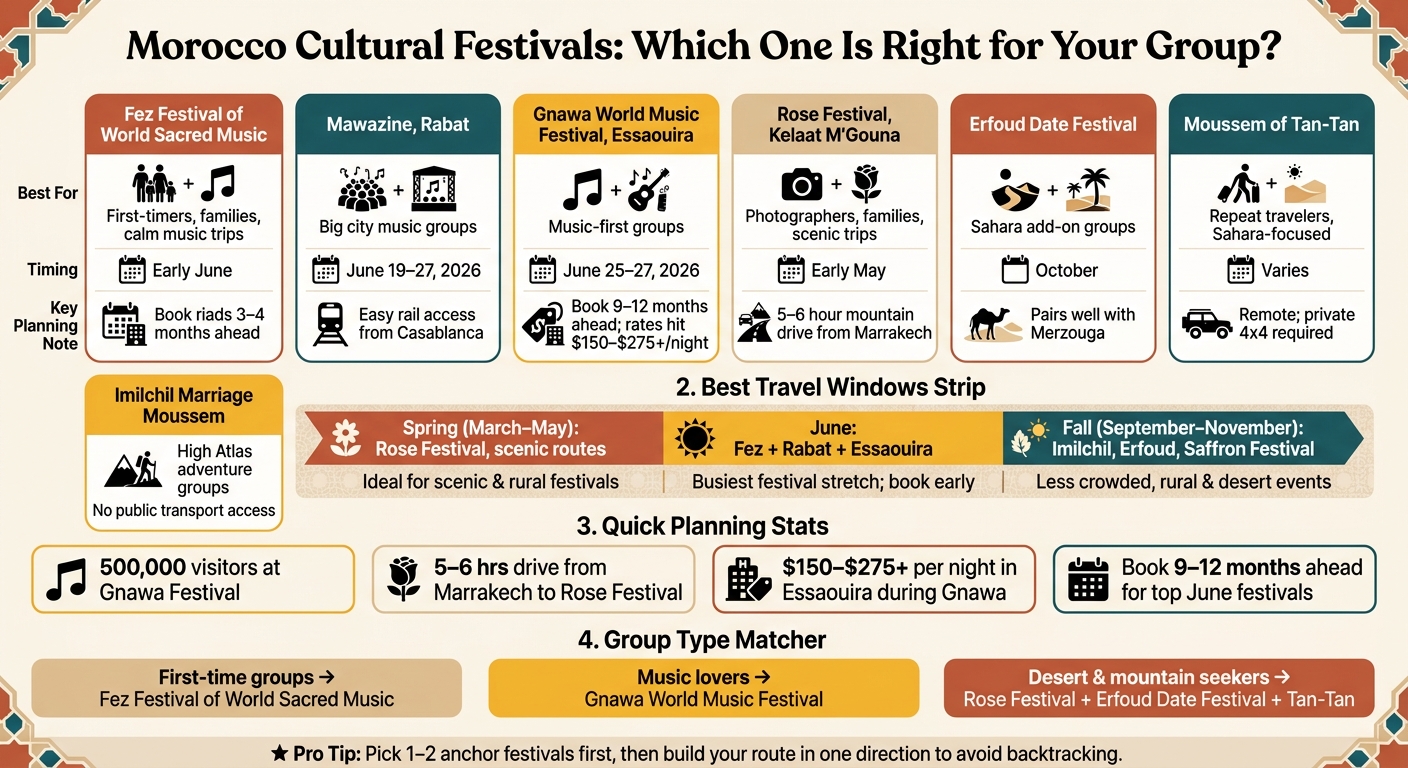
Morocco Festival Travel Guide: Which Festival Is Right for Your Group?
Quick comparison
| Festival | Best For | Timing | Main Planning Point |
|---|---|---|---|
| Fez Festival of World Sacred Music | First-time visitors, families, calm music trips | Early June | Book stays early; Fez fills fast |
| Mawazine, Rabat | Big city music trips | June 19–27, 2026 | Works well with rail links |
| Gnawa World Music Festival, Essaouira | Music-first groups | June 25–27, 2026 | Huge crowds; book 9–12 months ahead |
| Rose Festival, Kelaat M’Gouna | Scenic spring trips, photographers, families | Early May | 5–6-hour drive from Marrakech |
| Erfoud Date Festival | Sahara add-on trips | October | Pairs well with Merzouga |
| Moussem of Tan-Tan | Repeat travelers, Sahara-focused groups | Varies | Remote; private 4×4 needed |
| Imilchil Marriage Moussem | High Atlas trips | Fall | No public transport access |
If I had to sum it up in one line, it would be this: pick the festival first, keep the route moving in one direction, and leave room to rest on event days.
sbb-itb-6675d37
Choose the Right Festivals for Your Group
Morocco’s festivals fall into two main camps: scheduled city festivals and more rooted moussems. That split matters. Some trips feel smooth and easy to plan. Others ask for long drives, tighter timing, and a group that’s up for something less polished. The best pick comes down to pace, access, and the kind of experience your group wants.
Top Festivals for Music, Heritage, and Ceremony
The Fez Festival of World Sacred Music in early June works well for first-time visitors, multigenerational groups, and wellness-focused trips. The program centers on Sufi ceremonies, whirling dervish performances, and meditation sessions at Bab Makina and the Jnan Sbil Gardens. It’s a gentle entry point for groups that want music and ritual without too much travel friction. Fez fills up early, so reserve riads 3–4 months ahead.
The Gnawa World Music Festival in Essaouira, set for June 25–27, 2026, is a very different scene. Up to 500,000 visitors pack into a small coastal town. You’ll get beach stages, Gnawa trance, and jazz, which makes it a strong fit for music-first group trips. The tradeoff is pressure on space and prices. Riad rates can triple during the festival, so book 9–12 months ahead.
The Moussem of Tan-Tan sits at the other end of the spectrum. This is a remote, high-logistics gathering of more than 30 nomadic Saharan tribes, recognized by UNESCO. It includes camel races, traditional poetry, and tribal ceremony, and it’s accessible only by private 4×4. This one makes more sense for repeat travelers and groups that want a deeper connection to Saharan life.
Top Festivals for Scenic Routes and Celebratory Travel
The Rose Festival in Kelaat M’Gouna is Morocco’s most photogenic spring festival. Each early May, the Dades Valley fills with fragrant parades and local pageantry. Getting there means a 5–6-hour mountain drive from Marrakech, so it suits groups that don’t mind making the journey part of the trip. If rooms nearby are gone, stay in Ouarzazate, about 1.5–2 hours away. It’s a good match for families, photographers, and groups looking for a slower, festive rhythm.
The Erfoud Date Festival in October celebrates more than 100 date varieties on the edge of the Sahara and pairs easily with Merzouga.
Once you know which festivals match your group, the next step is to line them up with the best travel window and route.
Pick the Best Travel Window and Route
When to Go for the Smoothest Group Experience
Once you’ve picked your anchor festival, line it up with the season that suits your group best. Spring (March–May) and fall (September–November) are the two best windows for festival travel in Morocco.
June is the busiest part of the calendar. That’s when the Fez Festival of World Sacred Music (June 4–7), Mawazine in Rabat (June 19–27), and the Gnawa World Music Festival in Essaouira (June 25–27) all land in a tight stretch. That can be great if your group wants to stack major events into one trip. The trade-off? Fez and Marrakech can get hot.
Fall has a different feel. From September through November, you can catch the Imilchil Marriage Moussem in the High Atlas, the Erfoud Date Festival, and the Saffron Festival in Taliouine (October 23–November 1). These festivals tend to be more rural and less crowded, which makes group movement a lot easier and takes some pressure off lodging and on-the-ground planning.
One rule is pretty simple: book places to stay as early as you can. The larger the event and the smaller the town, the faster rooms disappear.
After that, plan your route in one direction so you don’t waste time doubling back.
How to Connect Casablanca, Rabat, Fez, Marrakech, Essaouira, and the Sahara Gateways
For a multi-festival trip, build one clean loop around the cities and entry points you plan to use. A strong route looks like this:
- Arrive in Casablanca
- Take the train north to Rabat (about 1 hour)
- Continue east to Fez
- Head south through Midelt toward the Sahara gateways of Erfoud and Merzouga
- Loop west through the Dades Valley toward Marrakech
- Finish on the Atlantic coast in Essaouira
This route puts the city festivals first, then moves into desert and mountain events. In plain terms, your group travels with the map instead of fighting it.
Morocco can look compact on paper, but travel times tell a different story. The drive from Marrakech to Kelaat M’Gouna is about 205 miles and still takes 5–6 hours on mountain roads. For out-of-the-way spots like Imilchil in the High Atlas, use a private 4×4 with a local driver. Mountain passes and desert tracks call for local know-how and the right vehicle.
Build the Itinerary, Stays, and Transport
Sample 7–10-Day and 10–14-Day Group Itineraries
Start with one or two festivals, then build the trip around them. That approach keeps the route clean and helps the group avoid too many hotel changes. For reunions, birthdays, or friends’ trips, it also helps to give each stop one shared moment everyone will remember.
| Duration | Focus | Route Sequence |
|---|---|---|
| 7–10 Days | Music & Imperial Cities | Casablanca → Rabat (Mawazine) → Fez (Festival of World Sacred Music) → Marrakech → Essaouira (Gnawa) |
| 10–12 Days | Culture & Desert | Fez (Festival of World Sacred Music) → Merzouga (Sahara) → Dades Valley → Ouarzazate → Marrakech |
| 10–14 Days | The Grand Loop | Casablanca → Rabat → Fez → Sahara (Merzouga) → Ouarzazate → Marrakech → Essaouira |
June 2026 is a strong fit for a city-to-coast music loop. The Fez Festival of World Sacred Music (June 4–7), Mawazine in Rabat (June 19–27), and the Gnawa World Music Festival in Essaouira (June 25–27) line up in a way that lets you move from city to city without backtracking.
One thing to avoid: treating Essaouira as a day trip from Marrakech during Gnawa. The drive is about three hours each way, and a lot of the magic shows up after dark. Plan at least two nights there.
Once the route is locked, the next step is simple: pick bespoke travel packages and stays that fit your group’s pace and comfort.
Riads, Boutique Hotels, and Desert Camps by Group Type
Choose lodging based on group size, mobility, and how close you want to be to venues. For family groups or trips with friends, private riads, villas, or staffed desert camps can make the whole trip feel smoother. You get more privacy, fewer moving parts, and less day-to-day hassle.
For the Fez festival, Riad Fès (Relais & Châteaux), Karawan Riad, and Riad Laaroussa are often suggested because they’re close to venues such as Bab Makina. Book 9–12 months ahead. During the Gnawa Festival, medina riad rates in Essaouira can climb to $150–$275+ per night, and rooms disappear fast.
| Setting | Stay Type | Best Group Fit | Comfort Level |
|---|---|---|---|
| Medina | Luxury Riad Buyout | Small groups (10–12) wanting privacy and dedicated staff | High / Boutique |
| City Center | Luxury Hotel / Resort | Larger groups or those needing easier accessibility | High / Modern |
| Sahara / Agafay | Luxury Desert Camp | Celebratory groups wanting a premium under-the-stars experience | Premium Glamping |
A small but important detail: many old riads have several floors, tight staircases, and no elevator. If older travelers are coming, or if anyone has mobility needs, confirm access before you book.
Private Drivers, Rail, and Internal Flights Compared
Different parts of the route call for different transport. What works between major cities won’t work in the desert.
"A route that looks ‘short’ on Google Maps can still be 5–6 hours in the Moroccan mountains." – Youness Labchir, Licensed Morocco Tour Guide
After lodging, sort transport by leg. Rail makes sense for city hops. Drivers make more sense for mountain and desert stretches.
Morocco’s ONCF rail network is fast and comfortable on the main city routes. Casablanca to Rabat takes about one hour. It’s a good option when you’re moving between big cities and don’t need extra stops.
For Merzouga, the Dades Valley, and other rural festival areas, private drivers and 4×4 vehicles do the heavy lifting. A licensed driver handles bags, deals with mountain roads, and can shift timing if road or weather conditions change. Internal flights make sense only on longer jumps when saving time matters more than the drive itself.
| Transport Mode | Best Routes | Key Advantage | Main Drawback |
|---|---|---|---|
| Private Driver / 4×4 | Sahara, Atlas Mountains, rural moussems | Door-to-door, luggage handled, full schedule control | Higher cost for smaller groups |
| Rail (ONCF) | Casablanca → Rabat → Fez → Marrakech | Fast, affordable, no driving stress | No access to desert or mountain routes |
| Internal Flights | Long-distance jumps (e.g., Fez to Marrakech) | Saves travel time on major legs | Misses landscapes; requires airport transfers |
Private touring costs more than rail, but that price usually covers the driver, fuel, lodging, meals, and full control over the schedule.
Handle Festival Logistics and Travel Etiquette
Manage Tickets, Meeting Points, and Daily Pacing
Once your route and hotels are set, sort out tickets, meeting points, and the day-to-day timing. As soon as the festival dates are locked, buy tickets and plan backward from the event schedule. Headline events can sell out fast, so it pays to move early. Bab Makina passes usually go on sale in March, and a Full Pass is the simplest way to get into the main shows.
When it comes to pacing, less is more on festival days. Don’t cram the schedule from morning to night. Leave a quiet afternoon break before evening performances so people can rest, reset, and show up with some energy left. Use WhatsApp to keep the group, driver, and guides on the same page. It also helps to pick one fixed meeting spot at each venue. If someone wanders off or gets stuck in a crowd, you’ll know exactly where to reconnect.
Dress, Etiquette, and Respect at Public Events
A smooth festival trip also depends on reading the room. Dress and behavior matter, and getting those basics right helps the group move through public spaces without friction.
Across Morocco’s festivals, modest clothing that covers shoulders and knees is the norm. At urban or coastal festivals like Mawazine or Gnaoua, a shirt and long trousers usually fit in well. At rural moussems, go a bit more conservative and skip transparent fabrics.
Shoes matter more than people think. Closed, comfortable walking shoes are your best bet for uneven medina streets and dusty fairgrounds. If the group is going to a High Atlas event like Imilchil, pack a warm layer even in summer. Nights at altitude can be bitterly cold.
For photos, ask before taking portraits, especially in rural areas. Pay attention to local drone rules, especially in places like Tan-Tan, and stay away from photographing military areas. It also helps to match the tone of the event. At religious festivals and in smaller towns, avoid public alcohol use.
Conclusion: Key Steps for a Smooth Morocco Festival Group Trip
With dates, stays, transport, and etiquette sorted, the trip is ready to book. A smooth Morocco festival group trip usually comes down to a few decisions made early. Pick one or two anchor festivals that match the group’s interests, then build the route around them. Book stays and transport ahead of time, especially for remote festivals and busy travel periods. Lock remote transport early.
After that, focus on the details that shape the trip once you’re there: buy tickets early, set clear meeting points, pace each day so the group reaches evening performances rested instead of worn out, and dress and act with respect for the communities you’re visiting.
For complex multi-stop trips, use a planner that can handle tickets, transfers, and on-trip support.
FAQs
How far in advance should we book a Morocco festival trip?
Book at least two to three months in advance if you want a better shot at getting accommodations and festival access in Morocco.
Big events like the Fes Festival of Sacred Music and the Gnaoua World Music Festival can fill nearby riads and hotels fast. Popular performances may sell out too. If you’re traveling with a group, Jo Vacations recommends planning at least two months before departure to make logistics easier.
Which Morocco festival is easiest for a first-time group?
For a first-time group, the Fes Festival of World Sacred Music is a smart pick. The setting feels organized and calm, which makes the whole experience easier to enjoy. The afternoon sessions in Jnan Sbil Gardens are a strong fit for families and groups that want a slower, more relaxed pace.
It also works well for organized travel. Many itineraries include VIP fast-track venue access and expert guides for the medina, which helps the visit feel smooth and low-stress.
Do we need a private driver for rural festivals in Morocco?
Yes, a private driver is highly recommended for rural festivals in Morocco.
Getting to remote areas often means spending hours on winding mountain roads. Having a driver makes the trip more comfortable and far less stressful.
Private transportation also makes the logistics easier. It can help you move around festival crowds and get to venues with less hassle. Jo Vacations can arrange private transfers as part of a tailored itinerary.