If I want the short answer: February is best for calving, June is a smart pick for the Western Corridor, and August–September is best for Mara River crossing chances. The timing is tied to rain, so the herds do not move on a fixed schedule. About 2 million wildebeest move through the Serengeti-Mara system, and around 500,000 calves are born during the calving season.
If I were planning this honeymoon, I’d match the month to the wildlife moment I care about most:
- Late January–March: Southern Serengeti and Ndutu for calving and predator action
- May–July: Western Corridor for moving herds and Grumeti area sightings
- July–October: Northern Serengeti and Masai Mara for Mara River crossings
- April–May or November: better for quieter camps, but with more rain and less certainty
The main trade-off is simple: peak wildlife moments often mean more people and higher prices, while quieter months can mean more privacy but harder road conditions and less predictable herd location.
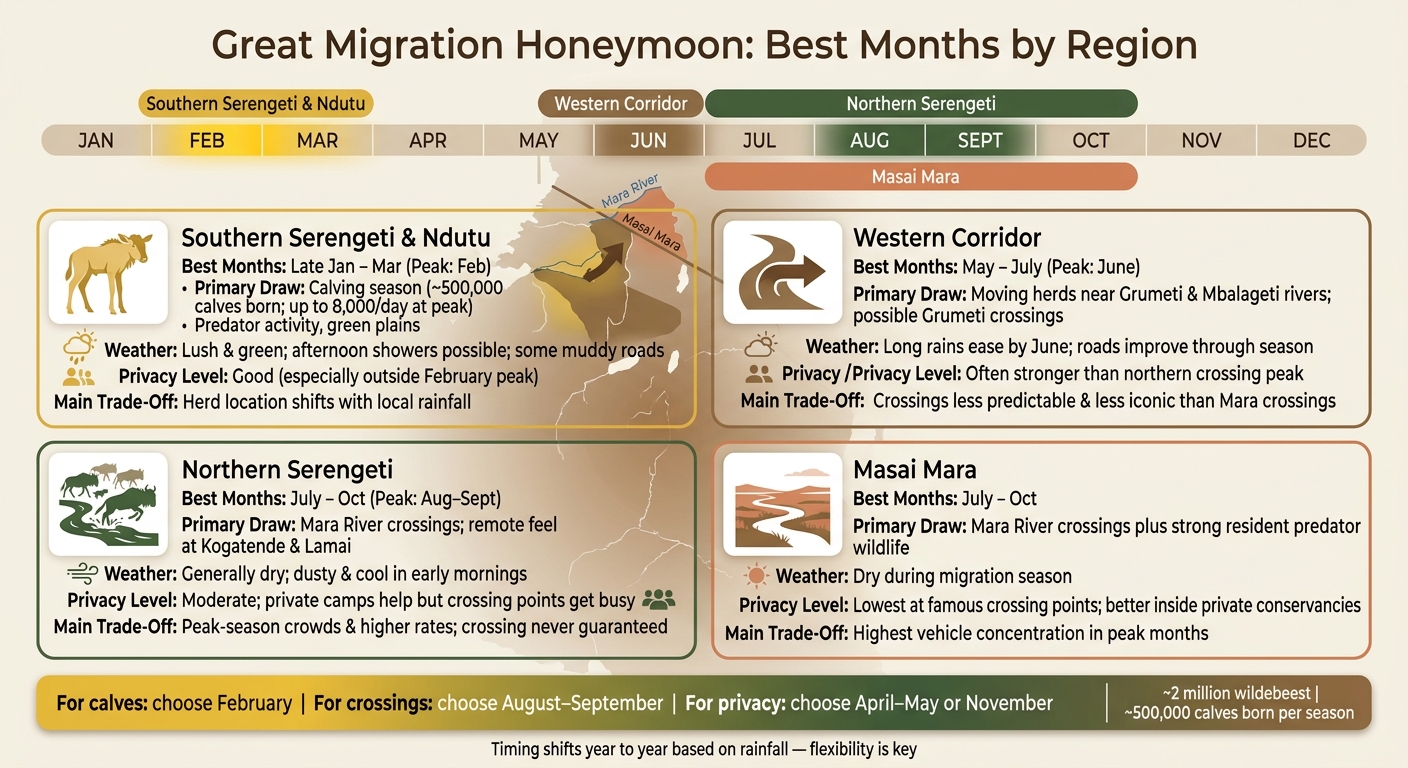
Great Migration Honeymoon: Best Months by Region at a Glance
The Serengeti & Great Migration: Everything You Need to Know (From Our Experience)
sbb-itb-6675d37
Quick Comparison
| Region | Best Months | Main Reason to Go | Main Downside |
|---|---|---|---|
| Southern Serengeti & Ndutu | Late January–March | Calving season, predator sightings, green plains | Timing can shift with rain |
| Western Corridor | May–July | Herd movement near Grumeti | Crossings are less common and less certain |
| Northern Serengeti | July–October | Mara River crossing chances | Busy viewpoints and higher rates |
| Masai Mara | July–October | Crossings plus strong resident wildlife | Most crowded in peak months |
| Privacy-focused trip | April–May or November | Lower visitor levels | Wetter weather and less certainty |
Bottom line: if I want the best odds for one headline event, I’d pick February for calves or August–September for crossings. If I want a quieter honeymoon, I’d look at shoulder or rainy-season dates and stay longer in each area.
Best Months by Region
Southern Serengeti and Ndutu: Late January Through March
February is the standout month for calving. Across the season, roughly 500,000 calves are born, and at peak, births can reach about 8,000 a day. That flood of newborns pulls in lions, cheetahs, hyenas, and other predators, which is why this is such a strong stretch for close, high-drama game viewing.
March can still be good as the herds start moving on. But in most cases, February gives you the best mix of dense calving activity and predator sightings.
Ndutu’s open short-grass plains make wildlife easier to spot, and the landscape stays green and lush. Short showers can still roll through, though, and heavier rain may turn some roads muddy. That’s where a 4×4, a skilled guide, and a bit of flexibility make a big difference.
This area works well for:
- Intimate tented camps
- Mobile migration camps
- Luxury camps near the seasonal herds
Private game drives, bush breakfasts, and sundowners can also make the trip feel quiet and personal, even in a busy month. For couples hoping to follow the migration into its next stage, the herds then drift northwest toward the Western Corridor.
Western Corridor: May Through July
As the southern plains dry out, the herds head northwest toward the Grumeti and Mbalageti rivers. June is often the most practical month here, though early July can also be a good fit. April and May can be wet, while June usually brings better roads and a stronger chance of finding the herds near the Grumeti River.
Grumeti crossings can happen, but they’re never guaranteed. Still, this period gives you a strong middle ground: migration movement without as much pressure as the better-known crossing season farther north.
Seasonal mobile camps and small tented camps tend to work best here because they can stay close to the herds. Even if a river crossing pulls in other vehicles for a while, the camp itself can still feel calm and private. After this stretch, the main action moves north toward the Mara River.
Northern Serengeti and Masai Mara: July Through October
August and September are the top months for Mara River crossings. On the Tanzania side, the Northern Serengeti – especially Kogatende and Lamai – often feels more remote and may have fewer vehicles than the busiest viewing points in Kenya.
Kenya’s Masai Mara is the classic crossing zone, with broad grasslands and access to the Mara and Talek river systems. For couples who want the best shot at crossings but still care about privacy, this part of the migration season is hard to beat.
During this dry-season window, skies are clearer, roads are easier to manage, and wildlife viewing is often simpler. A private camp helps with seclusion between drives, though not at the famous crossing points themselves. These months also book up early and come with higher rates.
If you want more space, choose Tanzania. If you want easier access to classic crossing viewpoints, choose the Mara.
Comparing the Regions: Wildlife, Weather, and Privacy
Region-by-Region Comparison Table
Each region gives you a different version of the migration. So the best pick comes down to what matters most to you as a couple: births, crossings, quieter game drives, or a camp that feels tucked away.
| Region | Strongest Window | Signature Experience | Weather | Privacy Potential | Best Camp Format | Main Trade-Off |
|---|---|---|---|---|---|---|
| Southern Serengeti and Ndutu | Late January–March | Calving and predator activity | Green and lush; afternoon showers possible; some muddy roads | Good, especially outside the February peak | Intimate seasonal tented camp or private mobile camp | Births and herd position shift with rainfall; no Mara River crossings |
| Western Corridor | May–July | Moving herds and Grumeti activity | Long rains ease by June; roads improve as the season progresses | Often stronger than the northern crossing peak | Seasonal mobile camp or secluded tented camp near migration routes | Grumeti crossings are less predictable and less iconic than Mara crossings |
| Northern Serengeti | July–October | Mara crossings | Generally dry; dusty and cool in the early morning | Moderate; private camps help, but famous crossing points get busy | Luxury mobile camp | Peak-season crowds and higher rates; a crossing is never guaranteed |
| Masai Mara | July–October | Mara crossings and resident predators | Dry during migration season | Lowest at famous crossing points in peak season; better inside private conservancies | Private conservancy lodge or boutique tented camp | Excellent wildlife density, but July–October brings the highest vehicle concentration |
These windows follow rainfall, so timing shifts from year to year.
How Many Nights to Spend in Each Area
Once you know which region fits your trip, give it enough time to work. A good rule is at least three nights per area. With less than that, you’re putting a lot of pressure on one game drive or one short patch of weather.
A longer stay gives your guide options. If the herd moves overnight, you still have more mornings to try again. And just as important, extra time leaves room for the slower parts of the trip that make a honeymoon feel different from a standard safari: a private bush breakfast, a sundowner away from camp, or an afternoon where you do absolutely nothing.
If your main goal is a crossing, four or five nights in Northern Serengeti or Masai Mara gives you a much better shot than a one-night stop.
You can also split nights based on your main focus:
- Calving-led: 3–4 nights in Ndutu, then 3 nights in the Western Serengeti
- Crossing-led: 4–5 nights in Northern Serengeti or Masai Mara
- Balanced: 3 nights in Ndutu, 3 in the Western Corridor, 4 in the north
Honeymoon Timing Strategies by Travel Style
Calving-Led, Crossing-Led, and Privacy-Led Trip Plans
Start with one main goal – calving, crossings, or privacy – and build the trip around that.
A calving-led trip focuses on February or early March in Southern Serengeti and Ndutu, with 4–5 nights in camp. February is the peak for calving. You can keep this plan fully within Ndutu and the southern Serengeti, which makes the pace calmer and the logistics easier. Early March is a good backup if you’d rather skip the busiest part of February but still want a strong shot at seeing calves.
A crossing-led honeymoon needs more built-in time because transfers are part of the trip. August or September is the best fit, pairing the Northern Serengeti with Kenya’s Masai Mara. Plan on at least 6–8 safari nights total, usually 3–4 nights on each side. That split helps balance crossing chances with predator viewing. The transfer itself also needs some planning. The overland route between the two parks goes through the Isebania–Sirari border crossing, which means immigration on both sides and a vehicle swap, so it’s smart to leave buffer time in the transfer day.
A privacy-led trip works best in April, May, or late October, when traffic drops off. The trade-off is simple: more privacy, but also more rain and the chance of muddy tracks. For many couples, that’s a fair exchange. The setting can feel far more intimate. In these months, it helps to choose camps with covered shared spaces and strong indoor comfort, and to keep the day-to-day plan flexible. After that, camp layout and trip flow do a lot of the heavy lifting.
Matching Camp Style to the Season
The type of camp you book should match the timing strategy.
A seasonal mobile camp is the best fit when staying close to the herds matters most. These camps move with the migration, which helps during calving season and during the river-crossing months. The feel is often intimate and romantic: canvas suites, private verandas, and bush dining that puts you right in the middle of the landscape.
A permanent luxury lodge or fixed tented camp makes more sense when comfort and built-in amenities matter more. Think reliable power, plunge pools, spa access, and rooms that hold up well in wet weather. That matters even more in April and May, when rain can turn a good indoor space from nice to have into something you’ll be glad you booked.
No matter which route you choose, a private vehicle is worth putting high on the list. It gives you room to linger by a riverbank, leave a crowded sighting, or start the morning later without working around another group’s plans. On a honeymoon, that freedom can change the whole feel of the trip.
Jo Vacations handles the sequencing details that make these plans work: private air transfers, carefully chosen camps, private vehicles, and on-trip concierge support timed around wildlife viewing, comfort, and privacy.
Planning Notes and Conclusion
Logistics, Comfort, and On-the-Ground Considerations
Once you’ve picked the right month and region, the next step is making sure the trip runs smoothly from one stop to the next.
Regional flights are the backbone of a multi-area itinerary. Light aircraft link the Serengeti’s southern, western, and northern airstrips. If your trip includes both Tanzania and Kenya, the route also brings immigration and border-planning details into play. It’s smart to confirm bush-flight baggage rules before you leave, since many aircraft allow about 15 kg in a soft-sided duffel.
For clothing, think in layers. A moisture-wicking base layer, fleece or insulated jacket, long pants, and a wind-resistant shell usually cover most conditions. If you’re traveling in April–May or November, add a waterproof layer and shoes with good grip.
It’s also wise to book 1–2 buffer nights near Arusha or Nairobi before your international flight home. Bush-flight schedules can move around, and weather or road conditions can throw off timing. A same-day international departure after your last bush flight is a gamble that’s usually not worth taking.
If you plan to visit a Maasai community, work with a reputable local partner. Ask before taking photos, dress modestly, and buy crafts through channels that send money back to the community.
How Jo Vacations Times Each Stop for a Smoother Honeymoon
Good timing on safari isn’t just about being in the right region. It also depends on how camps, transfers, and buffer nights fit together.
Jo Vacations starts with the wildlife moment you want most, then maps out the region, camp, transfers, and extra buffer time around it. On Tanzania–Kenya itineraries, that also includes border formalities, luggage handoffs, park-entry logistics, and that last airport buffer. If weather changes or herd movement shifts the plan mid-trip, 24/7 on-trip concierge support helps handle those adjustments.
Jo Vacations can build a bespoke migration honeymoon around your dates and wildlife priorities.
Key Takeaways: Best Months by Region for a Great Migration Honeymoon
Use this quick summary to match each region with the kind of honeymoon experience you want.
| Region | Best Months | Primary Draw | Main Trade-Off |
|---|---|---|---|
| Southern Serengeti & Ndutu | Late January – March | Calving, predator activity, green landscapes | Herd location can shift with local rain |
| Western Corridor | May – July | Herd movement toward the Grumeti region, with possible river crossings | Crossings are less predictable than the northern phase |
| Northern Serengeti & Masai Mara | July – October | Mara River crossings; August–September are usually strongest | Higher demand, crowds, no guaranteed crossing |
| Any region (privacy focus) | April–May or November | Quieter camps, lower visitor pressure | Wetter conditions and less predictable wildlife positioning |
No crossing is ever guaranteed, because herds respond to localized rainfall, forage, and conditions that no itinerary can fully predict.
FAQs
How far in advance should I book a migration honeymoon?
Book 12 to 18 months ahead if you want the best pick of accommodations and private guides, especially during peak river crossing season from July through October.
Some trips can still come together 6 to 9 months in advance. But the most in-demand luxury camps and exclusive properties tend to fill up fast.
Booking at least a year ahead also gives Jo Vacations more time to line up smooth private logistics and tailor-made experiences.
Should I choose Tanzania or Kenya for a more private trip?
If privacy and fewer vehicles matter most to you, Kenya is often the better pick.
Private conservancies near the Masai Mara, including Naboisho, Olare Motorogi, and Mara North, give you a more private game-viewing experience because they limit how many vehicles can gather at sightings.
They also allow night drives and off-road tracking. Those activities usually aren’t allowed in national parks.
A Tanzania-only safari is simpler from a logistics standpoint. But if you want to combine both countries, Jo Vacations can handle a smooth cross-border itinerary.
What should I pack for different migration months?
Pack for the season. From June to October, bring layers for chilly mornings around 59°F and pack protection for fine volcanic dust, especially if you’re carrying camera gear.
From November to May, focus on rain protection for afternoon downpours. Light, breathable clothing works best in the warmer, more humid weather.
One thing stays the same all year: bush flights often cap luggage at 26 to 33 pounds and usually require soft-sided bags. The upside is that many high-end lodges offer laundry service, so you don’t need to overpack.