
If you’re burned out, not sleeping, or stuck in stress mode, a spa trip is not the same as mental health care. I’d look for a retreat with licensed clinicians, a clear intake process, emergency support, and a written plan for after you get home.
Here’s the short version:
- I’d use a 4–5 night stay for early burnout and a brief reset.
- I’d look at 6–9 nights for burnout support plus sleep routine work.
- I’d consider 10–11+ nights for deeper exhaustion, chronic insomnia, or post-crisis recovery.
- I’d avoid any program that cannot show staff licenses or explain what happens in an emergency.
- I’d treat travel as part of the care plan: private lodging, short transfers, light scheduling, and limited work access matter.
A few facts stand out from this guide:
- Most standard luxury recovery stays fall in the 6–9 night range.
- Short decompression trips often run 4–5 nights.
- More intensive recovery often starts at 10–11+ nights.
- The first 30 days after returning home can shape whether progress holds.
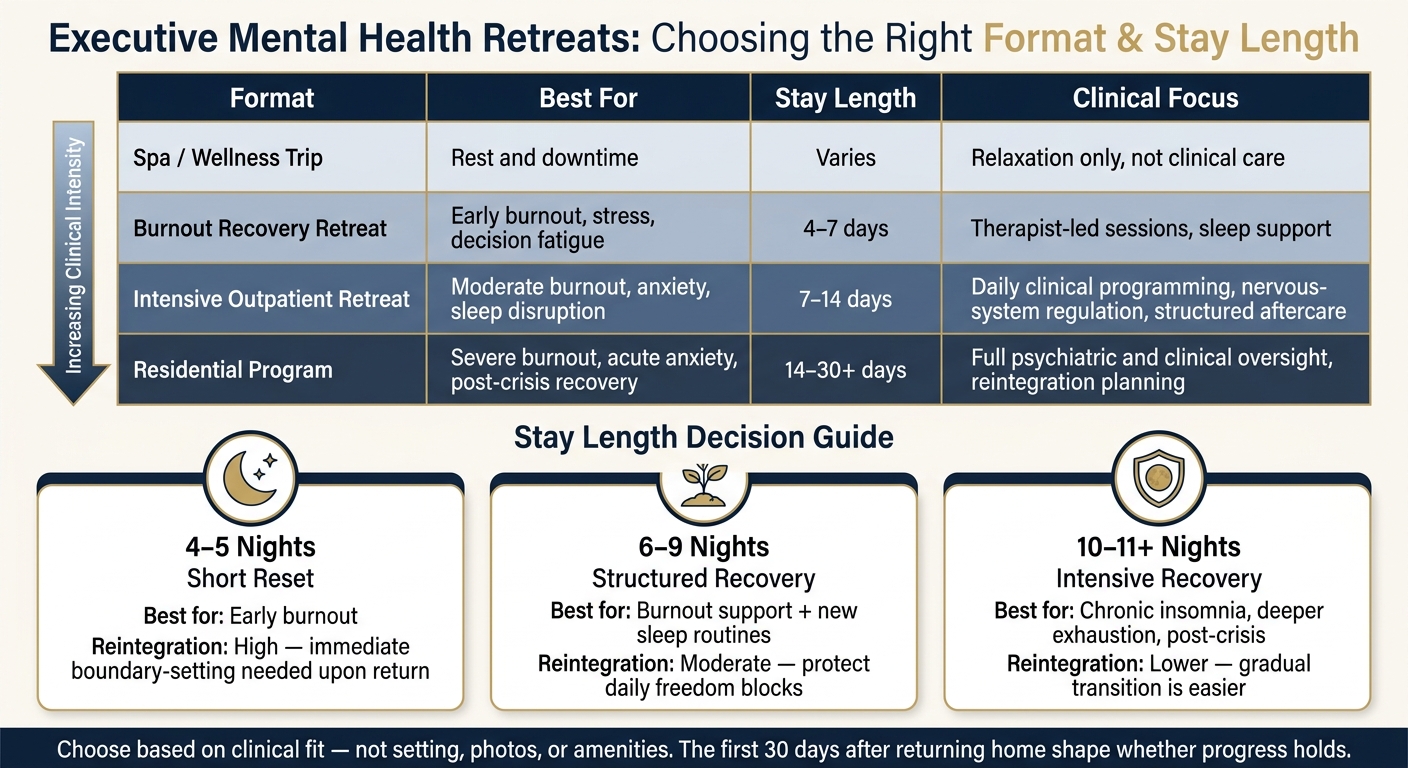
Executive Mental Health Retreats: Choosing the Right Format & Stay Length
Quick comparison
| Option | Best for | Stay length | What I’d check first |
|---|---|---|---|
| Spa or wellness trip | Rest and downtime | Varies | Good for relaxation, not clinical care |
| Burnout retreat | Early burnout, stress, decision fatigue | 4–7 days | Therapist-led sessions and sleep support |
| Intensive outpatient retreat | Burnout, anxiety, sleep issues | 7–14 days | Daily treatment and follow-up plan |
| Residential program | Severe burnout, acute anxiety, post-crisis recovery | 14–30+ days | Full psychiatric and clinical oversight |
My main takeaway: pick the retreat based on the level of care you need, not the setting, photos, or amenities. The travel side should make treatment easier to follow, while the clinical team should lead the care itself.
sbb-itb-6675d37
Retreat Formats and the Clinical Standards You Should Verify
The right retreat should match the kind of support you need, the level of privacy you want, and the kind of recovery structure that will help. For executives dealing with burnout, insomnia, anxiety, or post-crisis stabilization, format isn’t a small detail. It shapes whether the program can deal with the issue in a serious way. Once you find a format that fits, the next step is simple: check whether the program meets clinical standards.
Retreat Formats for Burnout Recovery, Sleep Support, and Residential Care
Retreat formats differ in intensity, length, and the kind of clinical oversight they offer. The best fit depends on where you are in recovery.
| Format | Primary Use Case | Typical Stay | Clinical Focus |
|---|---|---|---|
| Burnout recovery retreat | Chronic stress, decision fatigue, early-stage burnout | 4–7 days | Structured decompression, therapist-led sessions, sleep restoration |
| Intensive outpatient retreat | Moderate burnout, anxiety, sleep disruption | 7–14 days | Daily clinical programming, nervous-system regulation, structured aftercare |
| Residential care program | Severe burnout, acute anxiety, post-crisis stabilization | 14–30+ days | Full clinical oversight, psychiatric support, comprehensive reintegration planning |
Format matters. But clinical oversight matters more.
A long stay in a peaceful setting may sound good on paper. That alone doesn’t mean the program can help with burnout, anxiety, or sleep issues in a serious way. The setting and length only mean something when licensed clinicians are leading care.
Clinical Standards to Verify Before Booking Any Program
Before you commit, verify the basics directly. This is where you separate a clinical program from a wellness retreat dressed up in therapy language.
- Licensed clinical staff: Make sure psychiatrists, psychologists, or licensed therapists are on-site and directing care, not just available as add-ons.
- Structured intake process: A strong program reviews your history, goals, and clinical needs before you arrive, not after check-in.
- Emergency coverage: Ask whether the program has a clear protocol for psychiatric emergencies, including access to medical care when needed.
- Individualized care plan: Your care plan should reflect your situation, whether that’s burnout, insomnia, anxiety, or stabilization, instead of putting everyone on the same schedule.
- Aftercare structure: Recovery doesn’t stop when the stay ends. The program should give you a post-retreat reintegration plan with follow-up support.
If a program can’t clearly name its licensed clinicians, intake process, emergency plan, and aftercare structure, don’t book it.
From there, the next step is to see whether the program can support sleep and nervous-system recovery.
Sleep Support, Nervous-System Recovery, and Choosing the Right Length of Stay
What Meaningful Sleep and Stress Recovery Support Actually Looks Like
Once the clinical side checks out, the next step is simple: can the retreat help someone sleep again and calm an overloaded nervous system?
For executives, sleep trouble often shows up in familiar ways – insomnia, waking up through the night, jet lag, or that drained, stress-heavy fatigue that doesn’t go away with one good night of rest. The places that deal with this well don’t throw guests into a packed wellness agenda. They start with a quiet arrival, planned downtime, and a calm daily flow that lowers mental strain.
A good recovery day should have a steady rhythm. That can look like gentle movement in the morning, a solid midday meal, a relaxation block later in the day, and open time to rest. It’s a simple mix, but it helps with daylight exposure, physical release, and a more natural sleep-wake cycle without turning recovery into another job.
Warm oil massage or similar bodywork can also help ease tension and settle the system.
How Long Executives Should Stay Based on Their Goals
After sleep support, the next big factor is length of stay. This is what shapes how deep the reset can go.
Short decompression stays usually run 4–5 nights. Many standard luxury recovery packages sit in the 6–9 night range. And 10–11+ nights tend to fit more intense recovery goals.
| Stay Length | Best Use Case | Reintegration Needs |
|---|---|---|
| 4–5 nights | Short reset for early burnout | High; immediate boundary setting upon return |
| 6–9 nights | Structured burnout support and establishing new sleep routines | Moderate; focus on keeping freedom blocks in the daily schedule |
| 10–11+ nights | Intensive recovery for chronic insomnia or deeper exhaustion | Lower; a gradual transition is easier |
The key is to match the stay to the level of recovery needed.
Designing the Travel Around Your Care Plan With Jo Vacations
Once the retreat format and length of stay are set, the trip should support recovery, not make it harder. Jo Vacations handles accommodations, transfers, and concierge support, while the clinical team leads the care plan. From there, the focus turns to privacy, travel time, and a pace that doesn’t drain you.
What to Prioritize in the Luxury Setting and Logistics
Start with discreet accommodations and short transfer times. That alone can take a lot of pressure off the trip.
It also helps to avoid rushed arrivals. Keep ground transportation simple, and leave the first part of the schedule light. If meals or time off-site are part of the stay, build in room to slow down or shift plans as energy levels change. Recovery rarely moves in a straight line, so the itinerary shouldn’t feel locked in from day one.
These details matter most when they’re planned from the start, not patched together later.
How Jo Vacations Coordinates the Journey Before, During, and After the Retreat
The process begins with a consultation. After that, a dedicated travel advisor builds the itinerary around your dates, destination, and care needs.
Dates can stay flexible until bookings are finalized, which makes it easier to line up travel with a recovery plan that may still be shifting. During the stay, 24/7 concierge support manages changes as they come up, so your attention can stay on recovery instead of travel logistics. Return transfers are also timed to keep departure calm and predictable.
The next step is planning what happens before departure, during the stay, and after you return home.
Pre- and Post-Retreat Planning, Red Flags, and Key Takeaways
What to Plan Before Departure, During the Stay, and After Returning Home
After you lock in the retreat format and length of stay, plan the handoff on both ends: before arrival and after you get home.
Before departure, finish the clinical intake and confirm all medications, allergies, and emergency contacts with the retreat provider. On the work side, delegate your responsibilities and set firm communication boundaries so your therapy time stays protected. You should also wrap up travel documents, flights, and payments at least 60 days before departure.
During the stay, stick to the care plan and keep business access limited. If follow-up therapy or coaching is part of the plan, those sessions should already be on the calendar before you leave. Then, once you’re back home, ease into meetings during the first 30 days. That buffer helps protect progress tied to burnout recovery, sleep restoration, and nervous-system rebalancing.
| Planning Stage | Retreat Provider | Traveler (Executive) | Travel Designer (Jo Vacations) |
|---|---|---|---|
| Pre-Departure | Clinical intake screening; medication/allergy confirmation; emergency protocol briefing | Work delegation; setting communication boundaries; providing emergency contacts and passport/flight copies | Travel design, transfer timing, and schedule adjustments |
| During Stay | Delivery of therapy led by licensed clinicians; monitoring clinical progress; protecting scheduled therapy time | Adhering to limited business access; engaging in scheduled recovery activities | Trip logistics and schedule adjustments |
| Post-Retreat | Providing a written aftercare plan; scheduling follow-up therapy or coaching | Gradual return to meetings; implementing integration tools in the first 30 days | Coordinating the return journey; post-trip logistics support |
Once the logistics are mapped out, the next job is simple: tell the difference between a solid program and polished marketing.
Red Flags to Avoid and the Key Points to Remember
Before you book, check that the program can actually deliver the care it promises. The biggest warning signs are guaranteed transformation claims, staff credentials you can’t verify, and no written aftercare plan. If a retreat has no clear plan for what happens after you return home, that’s a problem.
Also watch for programs that blur the line between therapy and wellness coaching without saying so plainly. The same goes for retreats that push add-ons with no clinical reason behind them.
The short version: choose based on clinical fit, verify credentials and intake standards, match the stay length to your goals, and let Jo Vacations handle the logistics.
FAQs
How do I know if I need a retreat or a higher level of care?
If there’s a steady gap between what your work asks of you and how you actually feel, it may be time to look at a retreat built for that purpose. Common signs are pretty simple: you’re craving a reset, you can’t seem to step away from your usual routine, or normal vacations just don’t help you come back rested anymore.
Jo Vacations can turn that need for restoration into a structured, luxury itinerary built to support sleep, your nervous system, and mental clarity.
What should I ask before booking a mental health retreat?
Ask about the program structure, the wellness modalities included, dietary accommodations, the level of support, and how flexible the itinerary is.
Also confirm whether support includes 24/7 concierge services for emergencies or last-minute changes. And check whether the schedule mixes planned activities with enough downtime so the trip still feels restorative.
How can I protect my progress after I get home?
Keep the steady rhythm you built during your retreat. The idea isn’t to treat time away as a short escape. It’s to let that time become a base for lasting well-being.
Jo Vacations helps make that easier by planning balanced, smooth trips that cut travel stress. So instead of coming home drained, you return refreshed and more able to bring that sense of clarity into daily life.