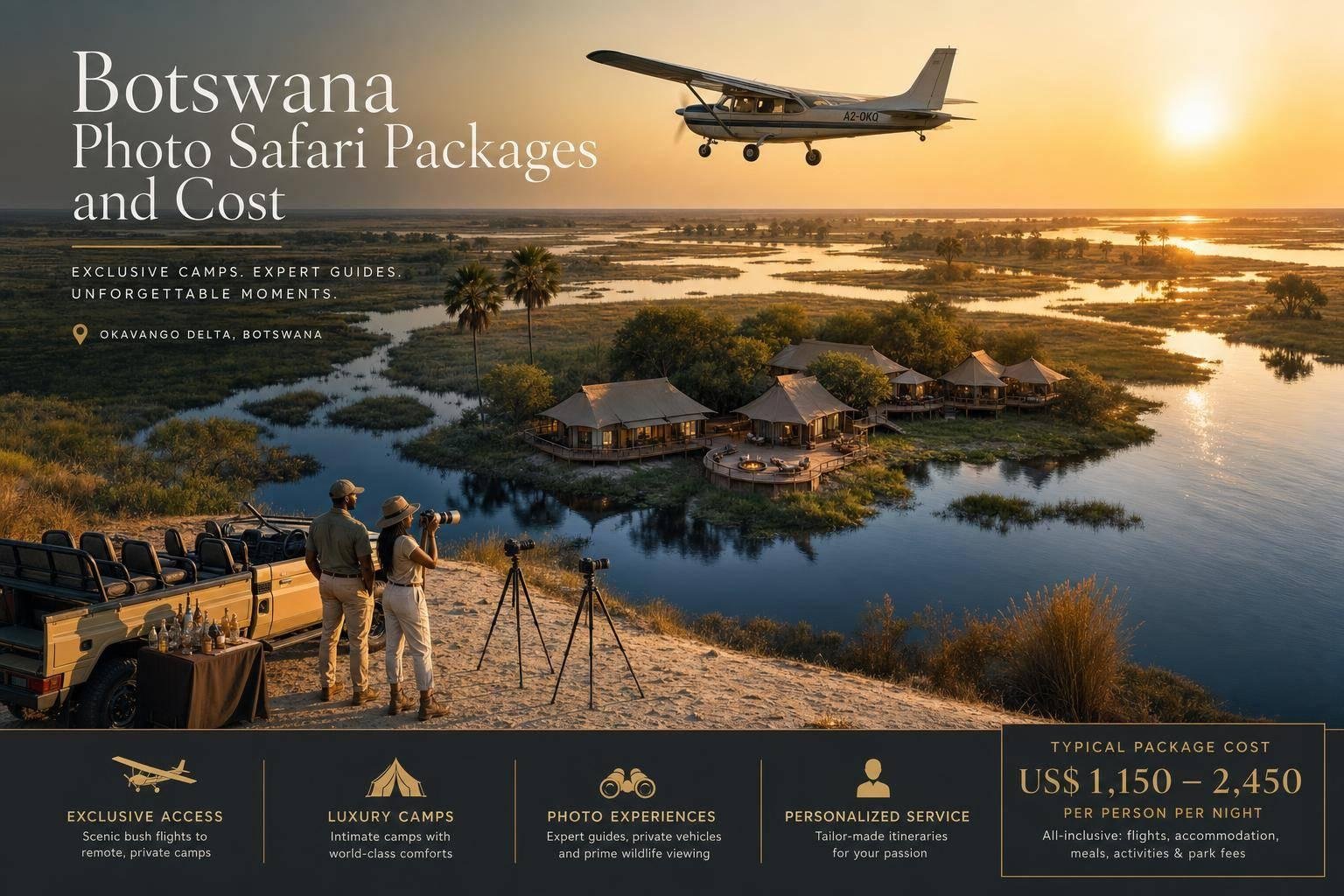
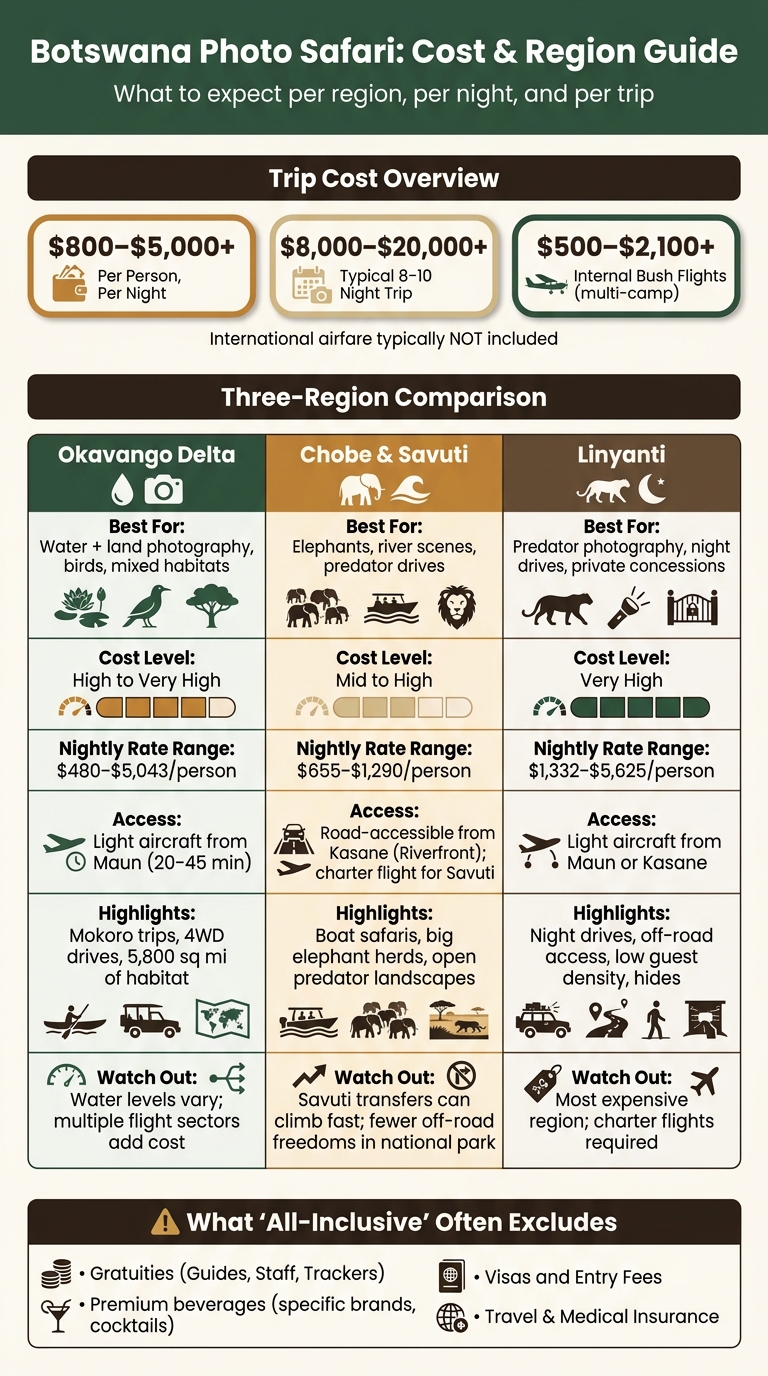
Botswana photo safaris are expensive, and the full trip cost matters more than the nightly rate. In most cases, I’d expect about $800 to $5,000+ per person, per night, with many fly-in luxury trips landing around $1,200 to $3,000+. A common 8- to 10-night trip often totals $8,000 to $20,000+ per person, and that’s before international airfare in many quotes.
Here’s the short version:
- Okavango Delta: best if you want water + land photography
- Chobe/Savuti: best if you want elephants, river scenes, or predator-focused drives
- Linyanti: best if you want private-concession access, night drives, and more time at sightings
- Peak season runs June to October, and that’s when rates are highest
- Internal bush flights can add $500 to $2,100+ per person on multi-camp trips
- “All-inclusive” often still leaves out private vehicles, premium drinks, tips, insurance, visas, and international flights
If I were comparing trips, I’d focus on just five things first:
- Nightly rate basis: shared, single, or private-use
- Internal flight cost: bundled or separate
- Private vehicle/photo guiding: included or extra
- Region mix: two camps often work better than three
- Travel season: green season can cut the total by thousands
Botswana Photo Safari: Region-by-Region Cost & Photography Comparison
Botswana Safari 2026: Best Parks, Wildlife & Costs
sbb-itb-6675d37
Quick comparison
| Region | Best For | Usual Cost Level | Main Cost Drivers | Main Watch-Out |
|---|---|---|---|---|
| Okavango Delta | Water and land shooting in one trip | High to very high | Remote camps, bush flights, camp tier | Water levels and flight costs |
| Chobe Riverfront / Savuti | Elephants, boats, predator drives | Mid to high | Road vs. air access, camp style | Savuti transfer costs can climb fast |
| Linyanti | Predator work, night drives, private-concession freedom | Very high | Small camps, private land, air access | Private vehicle and charter add-ons |
Bottom line: I’d judge Botswana safari pricing by the whole routing, not by the room rate alone. The same camp can look cheaper on paper and still cost more once flights, single supplements, and photo-focused extras are added in.
1. Okavango Delta Luxury Photo Safaris
Photo Experience
The Okavango Delta spans about 5,800 square miles of permanent waterways, seasonal floodplains, wooded islands, and open grassland. For photographers, that means one place can give you several different looks. You can shoot reed-lined water channels in the morning, open plains later in the day, and wooded islands in between.
That range is a big reason Delta trips can get expensive. The best photo setups often come with a higher price tag because they depend on where a camp sits and how hard it is to reach.
Bird photography stands out here. The mix of water, reeds, and woodland draws kingfishers, herons, African fish eagles, bee-eaters, and storks. Private concessions near Chief’s Island are also well known for lion, leopard, wild dog, buffalo, and elephant sightings, though wildlife is never a sure thing. That kind of shooting range is a major part of what you’re paying for.
Camp Style and Access
Most remote Delta camps are reached by light aircraft from Maun. Typical flight times are about 20–45 minutes to a nearby bush airstrip. These planes usually have strict baggage limits, so soft-sided bags are the norm. If you’re traveling with long lenses, backup bodies, or other heavy gear, check the luggage policy before you pack.
Camp style shapes the photo experience in a very direct way. Water camps focus on mokoro trips and motorboat outings. Predator-heavy concessions tend to lean more on 4WD game drives. If it’s your first photography trip to the Delta, a camp that combines water and land access is often the most flexible option. Those access differences show up in the final price. When budgeting, it helps to compare exclusive travel packages to see how different regions and amenities impact the total cost.
Included Activities and Hosting
Depending on the camp and water levels, activities may include 4WD game drives, mokoro excursions, motorboat safaris, guided walks, and birding outings. Not every camp offers the same mix, so what you can photograph depends a lot on which property you choose.
Private hosting can make a huge difference behind the camera. A dedicated guide, private vehicle, or private photographic departure gives you more control over:
- Vehicle position
- Departure time
- How long you stay at a sighting
For photographers, a private vehicle or private departure often matters more than the room category. Shared vehicles can still work, but they usually limit angles and cut down your time with the subject. Get it confirmed in writing whether your rate includes a private vehicle or shared departures.
Total Trip Cost Drivers
2026 Delta rates vary a lot by camp tier and season. If you’re trying to compare prices without getting lost in the details, tier is the fastest shortcut.
| Camp Tier | Rate Range (per person/night) |
|---|---|
| Boutique & owner-led camps | $480–$1,770 |
| Premium water-and-land lodges | $740–$4,271 |
| Ultra-luxury flagship camps | $1,848–$5,043 |
For a clear benchmark, Wilderness Mombo lists a 2026 rate of $5,043 per person per night for June 1–October 31, while Camp Okavango lists $1,290 per person per night for May–October and $990 for April and November 1–January 5. All rates are based on two people sharing, and single occupancy costs more.
A one-way shared light-aircraft seat from Maun to a Delta airstrip can cost $200–$600 per person, depending on the operator, routing, season, and baggage rules. Chobe and Savuti change the math by offering easier access and riverfront viewing.
2. Chobe and Savuti Photo Safaris
Photo Experience
Compared with the Delta, Chobe usually shifts the value equation toward easier access and stronger land-based wildlife viewing.
The Chobe Riverfront runs along the Chobe River, which forms the park’s northern boundary. This area is especially strong for elephant gatherings, along with buffalo, hippos, crocodiles, and lots of waterbirds. One of the big draws is boat access. It gives you eye-level shoreline shots of animals standing at the water’s edge or moving through the river. Early-morning and late-afternoon cruises tend to be best if you want softer light and more active wildlife.
Savuti sits about 95 miles southwest of Kasane. It feels more remote, more land-focused, and more geared toward predator photography. Lions, spotted hyenas, cheetahs, and leopards all feature here, often against open grassland that works well for classic game-drive images and, at times, dramatic predator-prey behavior. Put simply, the Riverfront is stronger for water-and-elephant photography, while Savuti leans toward remote predator scenes and big landscapes.
That difference matters because access and activity style drive much of the price gap between Riverfront and Savuti packages.
Camp Style and Access
Kasane is the main gateway to Chobe. You can reach it by air or by road from Victoria Falls or Livingstone in about 90 minutes, depending on border procedures. That makes a big difference on cost. Riverfront lodges near Kasane can often be reached without a charter flight, which cuts one of the main expenses you get with a fly-in Delta trip.
Savuti is harder to reach. The overland drive from the Riverfront takes about 5–6 hours, so many travelers either fly in by light aircraft or commit to a long 4WD transfer. Places to stay range from lodges to tented camps, but the setting is much more remote.
Included Activities and Hosting
A standard Chobe Riverfront package may include game drives and Chobe River boat safaris. It helps to ask what kind of boat is included. A shared sightseeing boat can be fine, but a smaller photo boat usually gives you more room and cleaner sightlines for shooting.
Savuti packages are usually built around twice-daily game drives. In Chobe National Park, walking, night drives, and off-road driving are generally not permitted. So while the wildlife can be excellent, activity options may feel tighter unless you’re staying in a nearby area outside the park. Private vehicle access matters most in Savuti, where park rules can limit flexibility.
Total Trip Cost Drivers
Kasane’s road access helps keep logistics costs down. Savuti’s remoteness pushes them up. Once you factor in transfers, Riverfront usually comes in below fly-in Delta camps, while Savuti prices climb with added transport. The 2026 rates show that spread pretty clearly:
| Property | 2026 Rate (per person, per night) | Peak Season |
|---|---|---|
| Camp Savuti (full board) | $655 Jan–Mar; $750 Apr–Jun and Nov; $850 Jul–Oct | July–October |
| Ghoha Hills Savuti Lodge (all-inclusive) | ~$840 shoulder season; $1,105 peak/migration season | Peak/migration season |
| Savute Safari Lodge | $690 Jan–Mar; $990 Apr and Nov–early Jan; $1,290 May–Oct | May–October |
| Permanent luxury camps, wider Chobe–Savuti region | ~$949–$1,040 | 2026 market comparison |
Road transfers from Kasane usually add about $100–$400 per trip, while charter flights between camps often run from about $300 to more than $700 per person, per leg. That’s why it pays to compare the full routing cost, not just the nightly rate.
3. Linyanti Private-Concession Photo Safaris
Linyanti is one of Botswana’s best areas for wildlife photography. It also tends to be one of the most expensive. What you’re paying for isn’t just a nicer room. It’s space, access, and freedom in the field.
Photo Experience
Linyanti’s waterways, floodplains, and mopane woodland pull in elephants, lions, leopards, hyenas, and wild dogs, especially during the dry season.
The big draw for photographers is the setup inside private concessions. Sightings are usually less crowded, guides can stay with animals longer, and night drives make a huge difference. After dark, leopard, serval, genet, civet, and porcupine become realistic photo subjects in a way that’s largely not possible in nearby national parks.
That extra freedom is a major reason many Linyanti trips cost more than Chobe and land closer to Delta pricing.
Camp Style and Access
Camps in Linyanti are small and remote, with a strong focus on privacy. Some, like Little DumaTau, have only a few suites.
Getting in usually means a light-aircraft transfer from Maun or Kasane. Self-driving isn’t practical here. Those flight logistics, plus the remoteness, help explain why Linyanti often costs more than Chobe stays that you can reach by road.
Included Activities and Hosting
Private concessions allow more than standard game drives. Depending on camp and conditions, you may have access to:
- Off-road driving
- Night drives
- Walking safaris
- Boating
- Hides
These options are limited in many national parks.
For photographers, a private vehicle or a guide who understands photo needs can make a big difference. It helps with vehicle position, light angle, timing, and staying longer at a sighting instead of moving on too soon.
Camp rates may include lodging, meals, activities, park fees, laundry, and local drinks. Premium imported brands are usually not included.
Total Trip Cost Drivers
Linyanti sits at the top end of Botswana safari pricing because accommodation is scarce, private-concession access is limited, guest numbers stay low, air transfers add cost, and the range of activities is broader. In plain English: the gap in price is driven less by the room itself and more by where you are and how much control you get once you’re out there.
| Camp | Period | Rate (per person, per night) | Key inclusions |
|---|---|---|---|
| Wilderness Kings Pool | June 1–Oct. 31, 2026 | $3,100 | Accommodation, meals, twice-daily activities, park fees, laundry, and local drinks; premium imported brands and champagne excluded. |
| Wilderness Kings Pool | Jan. 6–Mar. 31, 2027 | $1,332 | Low-season published rate. |
| DumaTau Camp | June 1–Oct. 31, 2026 | $4,327 sharing / $5,625 single | Published 2026 high-season rate. |
| DumaTau Camp | Jan. 6–Mar. 31, 2026 | $1,806 sharing / $2,348 single | Low-season published rate. |
These are camp rates only. You’ll still need to budget for regional air transfers, private-vehicle supplements, gratuities, and international airfare. For small groups, it can be smart to compare the cost of two shared suites against exclusive use of a four-suite camp like Little DumaTau.
If predator photography is high on your list, give Linyanti at least three nights. A few dawn drives, a few dusk sessions, and time out after dark can do a lot for your chances of getting the behavior you came to see.
Why Botswana Safari Costs Are High
Botswana safari prices are high in large part because of how the country controls access. The model is simple: keep camps small, limit guest numbers in sensitive wildlife areas, and spread the same fixed costs across fewer people. That means each traveler ends up covering a bigger share of the bill.
Small camps may feel intimate and quiet, but they still need the full setup behind the scenes: staff, generators, water systems, airstrip upkeep, and day-to-day management. The difference is that many luxury camps in the Delta and Linyanti host only 16 to 24 guests or fewer, and some run with just six to twelve beds. So even before game drives begin, the math is working against lower prices.
Private concessions add another layer of cost. Camps in these areas often pay lease fees and levies, and those charges are usually folded into the nightly rate. That money also helps pay for habitat protection, anti-poaching work, and community development. For many travelers, that’s part of the appeal: fewer vehicles, more space, and tighter control in the field. But that same scarcity is a big reason prices stay high.
Then there are the logistics. Remote Delta and Linyanti camps often rely on light aircraft, and that changes the cost picture fast. Internal flight sectors can run about $210 to $700 per person, depending on the route, aircraft, and whether the seat is shared or chartered. Private charters start at around $2,000 per hour. In many cases, especially for remote camps, those air transfers aren’t optional extras. They’re part of the core safari cost.
Conservation and park charges also play a role. Botswana’s Department of Wildlife and National Parks charges non-residents 120 Botswana pula per person per day for many parks and reserves, with a lower rate of 70 pula for clients of a licensed Botswana tour operator. Private concessions may add their own levies too, and those are often bundled into the camp rate instead of shown as a separate line item.
Even in the green season, the cost base doesn’t disappear. Rates are lower roughly January through March, but the camp still has to run. Aircraft still operate, staff still need to be paid, and supplies still have to reach remote areas all year. So while seasonal pricing can trim the total, it doesn’t erase the high cost of operating deep in the Delta or Linyanti.
How to Compare Package Pricing and Internal Flight Costs
Once camp rates are set, internal flights often decide the final bill. That’s why two Botswana quotes can look far apart even when the camps and travel dates are the same. The clean way to compare them is simple: convert each quote to a per-person, per-night total, then pull out flights, taxes, fees, and any add-ons.
An 8-night Botswana itinerary can vary by nearly $6,000 between peak and green season.
Internal flights are usually where quote comparisons go off the rails. Some operators fold bush-flight sectors into the itinerary price. Others show them as a separate charge. A scheduled bush flight between camps usually costs about $250 to $700 per person, per leg, depending on the route, season, and whether it’s part of a scheduled service. So if you’re looking at a two-camp itinerary with two flight sectors, that can add $500 to $1,400 per person if those flights sit outside the base package.
Private charters work differently. They’re usually priced by aircraft or flight time, and rates may start at around $2,000 per hour. That can make them a better deal as the group gets bigger, especially for photographers traveling with a lot of gear. Scheduled flights between Maun, Kasane, and Gaborone are a separate fare type and should be priced on their own.
Adding a third region can push costs up fast. A two-region Okavango-and-Linyanti trip may need just one inter-camp transfer. Add Chobe, and you’ll often need two or more sectors, plus extra airstrip transfers. At $250 to $700 per person per sector, that third region can add about $500 to $2,100 per person in air costs alone, before you even get into camp-rate gaps or minimum-stay rules. More regions can mean more variety, sure, but the smarter move is to compare the full trip, not just the nightly camp rate.
Before saying yes to any quote, ask for the currency, exact dates, cancellation terms, minimum-stay rules, and whether taxes and service charges are already included. Also, treat all-inclusive as a pricing label, not a full answer. Common exclusions include international flights, travel insurance, visas, gratuities, premium beverages, helicopter flights, and privately guided activities.
Use this line-by-line check to compare quotes on equal terms.
| Cost Item | Usually Included | Sometimes Extra | Typical Pricing Impact |
|---|---|---|---|
| Camp accommodation | Tent, suite, or lodge room; often based on double occupancy | Single supplement, upgraded suite, exclusive-use camp | Confirm whether the rate is based on sharing, single occupancy, or exclusive use. |
| Meals and standard drinks | All meals and many local drinks at luxury camps | Premium wines and imported spirits | Confirm premium beverage policies. |
| Daily safari activities | Game drives and, where conditions permit, boating, mokoro trips, or walking | Private vehicle, private guide, helicopter, or specialist photographic vehicle | Higher if you request private guiding or a private vehicle. |
| Park, concession, and conservation fees | Frequently built into luxury package rates | Government fee changes or special permits | Usually a smaller line item than accommodation and air transfers, but it should still be shown on its own. |
| Shared bush-flight sector | Often included in a bundled fly-in itinerary | Unscheduled routing, extra baggage, missed-connection recovery | Commonly about $250 to $700 per person per leg. |
| Private light-aircraft charter | Only when specifically requested or in an exclusive itinerary | Aircraft repositioning, waiting time, minimum flying time | Pricing may start around $2,000 per hour, rather than a flat per-person sector fee. |
| Road transfers | Transfers between accessible hubs, lodges, or airstrips | Long-distance or specially arranged road transfers | About $100 to $400 per trip. |
| Gratuities | Rarely included | Guide, tracker, camp staff, and transfer-team tips | Budget about $25 to $50 per guest per day for tips. |
| International flights | Generally not included | Seat upgrades, regional connections, airport hotels | Must be budgeted on top of the Botswana safari package. |
| Travel insurance and medical evacuation | Usually not included in camp rates | Evacuation, cancellation, and interruption cover | Treat this as a separate budget item. |
One last thing to check before you accept any quote: find out whether the nightly rate is based on single or shared occupancy. Single supplements can change the total in a big way, so two quotes that look similar at first glance may not match at all until that detail is nailed down.
Pros, Cons, and What ‘All-Inclusive’ Actually Covers
‘All-inclusive’ is a pricing label, not a standard. That’s the part many first-time safari buyers miss.
One camp may fold house drinks, laundry, park fees, and inter-camp flights into one rate. Another may use the same label and still bill extra for flights, premium wines and spirits, and private vehicles. Same phrase, very different final cost.
Get a written inclusions list before you book. It’s the easiest way to see what you’re paying for and what may show up later as an add-on. Private vehicles are often extra, and for photographers, that can make a big difference. If you want more time at a sighting, more control over positioning, or fewer trade-offs with other guests, that upgrade matters.
Use the table below to look past the headline rate and see where the money actually goes.
Here’s how the three regions compare for photographers, not just general safari guests.
| Region | Pros | Cons | Common Extra Charges |
|---|---|---|---|
| Okavango Delta | Water-and-land access gives you the broadest shooting range, with aquatic and terrestrial subjects from one camp; very strong for mixed light and habitat variety | Water activities depend on seasonal flood levels and camp location; remote access often means multiple aircraft sectors; top camps like Mombo can reach about $5,043 per person per night at peak | Premium wines and spirits, private vehicle or guide, helicopter flights, specialist photographic services, gratuities, international airfare, travel insurance |
| Chobe & Savuti | Big elephant numbers and river-based shooting; the Riverfront is road-accessible, which helps keep transfer costs lower; Savuti is strong for predator photography on open ground | The Riverfront can feel busier than private concessions; Savuti usually needs air access, which adds cost and transfer time | Park entry fees if not pre-bundled, premium wines and spirits, private vehicle upgrade, gratuities |
| Linyanti | Low guest density and private-concession access usually mean more time at sightings, off-road flexibility, and night drives that are not available in most national parks | One of the priciest choices; the remote setting limits access to scheduled light aircraft or charter arrangements | Gratuities, personal items, premium wines and spirits, private guide or private vehicle upgrades, international airfare, travel insurance |
If you’re comparing camps side by side, don’t stop at the nightly rate. A camp that looks pricier at first glance can sometimes end up closer in total cost once flights, park fees, and vehicle fees are added back in. And for photography, those extras aren’t small details – they shape how much freedom you’ll actually have in the field.
Sample Safari Pairings by Travel Style and Budget
Looking at each region by itself is useful. But most Botswana photo safaris are built as combinations, not stand-alone stays. These sample pairings turn the earlier camp rates and flight costs into itineraries you can picture in practice. The best place to start is simple: pick the pairing that lines up with what you most want to photograph.
Okavango Delta + Linyanti is a strong match for travelers who want water-based photography in the Delta and predator-focused game viewing in private concession areas. One published 6-night itinerary, flying from Maun into the Delta and then on to Linyanti, is priced from $14,899 per person for June 1–October 31, 2026. A 9-night version is listed at about $22,426 to $39,782 per person, with June through October coming in at the top end of that range. That’s a big swing, and it shows how much your travel dates can change the final bill.
Chobe or Savuti + Victoria Falls extension works well for travelers who want strong wildlife viewing plus one of southern Africa’s best-known scenic stops. A common setup is 6–8 nights total: 3–4 nights in Chobe or Savuti, then 2–3 nights near Victoria Falls. Published packages often land between $3,887 and $6,395 per person, and a flight from Maun or Kasane to Victoria Falls can add about $150 to $200 per person when it isn’t bundled into the package. Less common routes or private transfers can cost more.
Okavango Delta + Chobe is often the cleanest luxury Botswana combo: two top wildlife areas, with routing that’s fairly straightforward. A published 7-day Chobe-Savuti-Moremi circuit, starting in Kasane and ending in Maun, is priced at $2,925 per person. That said, this reflects an organized, non-luxury trip. Luxury versions of the same general pairing often run $10,000 to $18,000 per person for 7 nights, based on camp level, season, private guiding, and whether flights are part of the package.
| Pairing | Best For | Typical Structure | Published Price Range |
|---|---|---|---|
| Okavango Delta + Linyanti | Serious wildlife and predator photography | 6–9 nights; 2 luxury camps; light aircraft between regions | From $14,899/person for 6 nights in 2026; $22,426–$39,782/person for 9 nights |
| Chobe or Savuti + Victoria Falls extension | Wildlife plus a major scenic landmark | 6–8 nights; wildlife camp followed by Falls lodge | $3,887–$6,395/person; transfer adds about $150–$200+/person if separate |
| Okavango Delta + Chobe | First-time Botswana visitors; broad regional contrast | 7 nights; 2 camps; Maun–Kasane routing | $10,000–$18,000/person at the luxury level |
In many cases, two camps give you the best mix of cost, field time, and photo variety. For photographers, two camps often make more sense than three.
Conclusion
In practice, the best Botswana photo safari comes down to what you want to shoot, how close you can get, and how much control you want in the field. Pick the Delta if you want a mix of water and land photography. Go with Chobe or Savuti for elephants and simpler access. Choose Linyanti if your main goal is predator photography in private concessions, with more flexibility from guides. Season, water levels, and camp rules can all shape the experience on the ground.
Botswana is expensive by design. That’s exactly why itinerary planning matters more than hunting for the lowest nightly rate.
In many cases, two regions lead to better photos and better value than trying to pack in too much. For most photographers, two regions and 8–10 nights tends to work better than trying to see everything.
Before you book, look at the full package, not just the headline rate. “All-inclusive” often leaves out international airfare, gratuities, premium drinks, and private guiding.
Jo Vacations can build and coordinate a tailor-made Botswana photo safari, with camp selection, bush flights, and private transfers handled end to end.
FAQs
What does all-inclusive include?
For a luxury safari, all-inclusive usually means your stay, meals, expert-led game drives, wildlife activities, and park entry fees are covered.
With a Jo Vacations itinerary, that can also include internal flights, private airport transfers, and 24/7 concierge support. What’s usually not included? International flights, visas, travel insurance, gratuities, and any specialty activities or premium spirits that aren’t listed in your bespoke itinerary.
Is Botswana worth the high cost?
Yes – many travelers feel Botswana is worth the cost because of its high-end, low-impact tourism model built around conservation and exclusivity.
Visitor numbers stay low. Private concessions add more space and privacy. And activities like off-road driving, night safaris, and water-based photography in the Okavango Delta go far beyond a standard game drive.
That higher price often pays for an all-inclusive, smooth trip with expert-led wildlife sessions, private logistics, and intimate luxury camps.
How many nights do I need in Botswana?
A week-long safari can work. But 10 to 14 days is usually the better sweet spot.
That gives you time to settle in, adjust to the time zone, and enjoy the trip without feeling like you’re sprinting from one game drive to the next.
If you’re staying at one lodge, aim for 3 to 4 nights. That often gives you about eight game drives, which is enough time for strong wildlife sightings and a more memorable stay.