
If I want the easiest Bali beach trip, I’d pick dry season (April to October). If I want lower prices and quieter resorts, I’d look at wet season (November to March).
Here’s the short answer:
- Dry season is better for clearer water, steadier beach days, and smoother boat trips
- Wet season often means lower hotel rates, fewer crowds, and more choice in villa categories
- July and August are the busiest and most expensive months
- January and February are often the wettest months
- September is one of the best all-around picks for weather, beach time, and lower crowd pressure
- April, May, and October can work well if I want a middle ground
Beach trips in Bali are not just about sunshine. I need to think about sand quality, water clarity, swim conditions, island boat access, resort crowds, room rates, and how much slack my itinerary has. Water visibility can reach 15 to 30 meters in dry season at some snorkel and dive spots, while peak dry-season villas can run about $500–$700 per night, compared with about $280–$400 in wet season.
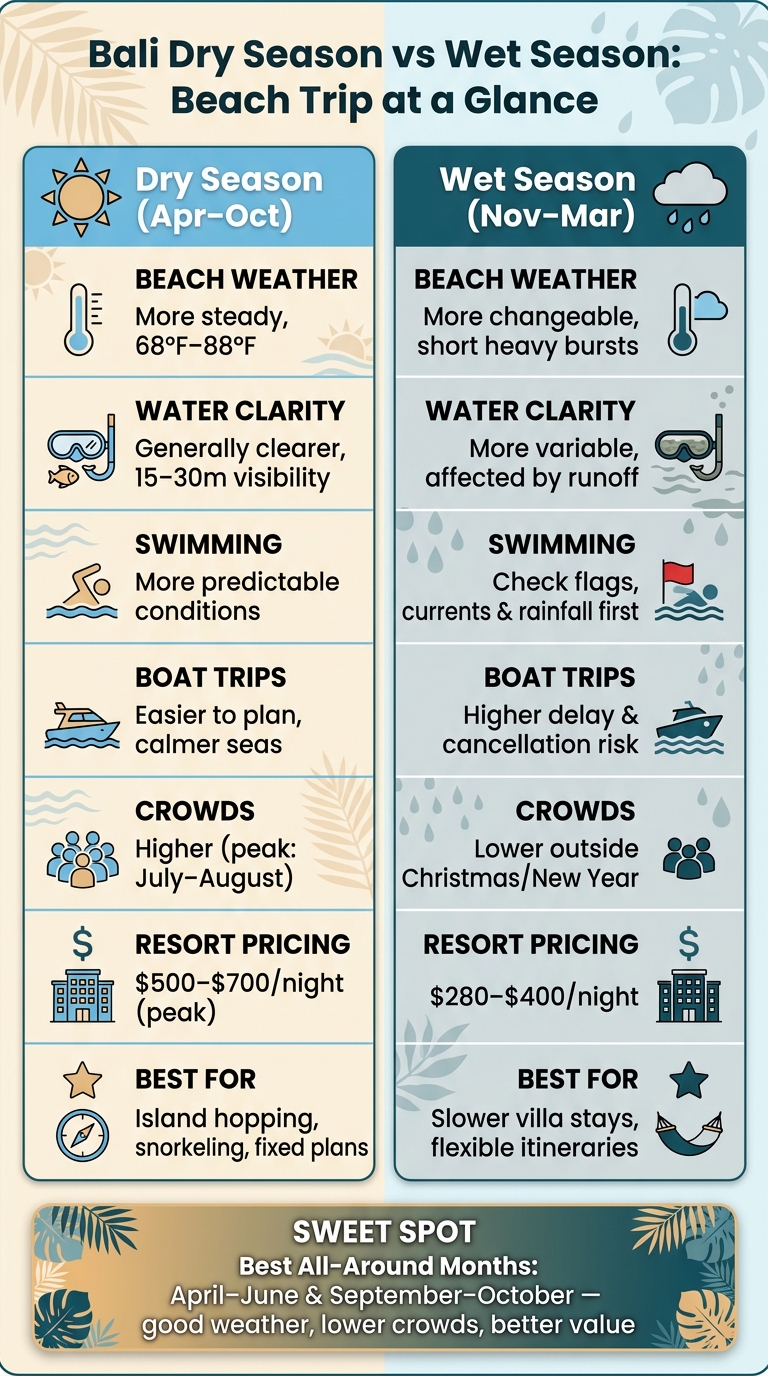
Bali Dry Season vs Wet Season: Beach Trip Comparison
When to Visit Bali 🇮🇩 | Best Month to Visit Indonesia Wet vs Dry Season
sbb-itb-6675d37
Quick Comparison
| Factor | Dry Season (Apr–Oct) | Wet Season (Nov–Mar) |
|---|---|---|
| Beach weather | More steady | More changeable |
| Water clarity | Usually better | More mixed, especially after heavy rain |
| Swimming | More predictable | Check rain, currents, and flags first |
| Boat trips | Easier to plan | More delay and cancellation risk |
| Crowds | Higher, especially July–August | Lower outside holiday weeks |
| Prices | Higher in peak months | Lower in many weeks |
| Best for | Fixed plans, island hopping, snorkeling | Slower resort stays, pool time, flexible plans |
My simple takeaway: choose dry season for a trip built around the beach and boat days. Choose wet season if I care more about space, price, and a slower resort stay and I’m fine changing plans when weather shifts.
That’s the lens I’d use for the rest of this guide.
Dry Season: Clearer Water and More Predictable Beach Days
Dry season usually means clearer water, firmer sand, and beach days that are easier to plan. One of the biggest upsides shows up right at the shoreline and during island transfers. Rain is less frequent, humidity is lower, and temperatures tend to sit between 68°F and 88°F, which makes outdoor plans feel far less like a gamble.
Sand, Shoreline, and Ocean Color
On Bali’s west and southwest coasts – Seminyak, Canggu, and Uluwatu – lower rainfall means less silt and debris washing into the surf zone. The result is often firmer sand and a better shot at clear blue water.
Still, those west-coast beaches are more exposed to the open ocean. That matters. Surf, chop, and wind can still stir up the water, even in dry season. If you’re after calmer swimming and an easier beach setup, Nusa Dua and Sanur on the southeast coast are the safer bet. They’re more sheltered, with gentler waves that work well for SUP boarding, easy wading, and polished resort-style beach days. Dry season improves your chances of good conditions, but it doesn’t promise them.
Boat Days, Crowds, and Resort Pricing
The same weather pattern tends to help on boat days too. Speedboat trips from Sanur to Nusa Penida and Nusa Lembongan are often smoother, and underwater visibility at spots like Manta Point and Crystal Bay can reach 15 to 30 meters. For many travelers, April through June hits a sweet spot: solid visibility without the heavier crowd levels that come later in the season.
Even then, wind and swell still matter, so it’s smart to check same-day marine conditions before heading out. Most operators suggest morning departures around 9 a.m. to noon, when the surface is often flatter and the water clearer before more boat traffic moves in.
Crowds and prices also change a lot across the dry season. July and August are the busiest months, with fuller beaches, tighter resort inventory, and higher nightly rates. Luxury villas in peak dry season can cost $500 to $700 per night, compared with about $280 to $400 per night in the wet season. If you want a better mix of weather, visibility, and room to breathe, June and September are often the strongest picks. You still get dry-season conditions, but with a bit less pressure on top-tier stays and day-to-day planning.
| Factor | Dry Season Advantage | Trade-off |
|---|---|---|
| Weather reliability | More sunny, predictable beach days | Short showers can still happen |
| Water clarity | Higher snorkeling visibility (15–30 m) | Varies by site, tide, and swell |
| Crowd levels | Easier beach days and outdoor planning | July and August are busiest |
| Resort availability | Better odds of polished resort stays and island transfers | Top rooms sell out earlier |
| Pricing | Better value in shoulder months like June and September | Peak months are much pricier |
| Logistics | More reliable for boat days and multi-stop itineraries | Same-day marine checks are still required |
Wet Season: Quieter Resorts and More Flexible Luxury
If dry season is about consistency, wet season is about flexibility. In Bali, that usually means planning with a bit more room to move. Rain often comes in short, heavy bursts, so mornings can still be good for beach time, pool hours, and open-air dining. That said, beach conditions are less predictable than they are in dry season, and some days just won’t play along.
Runoff, Water Clarity, and Swimming Conditions
A quick shower over the ocean will often cloud visibility for only a short time. The bigger issue is runoff after heavy inland rain. That runoff can make nearshore water look murky, especially near river mouths and drain outlets.
You can still swim in Bali year-round, but wet season calls for a little more care. Check beach flags, surf, currents, tides, and recent rainfall before getting in the water. If there’s been intense rain, it’s smart to wait for conditions to calm down before swimming near river outlets or anywhere the water looks visibly discolored.
This is where a resort with a well-kept pool earns its keep. If the sea isn’t a good option for a few hours – or even a full day – you still have somewhere pleasant to spend time. So in wet season, resort location and backup plans matter more than the calendar itself.
Atmosphere, Value, and Itinerary Design
Outside the Christmas and New Year period, wet season often brings quieter beaches and lower demand across much of Bali. For travelers who like a calmer feel, that’s a big plus. It can also mean better access to the room types people usually want most, including villas, private-pool suites, spa bookings, and prime poolside spots.
Pricing also tends to shift. Indicative luxury-villa rates in wet season are roughly $280–$400 per night, compared with $500–$700 per night in peak July and August – a directional gap of about 25%–35%. Actual pricing still depends on the property, travel dates, and what remains available. But the bigger win isn’t only the nightly rate. It’s often the extra room to choose better categories, ask for inclusions, and find cancellation terms that are easier to work with.
For itinerary design, the main move is simple: build in buffer time. Boat trips to Nusa Penida, Nusa Lembongan, or the Gili Islands face a higher chance of rough seas, harbor limits, delays, and cancellations during wet season. It’s better not to stack non-refundable offshore trips on back-to-back days. And don’t put one right before an international flight.
When weather changes the plan, a strong resort base can make the whole trip feel much smoother. Covered dining, a spa, flexible programming, and indoor-outdoor living spaces all help. Jo Vacations can coordinate transfers, reconfirm conditions, and adjust activities when the weather shifts.
Dry Season vs. Wet Season: Side-by-Side Beach Comparison
Season Comparison Table
| Criterion | Dry Season (Apr–Oct) | Wet Season (Nov–Mar) |
|---|---|---|
| Typical planning window | April–October; April, May, and October are transition months | November–March; December and January carry holiday demand |
| Rainfall pattern | Lower rainfall risk; showers are less frequent overall | Higher rainfall risk; short, heavy tropical showers are more common, especially from December through March |
| Humidity | Lower, though Bali stays humid year-round | Higher and more noticeable; commonly around 80%–85% |
| Sand and runoff risk | Lower; beaches generally look cleaner after dry spells | Higher near river mouths after storms; debris and discoloration are more likely |
| Ocean clarity | Generally clearer; calmer conditions support better visibility | More variable; runoff can cloud nearshore water for a day or two after heavy rain |
| Swimming predictability | More predictable overall; waves are more manageable on more days | More variable; check flags, currents, and recent rainfall before entering |
| Snorkeling and diving visibility | Usually stronger, especially from May through September | More variable; offshore sites may stay clearer than nearshore beaches |
| Boat-transfer planning | Easier; calmer seas make crossings more reliable | More flexibility needed; choppier seas can cause delays or cancellations |
| Crowds | Higher; July and August are the busiest months | Lower outside the Christmas and New Year period |
| Resort pricing pressure | Stronger; July and August can run 30%–60% above baseline | Generally lower outside holidays, with quieter months often offering better value |
| Best beach regions to consider | Seminyak, Canggu, and Uluwatu for beach clubs and sunsets; Padang Bai, Amed, Menjangan, and Nusa Penida for clearer-water snorkeling or diving when conditions cooperate | Sheltered or more flexible bases such as Amed and Tulamben when runoff affects southern beaches |
| Ideal itinerary style | Fixed resort-to-island itineraries with private transfers, boat excursions, snorkeling, diving, and beach club days | Slower, flexible luxury: spa time, villas, dining, cultural experiences, and weather-adjustable day trips |
| Main trade-off | Higher demand, busier beaches, and stronger pricing pressure in peak months | Less predictable beach quality, visibility, swimming, and boat logistics |
Note: Beach quality, currents, tides, runoff, water clarity, and marine conditions vary by date and location, so travelers should confirm local conditions before swimming or committing to boat and diving plans.
Best Months Within Each Season
April and May sit in the transition period. Beach conditions often start to improve as the dry season settles in, but you can still run into humidity and the odd shower. If you want better pricing without giving up too much weather stability, these months make sense.
June through August is the strongest stretch for weather consistency and water-based trips. You’re more likely to get clearer water, calmer seas, and smoother boat crossings. The catch is simple: July and August are the busiest and most expensive months, and international arrivals peak in July. If you’re set on this window, book hotels and boat services early.
September stands out for a reason. It can keep much of the dry-season dependability while easing some of the crowding and price pressure that comes with July and August. For travelers who want solid beach time without peak-season intensity, September is a smart choice.
October is another transition month. Beach days can still be good, but rainfall risk starts to move up. A loose schedule helps.
November through March brings more humidity and more day-to-day change, though resort demand usually drops outside the holiday stretch. January and February are often the wettest months and carry the highest runoff risk. Even so, this part of the year can work well for travelers who want quieter resorts and lower rates, as long as the itinerary leaves room for weather changes.
Which Season Works Best for a Resort-to-Island Itinerary?
Best Season by Travel Priority
Pick your season based on how you want the trip to work, not just the month on the calendar.
For most resort-to-island itineraries, dry season is the safer default. That matters even more if your plan includes island crossings, fixed flights, or full outdoor days with little room for delays.
| Travel priority | Better season | Why it matters |
|---|---|---|
| Clearer water and snorkeling | Dry season | Less rainfall generally means less runoff and better visibility near shore |
| Quiet beaches and a more private resort atmosphere | Wet season | Demand is typically lower outside the Christmas and New Year period, with more room to choose preferred room categories and villa types |
| Fixed-date international flights | Dry season | Fewer weather variables affecting road, boat, and outdoor timing |
| Nusa Penida or Nusa Lembongan island hopping | Dry season | Calmer seas make crossings easier to schedule |
| Outdoor-heavy daily schedule | Dry season | Beach clubs, private boat days, and open-air dining are easier to keep on plan |
| Best balance of weather and value | April–June or September–October | These shoulder months avoid the busiest stretch while keeping conditions favorable |
Here’s the simple way to think about it:
- Choose dry season if your dates are fixed and island crossings are a big part of the plan.
- Choose wet season if you want a slower villa stay, flexible beach time, and enough buffer for transfers.
A smart trip flow also helps. Put the island stay in the middle of the trip and finish in Bali before departure. That gives you more breathing room if sea conditions change and helps you avoid depending on a last-minute boat connection to catch your flight.
How Jo Vacations Can Reduce Planning Friction
Once you’ve picked the season, the next step is lining up stays, transfers, and backup plans without turning the trip into a puzzle.
That’s where Jo Vacations steps in across both seasons.
For dry-season trips, Jo Vacations secures handpicked five-star resorts and private villas during high-demand windows, arranges private airport transfers, and maps out realistic timing between your Bali base, the Sanur departure port, and your island accommodation. In other words, the team plans the full transfer sequence, not just the boat.
For wet-season trips, the 24/7 concierge support matters even more. If rain pushes dinner indoors or a boat runs late, the team can reshuffle plans. Jo Vacations can also curate private beach, wellness, dining, and cultural experiences that still work well when the weather shifts. That kind of flexibility is what helps a wet-season luxury itinerary run smoothly.
FAQs
Which Bali coast is best for swimming?
It depends on the season. From May to September, west coast areas like Canggu and Uluwatu are ideal for beach days. From November to March, east coast spots like Sanur and Keramas are usually the better pick.
Jo Vacations can help tailor your itinerary around your travel dates, so you’re on the right coast at the right time, with smooth logistics for a stress-free island stay.
How many buffer days do I need in wet season?
Plan for about 2 buffer days during Bali’s wet season (November–March) so weather hiccups don’t throw off your trip, especially when you’re moving between a resort and the islands.
That extra cushion can also help protect your beach time on the west coast and shore activities on the east coast. Rain can change conditions from one day to the next, and that tends to happen more often in wetter months like January.
Is September the best month for Bali beaches?
Yes, September is a great time for a Bali beach holiday. It falls in the dry season, which usually means sunny days, lower humidity, and very little rain.
Many travelers see it as one of the best months to visit. You get warm tropical weather without the peak-season crowds of summer, so beach days and time around the island tend to feel more relaxed and easier to enjoy.