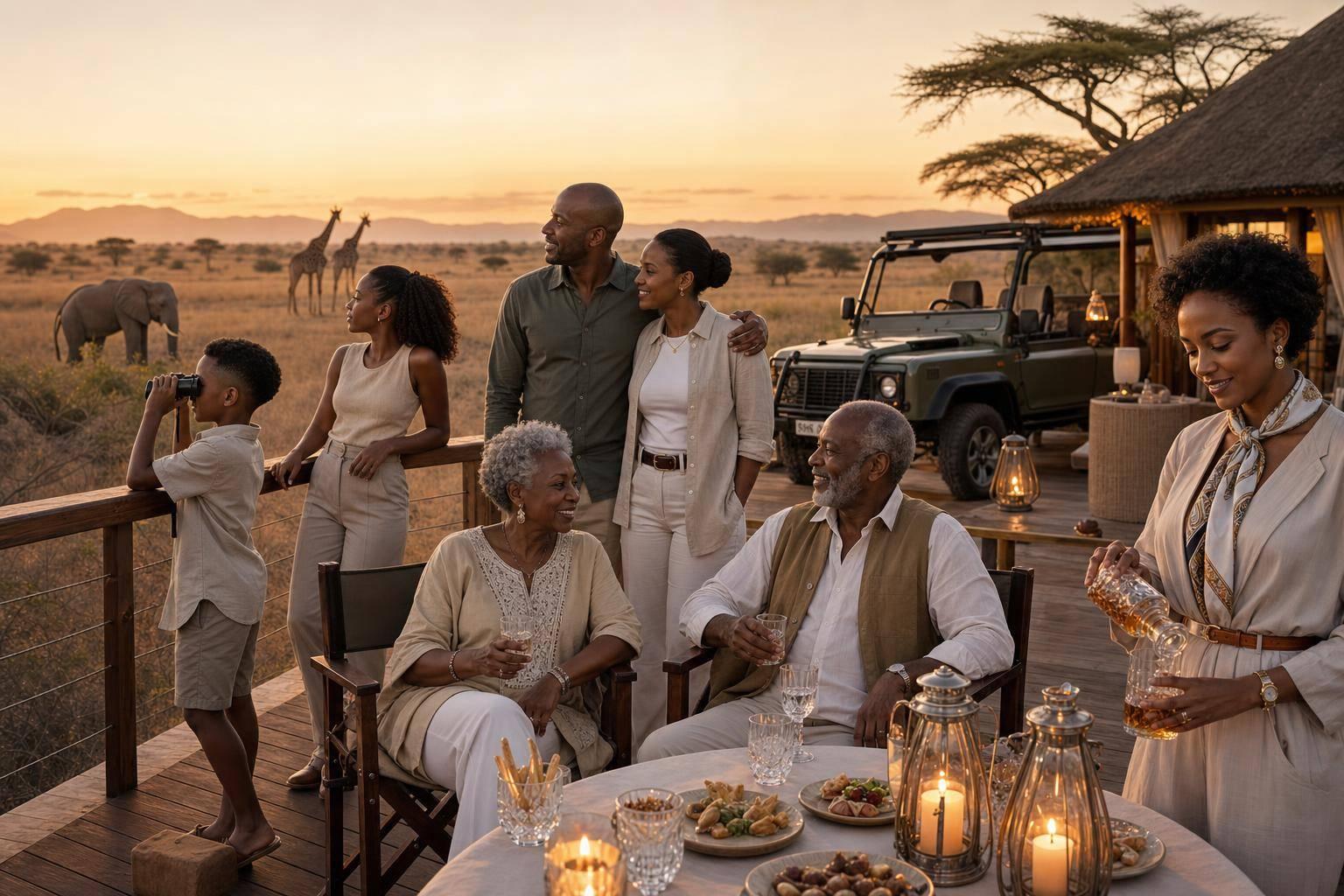
A family safari works best when I plan it around pace, safety, and transfer time first – not just wildlife. If grandparents, parents, teens, and young kids are all traveling together, the trip usually goes better with private game drives, 2–3 nights per stop, fewer long road transfers, and lodges that fit the group’s room and mobility needs.
Here’s the short version:
- I’d pick the trip around the slowest traveler’s comfort level
- I’d cut down fatigue with 1–2 nights in Nairobi or Johannesburg before the safari
- I’d favor private vehicles over shared drives for more control each day
- I’d look at malaria-free South Africa for toddlers or older travelers
- I’d check age limits, lodge layout, and walking distances before booking
- I’d plan for 12–18 months ahead, since family suites and villas sell out early
- I’d expect luxury private trips to often land around $10,000–$17,000+ per person for 11–14 days, while standard group trips are often $2,000–$5,000 per person
If I were choosing between regions, I’d keep it simple: East Africa is often better for classic savanna wildlife and older kids, while South Africa is often easier for mixed-age groups, shorter transfer stress, and malaria-free options.
Quick Comparison
| Option | Best for | Main tradeoff | Typical trip length | Approx. luxury budget per person |
|---|---|---|---|---|
| East Africa (Kenya/Tanzania) | Families with older kids or teens | Malaria precautions are often needed | 10–14 days | $12,000–$25,000+ |
| South Africa | Families with toddlers, grandparents, or first-time safari travelers | Wildlife style is less migration-focused | 10–15 days | $10,000–$18,000+ |
| Private custom safari | Families who need control over pace and room setup | Higher cost | 11–14 days | $10,000–$17,000+ |
| Standard group safari | Travelers focused on lower price | Fixed timing, shared vehicles, less privacy | Varies | $2,000–$5,000 |
The main idea is simple: the best multi-generational safari is not the one with the most stops. It’s the one that keeps the whole family comfortable enough to enjoy the trip.
The Most Common Problems Families Face When Planning a Safari
These planning problems usually fall into three buckets: pace, transfers, and safety.
Managing Different Energy Levels, Interests, and Mobility Needs
Many safaris begin before sunrise and include long morning game drives. That can wear out young kids fast and leave teens bored or annoyed.
The gap shows up in activities too. Grandparents may lean toward low-impact options like birdwatching or a cultural talk, while teens often want something more active, such as a walking trail or a mountain bike ride. If the itinerary only includes game drives, someone usually ends up doing something they didn’t want to do.
In most family groups, the pace gets set by the slowest traveler. That’s why rigid schedules tend to fall apart fast.
Once pace becomes a problem, transfers usually become the next one.
Travel Fatigue from Long Transfers and Too Many Stops
Families often need more downtime than they expect after long-haul flights. It helps to use the first day for recovery and acclimation.
Then come the internal transfers. Road trips between parks and reserves can last 6 hours or more on rough, dusty tracks. That’s tiring for older travelers and tough for kids who don’t want to sit still that long. Too many one-night stays make it worse because the family is always unpacking, repacking, and moving on before anyone settles in.
That’s why the setup of the lodge and its safety rules matter just as much as the route.
Health, Safety, and Accommodation Concerns
Malaria is one of the first things families worry about. Antimalarial medications can cause side effects in young children and some seniors, so malaria-free reserves like Madikwe or the Eastern Cape in South Africa are often a better fit for families with toddlers or older travelers.
Accommodation layout matters too. Some lodges require guests to walk more than half a mile on uneven, sandy paths just to get from their room to the dining area. Add stairs or rough ground, and even simple daily movement can become a hassle for anyone with limited mobility.
For families with young children, unfenced camps in high-wildlife areas like the Okavango Delta call for constant supervision, which makes it hard for parents to switch off. Fenced lodges or private villas with shared living space can make the stay much easier to supervise and move around in. Room setup matters as well. Interconnecting rooms or a private villa can help keep the group together without squeezing everyone into one room.
There’s one more catch: many lodges set minimum ages for game drives or walking safaris, which can leave younger children out.
How a Tailored Safari Itinerary Addresses These Problems
A tailored itinerary solves the pace, transfer, and safety problems by fitting the trip to your family. Every choice – destination, lodge, and logistics – should reflect your family’s ages, mobility, and travel style.
Matching the Right Destination to Your Family’s Needs
Destination choice comes first, and it shapes almost everything that follows.
South Africa works well for first-time family safaris and malaria-free travel. Reserves like Madikwe and the Eastern Cape can lower health worries for toddlers and older travelers. Kenya is a strong fit for families who want classic savanna wildlife plus direct access to Maasai experiences through private conservancies near the Maasai Mara. Tanzania often makes sense for larger groups that need private-use camps, with exclusive-use options that can comfortably host 6 to 10 guests across places like the Serengeti and Ngorongoro Crater.
Get the destination right first. After that, lodge layout and transfer time have a huge effect on how smooth the trip feels.
Choosing Lodges That Work for Three Generations
Not every luxury lodge fits a three-generation family well. A five-star label doesn’t tell you how easy the place is to move through day to day.
A custom plan should focus on details that make life easier: ground-floor rooms, short walks to dining areas, and as little extra walking as possible for guests with limited mobility. For families with young kids, fenced camps can make a big difference. Children have more room to move around, and adults don’t need to stay on constant high alert.
For bigger family groups, private villas or exclusive-use camps are often the simplest choice. These usually sleep 6 to 10 guests and may come with a private chef, dedicated staff, interconnecting rooms, and a private pool. High-end lodge rooms often cost $1,000 to $2,500+ per person, per night, while private villas or exclusive-use camps often fall in the $6,000 to $15,000+ per night range.
It also helps to look for lodges with Junior Ranger programs. These lodge-run activities – animal tracking, bush crafts, and guided nature walks scaled for younger children – keep kids engaged in a structured way while adults head out for longer game drives or spend time at the spa.
Once the right lodge is in place, the next job is protecting everyone’s energy.
Private Logistics and Smarter Trip Pacing
After lodging, pacing becomes the main factor.
A private vehicle is often the upgrade that changes the trip the most for a family group. It gives everyone more control. Photographers can leave at dawn, while others sleep in. And if a child or grandparent reaches their limit, the group can head back right away – no waiting on a shared vehicle and no trying to line up with strangers’ plans.
If long road transfers can’t be avoided, bush flights are often the better move. Swapping a 6-hour drive on rough, dusty tracks for a 45-minute scenic flight saves energy for the people who need it most.
It also helps to build in a 2- to 3-night stopover in a gateway city like Nairobi or Johannesburg before the safari starts. That pause gives everyone time to recover from a long-haul flight. Then, staying 2 to 3 nights at each camp cuts down on the constant packing and unpacking that can wear families out fast.
Midday rest windows matter more than many families expect. Time for swimming, napping, or doing absolutely nothing should be part of the plan from the start, not squeezed in later. The smartest itineraries work around the slowest traveler, whether that’s a toddler who still naps or a grandparent who can only handle 2 to 3 hours in a vehicle at one time. When the pace is realistic, the whole group has a better day.
Sample Safari Structures for Multi-Generational Families
These two sample itineraries show what tailored safari planning looks like in real life. Same big goal, very different trip feel. Change the route, pace, or lodge style, and the whole experience shifts.
Kenya Safari Plus Coast: Wildlife and Recovery Time Combined
A well-paced Kenya itinerary often looks like this: 2 nights in Nairobi to get over jet lag, 4 nights in the Masai Mara for the main wildlife stretch, 3 nights in Laikipia or the Matthews Range for walking-led activities and cultural experiences, and 4 nights at Diani Beach or Zanzibar for a slower finish.
Price-wise, Kenya packages start at about $3,050 per person for 7 days, while 14-day private trips can reach $17,000+ per person.
This setup tends to work best for families who want the safari to come first, then some space to slow down. It has a nice rhythm: big game viewing up front, then lighter days by the end.
South Africa Safari: Simpler Logistics and Malaria-Free Options
South Africa is often the easier pick for families traveling with toddlers, grandparents, or anyone who wants to keep malaria planning simpler. A common structure runs 10 to 12 days and starts with 4 nights in Cape Town for food and city time before heading into the bush. From there, families often spend 4 nights in a private malaria-free reserve such as Madikwe or Kwandwe, then add a 3-night extension in the Winelands or along the Garden Route.
South Africa packages start at about $3,250 per person for 8 days, and 14-day multi-generational itineraries usually range from $13,000+ per person.
This route works best when smooth travel matters just as much as the safari itself. Fewer moving parts can make a big difference, especially when you’re coordinating several ages at once.
East Africa vs. South Africa: Side-by-Side Comparison for Families
Use this table to narrow down the region, then line up trip length, season, and privacy level with your budget.
| Feature | East Africa (Kenya/Tanzania) | South Africa |
|---|---|---|
| Wildlife Focus | Great Migration, vast savannas, high predator density | Big Five, private reserves, rhino conservation, marine life |
| U.S. Air Connections | Typically 1–2 stops via Europe or the Middle East | Long-haul but often more direct to Johannesburg or Cape Town |
| Malaria Considerations | Malaria precautions are generally needed year-round | Malaria-free options available (Madikwe, Eastern Cape) |
| Activity Mix | Primarily game drives, with some walking and cultural safaris | Highly flexible: city tours, wine tasting, coastal activities, game drives |
| Best For | Families with older children or teens | All ages; especially strong for toddlers and seniors |
| Typical Trip Length | 10–14 days | 10–15 days |
| Approx. Luxury Budget per Person (USD) | $12,000–$25,000+ | $10,000–$18,000+ |
Once the region is set, the next job is figuring out a budget and timeline that fit the trip you want.
sbb-itb-6675d37
Setting a Realistic Budget and Timeline for a Family Safari
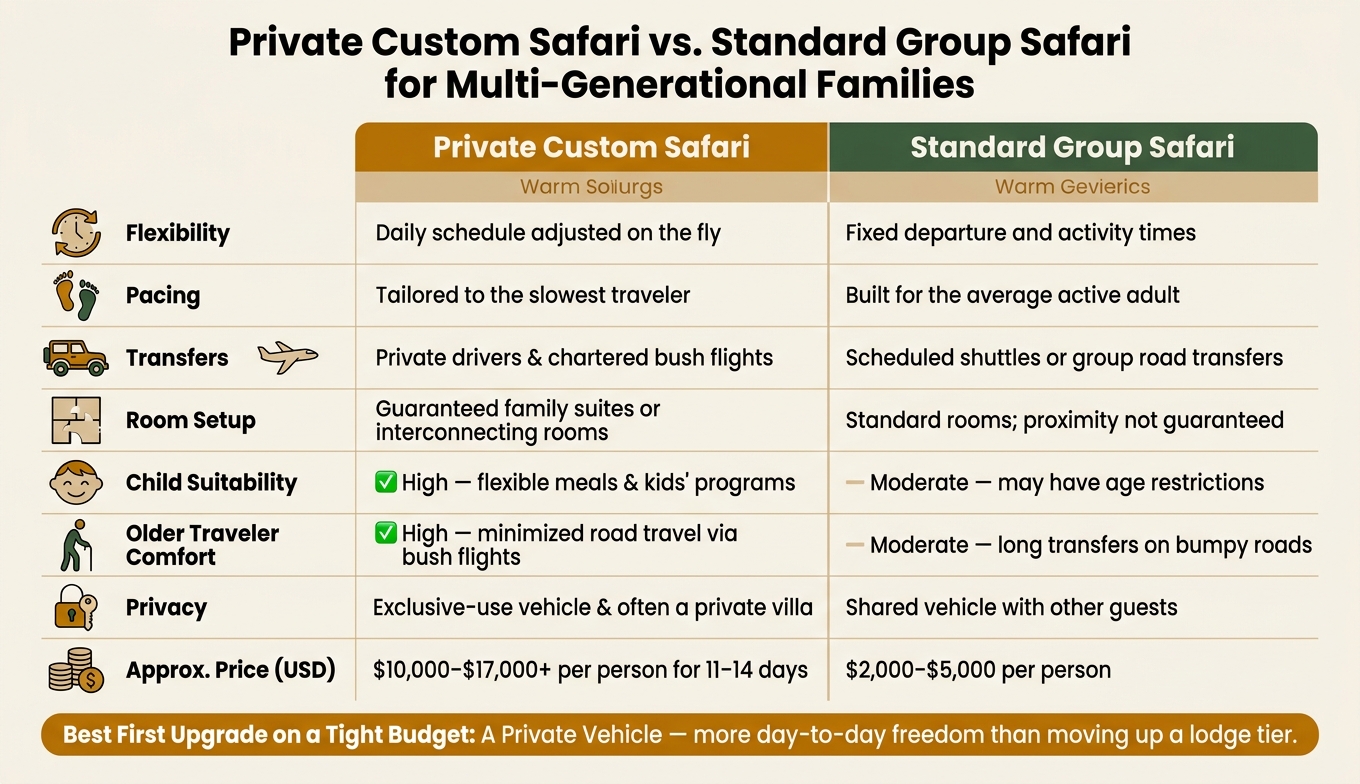
Private vs. Group Safari: Multi-Generational Family Cost & Feature Comparison
Once you’ve picked the region, budget and timing tend to narrow your choices FAST. They affect almost everything else: the lodge level, the kind of room you can book, how you get between camps, and whether the dates that fit your family are even open.
The Main Cost Drivers for a Family Safari
The biggest expenses usually come down to private transport, room setup, and peak-season travel dates. Bush flights cut down travel time, but they also push the price up. Private vehicles cost more too, but they give families much more control over the day.
Room layout matters more than many people expect. Family suites and private villas are often in short supply, so they can cost more and sell out early. Peak season pushes rates higher across the board, especially from June through October and again in late December.
When to Book Around Peak Season and School Breaks
For multi-generational trips, planning early matters just as much as picking the right place. Families should start planning 12–18 months in advance so they can line up school breaks, family schedules, and different mobility needs.
That longer booking window matters even more if you need a certain room setup, like:
- Interconnecting rooms
- An exclusive-use villa
Those options are limited, and they don’t sit around for long.
Shoulder seasons, such as October through March – with late December left out – can bring lower prices. The tradeoff is that you may run into hotter weather or shorter afternoon game drives. If your family has some wiggle room around the school calendar, those dates are well worth a look.
Private Custom Safari vs. Standard Group Safari: Side-by-Side Comparison
The price gap between a private safari and a group safari is real. So is the gap in what you get, especially if you’re planning for young kids, teens, and grandparents who don’t all move at the same speed. In plain English: the choice is less about luxury and more about control.
| Feature | Private Custom Safari | Standard Group Safari |
|---|---|---|
| Flexibility | Daily schedule adjusted on the fly | Fixed departure and activity times |
| Pacing | Tailored to the slowest traveler | Built for the average active adult |
| Transfers | Private drivers and chartered bush flights | Scheduled shuttles or group road transfers |
| Room Setup | Guaranteed family suites or interconnecting rooms | Standard rooms; proximity not guaranteed |
| Child Suitability | High; flexible meals and specialized kids’ programs | Moderate; may have age restrictions |
| Older Traveler Comfort | High; minimized road travel via bush flights | Moderate; long transfers on bumpy roads |
| Privacy | Exclusive-use vehicle and often a private villa | Shared vehicle with other guests |
| Approx. Price (USD) | $10,000–$17,000+ per person for 11–14 days | $2,000–$5,000 per person |
These tradeoffs often decide whether the trip feels smooth or draining. If your budget is tight, the smartest first upgrade is usually a private vehicle. It gives you more day-to-day freedom than moving up to a higher lodge tier.
With budget and timing in place, the next step is figuring out how much pace, privacy, and support your family needs.
Questions to Answer Before You Book a Family Safari
After budget and destination, the next move is to match the trip to the slowest traveler. Three things shape almost every choice from there: pace, activity fit, and privacy.
Start with the Traveler Who Needs the Slowest Pace
Start with the person who will need the gentlest rhythm. That might be the family member with the lowest stamina, or the one with the most mobility needs. Build the plan around that person first.
That baseline should guide the whole day: drive times, activity length, and how easy it is to get around the lodge. A simple rule helps here – plan around the shortest comfortable drive time, not the longest one the group might be able to push through.
Identify What Each Generation Wants Most from the Trip
Once the pace is clear, the next step is simpler: figure out what each person wants most from the trip.
Young kids often do best with hands-on activities that don’t drag on too long. Think Junior Ranger programs, animal tracking, and time in the pool. Teens usually lean toward more active outings, like walking safaris, mountain biking, or photography-focused game drives. Grandparents often prefer a slower flow, with birdwatching, a conservation talk from a resident conservationist, and a comfortable sundowner spot that doesn’t require much walking.
Use this table to line up age groups with activities and lodge needs:
| Generation | What They Usually Want Most | Key Logistical Need |
|---|---|---|
| Young Kids | Junior Ranger programs, pools, short drives | Fenced camps, flexible meal times |
| Teens | Walking safaris, biking, photography | More active outings, some independence |
| Parents | Private time, managed logistics, spa | Interconnecting rooms, child-care support |
| Grandparents | Birdwatching, conservation talks, slow drives | Ground-floor rooms, midday rest, accessible paths |
Decide How Much Privacy and On-the-Ground Support You Need
Then comes the practical part: how much private space and trip support does your family need?
For a multi-generational group, a private vehicle is often the upgrade that changes everything. It gives photographers the option to head out at dawn while everyone else sleeps a bit longer. It also makes it much easier to turn back early if a child suddenly runs out of steam.
From there, think about the room setup. Some families need a private villa with a shared lounge and private pool. Others are fine with interconnecting standard rooms. The right choice usually comes down to how much togetherness you want, and how much space people need when they want a break.
Food and medical needs matter too. If your group has dietary restrictions, refrigerated medications, or a mix of picky eaters and adventurous eaters, tell the lodge staff weeks before arrival. That kind of heads-up can make the stay go much more smoothly.
Jo Vacations can handle private transfers, lodge coordination, and on-the-ground support. Before you confirm the booking, list out every transfer, room need, and dietary request.
Conclusion: What a Well-Planned Family Safari Actually Looks Like
A well-planned family safari deals with the big planning snags up front: pace, transfers, lodging, and on-the-ground support.
You feel the difference most in the day-to-day rhythm. Long road transfers can wear everyone out fast. A 45-minute bush flight, on the other hand, often saves enough energy for an afternoon game drive.
The best itineraries aren’t built around packing in as much as possible. They’re built around real downtime. That means wake-up times with some wiggle room, meals that suit everyone, and lodge setups that work for families with different needs. Think ground-floor rooms, shorter walks to dining areas, and fenced camps that help keep toddlers safe. It also means picking a safari style that lets each generation do its own thing during the day, then come back together for shared meals.
That’s the kind of planning that makes a trip feel smooth instead of stressful. Jo Vacations plans tailor-made multi-generational safaris with handpicked stays, private transfers, and 24/7 support. If you’re ready to plan one, contact Jo Vacations.
FAQs
Which safari destination is easiest for mixed-age families?
For mixed-age families, the easiest safari trips usually come down to three things: flexibility, private reserves, and lots to do without constant moving around. That’s why places like South Africa, Kenya, and Botswana come up so often.
Kenya is a common pick because it blends classic safari country with time by the coast. You can pair places like the Maasai Mara with a beach stay, which makes the trip feel easier for everyone. And if you book an exclusive-use lodge or private villa, your family can move at its own pace instead of following someone else’s schedule.
How can we make a safari easier for grandparents and toddlers?
Jo Vacations makes safaris easier for grandparents and toddlers by building a private, flexible trip around each generation’s pace and comfort. With a private vehicle and exclusive-use lodges, families can take shorter game drives, pause for midday rest, and head back to camp whenever they need to.
They also pick family-friendly places to stay with accessible room layouts and safe settings. The trip mixes shared activities with slower options and built-in downtime, so everyone can enjoy the safari without feeling worn out.
What should we book first for a family safari?
Book the accommodation first. For a multi-generational family safari, exclusive-use villas, private safari houses, or interconnected family suites give your group the space, privacy, and flexible dining setup that makes the trip feel easy from day one.
Once that’s locked in, add private vehicles and guides so your family can set the pace each day. Jo Vacations can tailor those details to fit your family’s needs.