
Planning a multi-country trip can be overwhelming, but it doesn’t have to be. Here’s the gist: focus on efficient routes, manageable itineraries, and smart budgeting. Whether you’re dreaming of a culinary tour through Italy, France, and Spain or a mix of history and nature in Greece and Egypt, the key is to prioritize quality over quantity. Limit your itinerary to three countries in 10 days or up to six for a month-long trip to avoid burnout. Use high-speed trains for short distances and open-jaw flights for longer routes.
Quick Tips:
- Choose destinations based on proximity and interests. Example: Japan and Thailand for food lovers or Switzerland and Austria for mountain views.
- Plan your budget: Allocate funds for what matters most – splurge on experiences or business-class flights while saving on accommodations.
- Balance activity and rest: Include downtime like spa sessions or coastal retreats after busy city days.
- Prepare travel documents early: Check passport validity, visas, and digital authorizations like ETIAS for Europe.
- Work with experts: Travel specialists can help streamline logistics, secure perks, and provide 24/7 support.
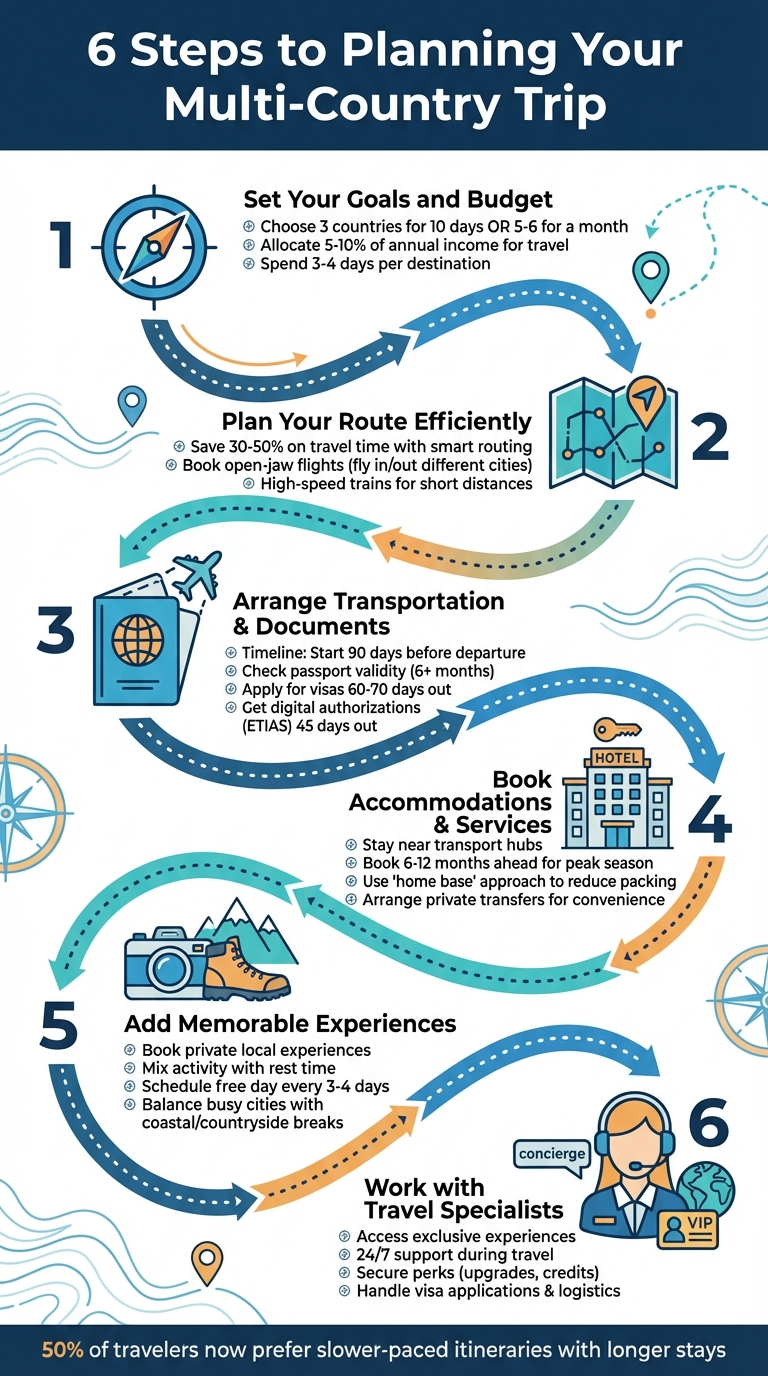
6-Step Multi-Country Trip Planning Process
Step 1: Set Your Goals and Budget
Choose Your Destinations
Start by defining your travel goals. Are you drawn to ancient history and iconic landmarks? A trip combining Greece and Egypt lets you marvel at the Acropolis and the Pyramids in one adventure. If food is your passion, Japan and Thailand offer a perfect blend of refined dining and vibrant street food markets. Whether your interests lie in art, outdoor adventures, or breathtaking mountain landscapes, let them guide your destination choices.
Consider geographic proximity alongside your interests. Choosing neighboring countries can save you transit time and allow for a more immersive experience. For food enthusiasts, Italy, France, and Spain create an ideal Mediterranean circuit. Meanwhile, mountain lovers might prefer exploring Switzerland, Austria, and Germany. Keep your itinerary manageable – spend three to four days in each destination to avoid travel burnout and truly connect with the local vibe.
Once you’ve picked your destinations, align your spending with what matters most to you.
Set a Practical Budget
After deciding where you want to go, craft a budget that reflects your priorities. Luxury travel doesn’t have to break the bank. Focus your spending on experiences that matter most to you. For instance, you might splurge on lie-flat business class seats while opting for high-quality yet less extravagant accommodations. Financial expert Gloria Park, CFP®, advises setting aside 5–10% of your annual income for travel, treating it like any other major financial goal.
Costs can vary significantly depending on your destination. For example, you can enjoy luxury at Bangkok’s Sheraton Grande Sukhumvit for under $200 per night, but a similar experience in Zurich will likely cost much more. A 12-day luxury tour in Vietnam and Laos starts at around $5,240 per person, while a South African excursion, including Victoria Falls, can climb to $14,310. Timing is also crucial – traveling during Europe’s shoulder season, like October, can cut luxury hotel rates by up to 50%. To fund your trip, consider automating monthly savings into a dedicated account and using tools like high-yield savings accounts or short-term bonds to grow your travel fund.
"Luxury travel is often split and judged by 5 Cs, all of which are integral to making the best stays. Culture, Cuisine, Community, Content, and Customization should all be at the heart of your luxe experience." – Blacklane
Break your budget into clear categories – flights, local transportation, accommodations, dining, and activities – and track everything in a master spreadsheet. This approach helps you see where you can cut costs and where to invest in experiences that will make your trip unforgettable.
sbb-itb-6675d37
Step 2: Plan Your Route Efficiently
Map Out Smart Travel Routes
The order of your destinations can make or break your travel experience. A carefully planned route can reduce both travel time and expenses by as much as 30–50%. For example, if you’re traveling through France, Germany, and Austria, it’s more efficient to visit Germany in between France and Austria, rather than zigzagging back and forth.
There are two popular strategies for planning multi-country trips. A straight-line route involves traveling in one direction, such as Paris to Provence, then on to Barcelona and Madrid, which eliminates unnecessary backtracking. Alternatively, a loop route works well if you’re flying in and out of the same city. For instance, starting in Lisbon, you could loop through Madrid, Barcelona, and Nice before returning to Lisbon.
"Choose countries that are geographically close to minimize travel time." – Juniper Tours
Another way to streamline your journey is by booking open-jaw flights. These multi-city tickets let you fly into one city and out of another, saving you a full day of travel. For example, instead of a round-trip to Rome, you could fly into Rome and out of Athens if you’re exploring Italy and Greece.
For those seeking comfort and convenience, efficient routing is key. Luxury travelers can maximize exclusive experiences, while budget-conscious travelers can rely on high-speed trains. For example, the Frecciarossa connects Milan to Rome in just 2 hours and 50 minutes, and a direct EuroCity train from Bern to Milan takes about 3 hours and 30 minutes. For a deeper connection to the area, consider the "home base" approach. This involves staying in a central city – like Kyoto or Tulum – and taking day trips to nearby attractions, which reduces the hassle of constant packing and unpacking.
Once your route is planned, the next step is figuring out how to divide your time between destinations.
Divide Time Between Destinations
The key to a smooth trip is not cramming too much into your itinerary. Stick to visiting no more than three countries in 10 days. For a two-week trip, aim for three to four countries, and for a month-long journey, five to six destinations is a good balance. Major capitals like Paris, London, and Rome deserve at least three full days, especially if you plan to include day trips or explore specific neighborhoods.
Keep in mind that every city transfer eats up at least half a day. Between packing, checking out, traveling to transportation hubs, and settling into new accommodations, you’ll lose valuable time. For large cities like Tokyo or New York, consider adding an extra day to explore unique districts or indulge in specialized activities like food tours, art galleries, or nightlife.
To avoid burnout, balance busy city stays with relaxing breaks in quieter coastal or countryside locations. For instance, after five days of exploring Rome’s historical landmarks, unwind with three days on the Amalfi Coast. Scheduling a free day every three to four days of travel allows for rest, flexibility, and unexpected discoveries.
Recent surveys show that about 50% of travelers now prefer slower-paced itineraries with longer stays. This approach not only reduces stress but also creates opportunities for more meaningful experiences. By thoughtfully dividing your time, you’ll craft an itinerary that feels both enriching and refreshingly stress-free.
Step 3: Arrange Transportation and Travel Documents
Select Transportation Options
High-speed trains are a fantastic way to travel between nearby cities. They connect city centers directly, cutting out long transfers and tedious security checks. For instance, Eurostar links London and Paris, while Frecciarossa zips between Milan and Rome in under three hours.
When covering longer distances – like traveling from Western to Eastern Europe – flying is often the better choice. A train ride from Paris to Warsaw can take anywhere from 15 to 23 hours, but a flight gets you there in just over two hours. To save time and avoid unnecessary backtracking, consider booking open-jaw flights – fly into one city and leave from another.
Private car services are another great option if you want door-to-door convenience and the flexibility to make scenic stops along the way. For example, Jo Vacations offers chauffeured transfers, which are especially useful for regional routes like Rome to Florence, with a detour to explore San Gimignano.
"Every time you move you will lose a half to a full day to travel and its associated tasks (packing, getting to the station, waiting, finding your way to your new hotel, checking in, etc.)." – Rick Steves Travel Forum
For budget-conscious travelers, modern bus networks like FlixBus provide affordable alternatives. In 2024, FlixBus served over 90 million passengers across 400,000 routes spanning 40+ countries. Night trains are another solid option, letting you travel while saving on accommodation costs.
Once you’ve sorted out your transportation, it’s time to focus on your travel documents.
Prepare Visas and Travel Documents
Getting your travel documents in order ahead of time can save you from last-minute stress. Start by checking your passport’s expiration date – many countries require it to be valid for at least six months beyond your return date. Keep in mind that children’s passports (for those under 16) often expire after just five years.
Look into the entry requirements for each destination on your itinerary, including any layover countries. If your trip involves separate tickets that require you to re-check your luggage, you might need a transit visa. For trips spanning multiple countries, check whether you need single-entry or multiple-entry visas, as even brief side trips could require additional documentation.
New digital authorizations like ETIAS (for Europe) and the UK ETA are now mandatory for many travelers who previously didn’t need a visa. Within the Schengen Area, you can move freely across 29 countries, but your stay is limited to 90 days within any 180-day period. Overstaying could lead to fines or even travel bans.
"Border authorities will read your passport and visas before they look at your boarding pass, so every document in your wallet (digital or paper) must match the story your itinerary tells." – Loris Mazloum
Here’s a timeline to keep your preparations on track:
- 90 days before departure: Check your passport’s validity and ensure you have enough blank pages.
- 60–70 days before departure: Submit visa applications for countries with longer processing times.
- 45 days before departure: Apply for digital authorizations like ETIAS.
- 30 days before departure: Double-check transit visa requirements in case of flight changes.
- 7 days before departure: Save digital copies and print physical backups of all necessary documents.
Make sure all personal details – like middle names and special characters – match your passport exactly on flight bookings and visa applications. Even small discrepancies can lead to denied boarding or additional security checks. If you’re a U.S. citizen, consider enrolling in the Smart Traveler Enrollment Program (STEP) to receive safety updates and access embassy assistance during emergencies.
With transportation and travel documents squared away, you’re ready to move on to securing accommodations and other key services for your trip.
How to Plan a Multi-Stop Trip to Europe
Step 4: Book Quality Accommodations and Services
Once your transportation and travel documents are sorted, the next step is locking in top-notch accommodations and smooth transfers.
Choose Hotels Based on Location and Amenities
When picking hotels, prioritize locations close to major train stations or airports to avoid the hassle of navigating unfamiliar cities with luggage. Interactive maps can help confirm how close your hotel is to transport hubs.
Mixing stays between boutique hotels and countryside resorts can give you a balance of convenience and relaxation. For instance, in June 2025, a luxury Tokyo itinerary included the Keio Plaza Hotel, paired with dinner at Soujuan restaurant, famed for its seasonal Japanese dishes. Guests also enjoyed private chauffeur transfers from Narita Airport via Blacklane. Similarly, an October 2025 Paris itinerary featured Maison Souquet, a Montmartre gem with Belle Époque charm, complete with a 90-minute signature spa ritual and private transfers to the Jules Verne restaurant on the Eiffel Tower’s second floor for a Michelin-starred dining experience.
Instead of constantly switching hotels, consider using a "home base" approach. Staying in one location and taking day trips to nearby areas can save you the trouble of frequent packing. A good rule of thumb is to spend 3 to 4 days in each destination to enjoy a more relaxed pace.
Opt for refundable rates to keep your plans flexible in case of delays or extended stays. If you’re eyeing high-demand options like Michelin-starred restaurants or premium suites, book 6 to 12 months in advance, especially for peak travel seasons. Experienced travel advisors – who have planned over a million trips – can often secure perks like room upgrades or spa credits at no extra cost.
Once your accommodations are set, take your travel planning a step further by arranging private transfers and local support.
Set Up Private Transfers and Concierge Services
Private transfers are a lifesaver after long flights, sparing you the stress of crowded terminals. Pre-booking ensures seamless door-to-door connectivity. For example, a 7-night chauffeured trip through Rome, Florence, and Venice, with scenic stops in Montepulciano and San Gimignano, starts at around $2,369.
Turn transfers into part of the adventure by hiring private drivers who can take you to charming towns or scenic spots that trains might bypass. Having 24/7 local concierge support can also be a game-changer. These services can help with emergencies, last-minute changes, or securing reservations at exclusive restaurants and private tours. Working with seasoned travel specialists ensures you’re in expert hands – only the top 2% of travel advisors globally handle these kinds of premium arrangements. Companies like Jo Vacations offer round-the-clock concierge assistance, ensuring expert support at every step of your journey.
Step 5: Add Memorable Activities and Experiences
With your accommodations and transfers sorted, it’s time to elevate your trip by including unforgettable activities that truly showcase the heart and soul of each destination.
Book Private Local Experiences
Adding private, tailored experiences to your itinerary can make your journey feel more personal and enriching. Imagine learning to make homemade pasta with a family in Umbria, savoring freshly shucked oysters on the Algarve coast, or participating in a private wine tasting. These kinds of activities offer a deeper connection to the places and people you visit.
For something even more exclusive, consider private access to historic sites, conservation efforts, or expert-led tours. For example, a 12-day Northern Hills of Vietnam & Laos itinerary includes a private visit to the Vieng Xai Caves, a historic war headquarters, with prices starting at $5,240 per person. Similarly, you could arrange after-hours tours of iconic landmarks like the Tower of London or Machu Picchu, giving you the chance to explore without the crowds while learning about the rich history from a specialist guide.
Take it a step further with unique transportation options that enhance the experience – like cruising on a private yacht along the French Riviera, flying over Scandinavia in a seaplane, or enjoying a gourmet meal aboard the restored 1920s Royal Livingstone Express steam train in Zambia. Jo Vacations’ 24/7 concierge service can help you book these one-of-a-kind experiences and handle any last-minute adjustments to your plans.
Once you’ve curated these exclusive activities, it’s important to balance the excitement with time to unwind.
Mix Activity with Rest Time
A well-paced itinerary is essential to avoid exhaustion and keep the journey enjoyable. For instance, after an adventurous morning heli-hiking in the Canadian Rockies or snowmobiling through Norway’s winter landscapes, treat yourself to a luxurious wellness experience. Options like a traditional hammam in Istanbul or an indulgent spa treatment can help you recharge while maintaining the sophistication of your trip.
On travel days, consider leaving your schedule open to allow for a more relaxed transition between destinations. And as your trip winds down, plan a peaceful finale – such as a sunset cruise in Amsterdam or a leisurely soak in Budapest’s famous thermal baths. These moments of calm ensure you’ll return home feeling refreshed and fulfilled.
Step 6: Work with Travel Specialists
Planning a multi-country trip can feel like juggling a dozen moving parts – flights, visas, transfers, accommodations, and all the nuances of different time zones and languages. Professional travel specialists simplify this process, turning what could be a logistical headache into a well-orchestrated adventure.
Why Work with Travel Specialists?
Travel specialists are like puzzle masters for multi-country journeys. They handle everything from arranging flights and private transfers to booking luxury train rides, ensuring your connections are perfectly timed. They also take care of tedious tasks like visa applications and navigating tricky entry requirements. Instead of spending hours on government websites, you can relax knowing all the paperwork is in expert hands. This attention to detail aligns perfectly with the high expectations of luxury travel.
But it doesn’t stop at logistics. Specialists offer access to exclusive experiences you won’t find on standard booking platforms. Imagine after-hours tours of iconic landmarks like the Sistine Chapel, private wine tastings with local vintners, or VIP fast-track services at major airports.
"My advisor completes my plans seamlessly… I can’t imagine planning anything international or the least bit complicated without her." – Mike Browder
Perhaps the most reassuring benefit is their 24/7 support. Whether you miss a connection, face a sudden illness, or need to make last-minute changes, they’re just a phone call away. Their assistance can be particularly invaluable in regions where language barriers might complicate things. For instance, Jo Vacations’ concierge service ensures you’re never left to handle these challenges alone.
Custom Itineraries That Make Travel Easier
Professional planners don’t just focus on logistics – they also design itineraries that prioritize comfort and efficiency. Instead of hopping between destinations every other day, they often recommend using strategic "home bases." For example, staying in Kyoto allows you to explore Japan without constant packing, while Florence serves as a perfect hub for discovering Tuscany. This approach minimizes travel fatigue and maximizes your time to truly enjoy each place.
They also build in moments for relaxation, like scheduling a hammam experience in Istanbul or a private cabana day in Phuket. These thoughtful touches help prevent travel burnout, ensuring you return home refreshed rather than exhausted.
Specialists are experts at optimizing routes to save time and eliminate unnecessary backtracking. For instance, a well-planned Southeast Asia trip covering Vietnam, Cambodia, Laos, and Thailand can be comfortably completed in about 23 days. Plus, thanks to their industry connections, they often secure perks like room upgrades, daily breakfast, and resort credits – benefits you wouldn’t get by booking on your own.
Conclusion
Planning a multi-country trip isn’t just about booking flights and accommodations – it’s about crafting an adventure that feels both seamless and unforgettable. Thoughtful preparation and a bit of strategy can turn what might seem like a whirlwind journey into a well-paced exploration of diverse destinations.
Rather than trying to cram too many stops into one trip, focus on selecting three destinations that work well together, both geographically and thematically. This approach ensures you’ll have enough time to truly experience each place without feeling rushed.
"Planning a multi-destination trip requires a bit more effort, but it’s well worth it for the incredible experiences and variety of sights you’ll encounter." – Gaia Gazer
Professional travel services can take the stress out of logistics, leaving you free to enjoy every moment. For instance, Jo Vacations’ concierge service offers tailored support, whether you’re wandering through Bali’s temples or bargaining in Morocco’s vibrant souks. Their expertise ensures you’re never left to navigate the complexities of multi-country travel on your own.
Set clear travel goals and let them shape your itinerary. Research entry requirements early, and always leave room for flexibility in your plans. With careful preparation and the right resources, your journey can become more than just a trip – it can be a tapestry of unforgettable experiences across the globe. By following these steps, you can elevate your travel from a series of stops to a truly seamless and enriching adventure.
FAQs
How do I choose the best country order?
When planning the order of countries to visit, think about what you want to achieve during your trip, as well as practical details like transportation and ease of travel. Focus on destinations that are near each other or have convenient connections, such as direct flights or train routes, to cut down on travel time.
Don’t forget to check visa requirements and how easily you can access each destination. Mapping out your route in a logical way – whether it’s a circular loop or a straight line – can simplify your itinerary and make the journey smoother.
Do I need visas for each country and layover?
Visa rules vary based on your nationality and the countries you’re visiting – or even just passing through. If you’re a U.S. citizen, some destinations might require you to get a visa ahead of time, particularly for extended stays. Even during layovers, a transit visa could be needed if you plan to leave the airport or have a long stopover. To avoid any surprises, double-check your travel route and consult official sources to confirm your visas cover every destination and layover.
Is a travel specialist worth it for multi-country trips?
Yes, a travel specialist can make all the difference when planning a multi-country trip. They take care of the tricky logistics – like coordinating flights, accommodations, transfers, and activities across multiple destinations – while ensuring everything aligns with your preferences. Beyond that, they offer round-the-clock support, access to exclusive local experiences, and help you make the most of your time. Their knowledge turns a potentially overwhelming itinerary into a smooth and unforgettable journey.